

India’s Digital India initiative has become a cornerstone of the country’s economic growth, social development, and technological advancement. With major government investments and private-sector participation, India is transforming into a digitally empowered nation, GSMA Intelligence said in a report. To further accelerate this journey, here are 10 key steps for enhancing Digital India.

# Expand High-Speed Internet Access Across the Country
High-speed connectivity is the foundation of Digital India. Operators like Bharti Airtel and Reliance Jio have deployed over 460,000 5G base stations, covering most urban areas. Expanding fibre connectivity in rural regions remains critical, with only 30 percent of mobile towers currently fibre-linked. Streamlined Right-of-Way (RoW) rules introduced in 2024 can significantly improve last-mile connectivity.
# Strengthen Data Centre Infrastructure
India’s current data centre capacity is under 5 GW, far below global peers like China and the US. Reviving the national data centre policy, offering single-window approvals, and incentivizing private investment can help meet growing demand. Major projects by Google ($6 billion, 1 GW) and the Adani Group ($10 billion, 2 GW) highlight the potential for rapid expansion.
# Promote Cybersecurity and Secure Digital Ecosystems
With 4.26 billion cyberattacks blocked in early 2025 and cybercrime surging nationwide, cybersecurity remains paramount. Initiatives like the Telecommunications (Cyber Security) Rules 2024, quantum-resistant encryption transition, and public awareness campaigns for 120 million people strengthen digital security. A fully functional Data Protection Board of India will enforce the Digital Personal Data Protection (DPDP) Act to protect sensitive information.
# Boost Digital Skills and Education
India has trained over 100 million individuals through programs like Skill India Digital Hubs, FutureSkills Prime, and the National Education Policy 2020. Addressing skills gaps in AI, cloud computing, and cybersecurity is essential to ensure a digitally capable workforce and close the gender and rural usage divide.
# Foster Innovation and Support Startups
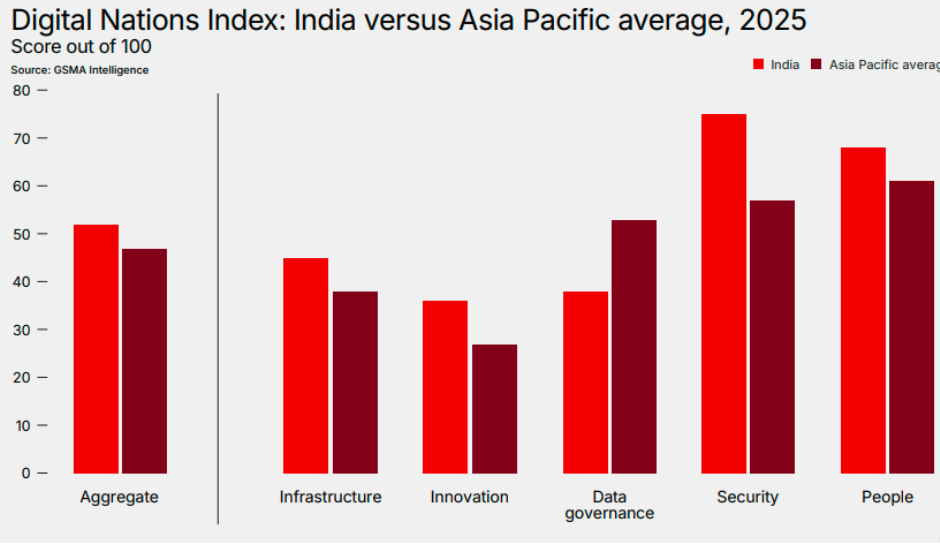
India’s innovation score on the GSMA Digital Nations Index remains low at 36, highlighting the need for stronger R&D investment. Supporting startups through schemes like Startup India Seed Fund and the Atal Innovation Mission can drive homegrown innovation in fintech, health tech, deep tech, and e-commerce. Leveraging India Stack (Aadhaar, eKYC, UPI, DigiLocker) enables scalable digital solutions.
# Encourage Private Investment and Infrastructure Development
Private sector spending of $98.5 billion on 4G and 5G networks has been pivotal. Policies reducing bureaucratic hurdles, providing regulatory clarity, and offering incentives—such as 5G spectrum auctions and RoW rules—can further attract capital for R&D, data centres, and digital infrastructure.
# Bridge the Digital Inclusion Gap
Digital inclusion must extend to women, rural populations, and older citizens. With a 33 percent gender gap in mobile internet usage and a 47 percent overall mobile internet usage gap, targeted interventions like BharatNet and BSNL–Department of Posts collaborations are key to equitable access.
# Strengthen Regulatory and Institutional Capacity
Managing emerging technologies like AI, 5G, blockchain, and quantum computing requires robust regulatory frameworks. Implementing sandboxes, updating compliance policies, and building institutional capacity will ensure secure and sustainable digital growth.
# Advance Digital Sovereignty and Local Innovation
India aims for technological self-reliance through digital sovereignty. Strategic partnerships for sovereign AI models (e.g., BharatGen with IBM), domestic innovation, and controlled data localisation policies can reduce dependence on foreign technology while fostering national leadership in digital solutions.
# Promote Global Cooperation and Strategic Partnerships
Cross-border collaboration is critical to address digital fraud, AI biases, and talent shortages. Trade agreements, technology transfer, and global partnerships support India’s leadership in the Global South and enhance its position in the international digital ecosystem.
Conclusion
Enhancing Digital India requires a multi-pronged approach combining connectivity, cybersecurity, skills, innovation, and regulatory support. By focusing on these 10 steps, India can achieve its vision of a secure, inclusive, and innovative digital economy, driving growth toward developed-nation status by 2047.
Baburajan Kizhakedath