Brazil’s smartphone market is entering a tougher phase in 2026 as rising memory costs push handset prices higher and force consumers to become more selective about upgrades. The shift is particularly important in Brazil, where affordable and mid-range smartphones account for a substantial portion of demand and installment payments remain central to device purchasing.
The broader Latin American market illustrates the pressure facing smartphone brands. Smartphone shipments across the region dropped 12 percent year over year to 30.3 million units in 2Q26, while the average selling price increased 25 percent, according to Omdia. Entry-level smartphones suffered the greatest pressure as higher memory and component costs forced vendors to raise prices, reduce product portfolios or shift their attention toward higher-value devices.
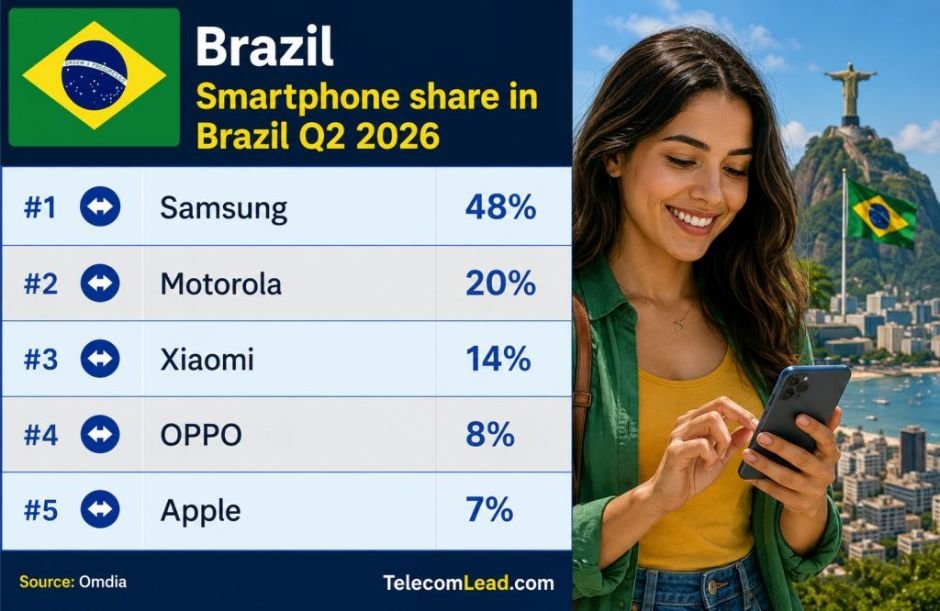
Omdia report on Brazil smartphone market share in Q2-2026 shows the changing market conditions are strengthening the importance of scale, supply-chain management, operator relationships, financing and promotions. In Brazil, Samsung leads with 48 percent of smartphone shipments, followed by Motorola with 20 percent, Xiaomi with 14 percent, OPPO with 8 percent and Apple with 7 percent.
Together, the five leading smartphone brands account for 97 percent of the Brazilian market, leaving relatively little room for smaller vendors.
Samsung Leads Brazil Smartphone Market With 48 Percent Share
Samsung has established a commanding position with 48 percent of Brazil’s smartphone market, giving it more than twice the share of second-ranked Motorola.
The Galaxy A portfolio remains central to Samsung’s strategy because it allows the company to address the large population of consumers looking for affordable smartphones while creating an upgrade path toward more sophisticated 5G models.
The Samsung Galaxy A07 5G launched at R$1,399 for 128GB, providing a relatively affordable entry point into 5G. Samsung initially made the smartphone available through Claro, Vivo and TIM, strengthening distribution through Brazil’s three dominant mobile operators.
Consumers can find additional specifications and availability information through Samsung’s Galaxy A07 5G launch in Brazil.
The smartphone’s 6,000mAh battery and extended software-support commitment are particularly relevant in the current environment. Consumers delaying upgrades may increasingly prioritize battery life, durability and software support when deciding whether a new smartphone represents sufficient long-term value.
Samsung has also expanded its choices at higher price levels. The Galaxy A17 5G starts at R$1,699, while the 256GB version costs R$1,849.
Further up the portfolio, the Galaxy A37 5G starts at R$3,299, while the Galaxy A57 5G starts at R$3,599.
Samsung supplemented the April 2026 launch with aggressive incentives. Customers purchasing eligible models could add a Galaxy Fit3 or Galaxy Buds Core for R$99, while qualifying purchases also received a R$150 Galaxy Store voucher.
Details are available through Samsung’s Galaxy A37 5G and Galaxy A57 5G Brazil launch offers.
For Samsung, the competitive advantage is increasingly about effective affordability rather than headline retail price. Operator financing, accessories, promotional discounts and longer software support can make a higher-priced Galaxy smartphone easier for consumers to justify.
Samsung also has a global supply-chain advantage during the memory shortage. The company shipped 60.5 million smartphones worldwide in 2Q26, up 5 percent year over year, giving it a 22 percent global share. Omdia said Samsung’s vertically integrated memory business helped the company manage component shortages more effectively than several rivals.
Motorola Holds 20 Percent as Moto G Targets Value Buyers
Motorola is Brazil’s second-largest smartphone brand with a 20 percent market share, supported heavily by the Moto G family.
The Moto G17 launched at R$1,299 for 128GB and R$1,499 for 256GB, putting it directly into one of Brazil’s most price-sensitive market segments.
Motorola distributes its devices through online channels, major retailers and operators, giving consumers multiple options for purchasing devices outright or through installment plans.
One limitation of the Moto G17 is the absence of 5G. Consumers intending to keep their smartphone for several years may therefore consider spending more for a 5G-capable device.
The Moto G67 5G addresses that requirement with 5G connectivity, a 120Hz AMOLED display and 50MP Sony LYTIA camera. Launch pricing was around R$1,600 for 128GB and R$1,999 for 256GB.
Consumers comparing Motorola devices can explore the company’s Moto G smartphone portfolio in Brazil.
Motorola’s challenge during 2026 will be convincing budget-conscious customers that features such as 5G, additional storage and improved displays justify moving to more expensive models. Retail discounts and financing can narrow that price difference.
Xiaomi Takes 14 Percent as Redmi Note Faces Price Challenge
Xiaomi has captured 14 percent of Brazil’s smartphone market, maintaining its position among the country’s largest handset brands.
However, rising memory costs create a particular challenge for Xiaomi because its global business remains heavily exposed to affordable smartphones. More than half of Xiaomi’s global shipments were priced below US$200 in 2Q26, according to Omdia. Xiaomi shipped 31.2 million smartphones worldwide during the quarter, down 26 percent year over year.
In Brazil, the Redmi Note 14 5G demonstrates the changing economics of Xiaomi’s traditional price-performance strategy.
The smartphone launched at around R$3,000, offering a 108MP camera, AMOLED display, 5G connectivity and 45W charging.
Consumers can review the specifications through Xiaomi’s Redmi Note 14 5G Brazil product page.
At around R$3,000, however, Xiaomi faces stronger competition from Samsung and Motorola. Consumers are no longer necessarily comparing Redmi smartphones only against other value devices; they can also evaluate established Galaxy and Motorola alternatives.
Promotional pricing, financing and bundled services will therefore become increasingly important if Xiaomi wants to maintain its traditional price-to-feature advantage as component costs rise.
OPPO Reaches 8 Percent With Reno Premium Mid-Range Strategy
OPPO has expanded its presence to 8 percent of Brazil’s smartphone market, giving it a meaningful position in one of Latin America’s largest handset markets.
The company is targeting consumers willing to move beyond entry-level devices with products such as the OPPO Reno14 F 5G, which launched at R$3,499.
The smartphone includes 12GB RAM, 256GB storage, a 50MP camera, 6,000mAh battery and IP69 protection, placing considerable emphasis on memory, photography, battery capacity and durability.
More information is available through the official OPPO Reno14 F 5G Brazil product page.
The challenge for OPPO is the competitive intensity at R$3,499. At this price, consumers have multiple alternatives from Samsung and Motorola, while some buyers may consider stretching their budgets toward premium devices.
OPPO consequently needs promotions, financing, retail visibility and clear product differentiation to convert consumer interest into sales.
Apple Holds 7 Percent as iPhone 17e Targets Premium Buyers
Apple represents 7 percent of Brazil’s smartphone market, substantially below Samsung and Motorola in shipment volume but with a strong position among premium consumers.
The iPhone 17e starts at R$5,799 with 256GB storage, while the 512GB version costs R$7,299.
Apple provides payment options of up to 12 installments, while its Brazilian store also advertises a 10 percent upfront discount on eligible purchases.
Consumers can compare configurations through the Apple iPhone 17e Brazil store.
Apple’s strategy relies less on conventional handset discounting and more heavily on installments, trade-ins and the strength of its ecosystem.
Its performance globally suggests that premium smartphone demand has been more resilient than mass-market demand. Apple shipped 55.1 million iPhones in 2Q26, an increase of 23 percent year over year, capturing a record 20 percent global smartphone share for a second quarter.
For Brazilian consumers, the iPhone’s high purchase price remains the biggest barrier. Starting storage of 256GB, installment plans and trade-in mechanisms can nevertheless make the purchase more manageable for premium buyers.
Vivo, Claro and TIM Dominate Brazil’s Mobile Operator Market
Brazil’s smartphone business is closely connected with the country’s three dominant mobile operators — Vivo, Claro and TIM — because operator stores, installment plans, postpaid contracts and device promotions provide important distribution channels for Samsung, Motorola, Apple and other handset vendors. Brazil had about 277.8 million mobile accesses at the end of 2Q26. Vivo led with 37.8 percent market share and about 105.1 million accesses, followed by Claro with 33.2 percent and 92.3 million, while TIM held 22.3 percent with 61.9 million accesses. Together, the three operators controlled more than 93 percent of mobile connections. Brazil also had approximately 67.2 million 5G connections in 2Q26, making operator-led 5G smartphone upgrades increasingly important to handset demand.
Rising Memory Costs Change Brazil Smartphone Economics
The pressure affecting Brazil is part of a much larger smartphone supply-chain problem.
Global smartphone shipments dropped 6 percent year over year to 272 million units in 2Q26, according to Omdia. Persistently high memory prices increased component costs and forced manufacturers to rethink pricing, product portfolios and channel strategies.
The impact is particularly significant at the affordable end of the market because handset manufacturers have less margin available to absorb higher component costs.
Consumers consequently face several choices: pay more for a new smartphone, select a lower specification, use financing, delay the upgrade or purchase a refurbished device.
This environment favors manufacturers with large purchasing scale, strong operator relationships and diversified portfolios.
Brazil Smartphone Competition Shifts From Specifications to Value
Brazil’s smartphone competition in the remainder of 2026 will increasingly revolve around what customers actually pay and receive over the complete purchase cycle, rather than specifications alone.
Samsung’s extraordinary 48 percent market share provides considerable scale, while its partnerships with Vivo, Claro and TIM strengthen distribution. Motorola, with 20 percent, remains Samsung’s most important challenger and can use the Moto G portfolio to compete for value-conscious consumers.
Xiaomi’s 14 percent share gives it an established position, but higher component costs threaten the aggressive price-performance proposition that helped build its Brazilian business. OPPO, at 8 percent, is attempting to move consumers toward higher-value smartphones, while Apple’s 7 percent share reflects a smaller but valuable premium customer base.
With Latin American smartphone shipments already down 12 percent to 30.3 million units in 2Q26 and regional average selling prices rising 25 percent, affordability is likely to remain the defining issue.
For Brazil’s smartphone buyers, discounts, installment financing, operator subsidies and promotions, storage capacity, 5G support, software longevity and bundled accessories will increasingly determine whether a new device is worth the upgrade.
FASNA SHABEER