Mexico’s smartphone market is entering a more challenging phase in 2026 as rising memory costs, higher device prices and economic pressures make consumers increasingly cautious about upgrading their phones.
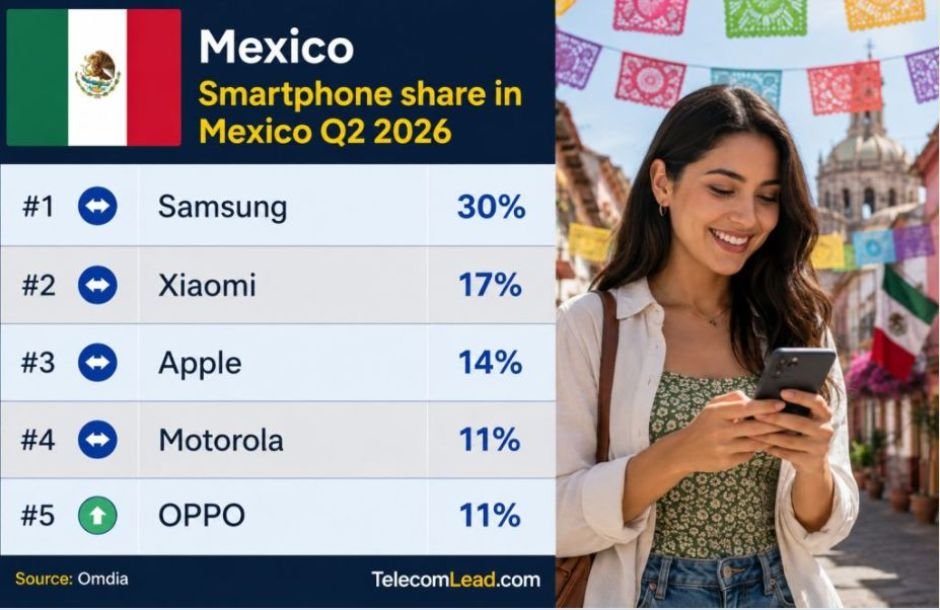
Omdia report on Mexico smartphone market share in Q2-2026 shows competition remains intense. Samsung led Mexico with a 30 percent smartphone shipment share in 2Q26, followed by Xiaomi at 17 percent, Apple at 14 percent, and Motorola and OPPO at 11 percent each. Together, these five brands accounted for 83 percent of shipments, highlighting the increasingly concentrated nature of the Mexican smartphone market.
The pressure is particularly severe in the affordable smartphone segment. Counterpoint Research said Mexico’s smartphone sell-through declined an average 9 percent year over year during January and February 2026, while devices priced below US$250 represented around 64 percent of smartphone sales in 2025.
Memory inflation is a major factor behind the slowdown. Memory prices surged 130 percent quarter over quarter in Q1 2026 and are expected to increase another 15 percent in Q2, forcing smartphone makers to reconsider pricing, specifications and product portfolios.
The trend is not confined to Mexico. Latin American smartphone shipments dropped 12 percent year over year to 30.3 million units in 2Q26, as higher DRAM and NAND costs translated into higher retail prices, particularly affecting entry-level demand.
Samsung Leads Mexico Smartphone Market With 30 Percent Share
Samsung maintained its leadership in Mexico with a 30 percent shipment share in 2Q26, supported by one of the industry’s broadest portfolios spanning affordable Galaxy A smartphones and premium Galaxy S devices.
The Galaxy S26 family strengthened Samsung’s position among premium buyers. In Mexico, the Galaxy S26 starts at MX$22,499, while the Galaxy S26+ starts at MX$28,499 and the Galaxy S26 Ultra at MX$32,999. At the top end, Samsung’s Mexican online store lists the 1TB Galaxy S26 Ultra at MX$45,499.
Consumers considering the flagship can check the Samsung Galaxy S26 Ultra pricing and purchase options in Mexico.
Samsung is simultaneously lowering the effective purchase cost through discounts, interest-free installment plans and its Samsung Galaxy Canje smartphone trade-in program.
Samsung also has a structural advantage during the memory shortage. Counterpoint expects Samsung and Apple to be among the smartphone vendors least affected by memory supply constraints, while several Chinese brands could face greater pressure.
Xiaomi Holds 17 Percent Share With Aggressive Value Strategy
Xiaomi ranked second in Mexico with a 17 percent smartphone shipment share in 2Q26, maintaining a strong position among consumers looking for higher specifications at competitive prices.
Its Redmi and POCO portfolios allow Xiaomi to compete from entry-level smartphones through performance-oriented mid-range devices.
The Redmi Note 15 range demonstrates this strategy. Xiaomi has promoted the Redmi Note 15 Pro+ 5G with 12GB RAM and 512GB storage, alongside a 6,500mAh battery and 100W charging. Promotional packages have included gifts and as much as 12 months of interest-free financing.
The company’s Xiaomi Redmi Note 15 Series Mexico offers show how bundles and financing are being used to reduce the impact of higher device costs.
However, Xiaomi’s strong exposure to affordable devices creates additional risk from memory inflation. Globally, more than half of Xiaomi’s shipments were priced below US$200 in 2Q26, making the company particularly exposed to rising component costs in emerging markets, including Latin America.
Apple Captures 14 Percent as Premium iPhone Demand Holds
Apple accounted for 14 percent of Mexico’s smartphone shipments in 2Q26, demonstrating that premium demand remains comparatively resilient despite broader weakness in the market.
The iPhone 17e starts at MX$14,999, while the iPhone 17 starts at MX$19,999 in Mexico. Apple supplements these prices with trade-in credits and interest-free financing, reducing the immediate cost of upgrading.
Mexican consumers can compare models through the Apple Mexico iPhone lineup and pricing page.
Apple entered the second quarter with considerable momentum. Omdia reported that Apple’s smartphone shipments in Mexico jumped 80 percent year over year in 1Q26, helped by strong reception for the iPhone 17 series.
Apple’s premium positioning could provide some insulation from the affordability problems affecting the mass market. Across Latin America, smartphones priced above US$500 demonstrated greater resilience during the first quarter, while value and entry-level devices faced increasing affordability pressure.
Motorola Holds 11 Percent With Mid-Range Price Cuts
Motorola captured 11 percent of Mexico smartphone shipments in 2Q26, keeping the brand among the country’s five largest smartphone suppliers.
Motorola’s G-series targets price-sensitive consumers, while the Edge family gives the company a route into higher-value segments.
Promotional pricing demonstrates how aggressively Motorola is competing. The moto g17 has been offered at MX$4,699, down from MX$5,499, while the moto g67 has been promoted at MX$4,999 versus MX$6,999 previously.
The Motorola Edge 70 Fusion has been offered for MX$7,999, down from MX$10,999.
Such discounts could become increasingly important because Mexico’s smartphone buyers remain heavily concentrated in lower price categories. Motorola can use promotional pricing to defend volumes while attempting to move selected consumers toward more profitable Edge smartphones.
OPPO Takes 11 Percent Share With Reno16 Premium Push
OPPO also secured 11 percent of Mexico’s smartphone shipments in 2Q26, putting it level with Motorola.
The company is increasingly using its Reno portfolio to compete for upper-mid-range consumers interested in cameras, design and AI-enabled smartphone capabilities.
Mexico launch pricing placed the Reno16 F 5G at MX$10,999 for the 8GB/128GB version and MX$13,999 for the 8GB/256GB model. The Reno16 5G was priced at MX$15,999, while the Reno16 Pro 5G reached MX$18,499.
Details of promotional activity are available through the OPPO Reno16 Series Mexico pre-sale offers.
OPPO’s challenge is to convince buyers that improved cameras, AI capabilities and design justify moving into higher price bands at a time when Mexican consumers are extending replacement cycles.
Memory Costs Reshape Mexico Smartphone Buying
Memory inflation is becoming one of the defining forces in Mexico’s smartphone market.
Counterpoint says smartphones priced below US$250 accounted for around 64 percent of Mexico’s smartphone sales in 2025. The most popular memory configuration was 8GB RAM plus 256GB storage, representing 37 percent of the market, replacing the 4GB/128GB configuration that had previously been dominant. The 8GB/256GB combination is expected to remain Mexico’s best-selling configuration in 2026.
But maintaining those specifications at affordable prices is becoming more difficult.
The global AI infrastructure boom has increased demand for higher-margin DDR5 and High Bandwidth Memory products. Although smartphones use LPDDR memory, the products compete for semiconductor manufacturing capacity. This is contributing to tighter supply and higher costs for smartphone manufacturers.
Consumers are consequently more likely to extend upgrade cycles, repair damaged phones or consider refurbished devices rather than immediately purchasing a new smartphone. Counterpoint expects Mexico’s refurbished smartphone market growth to accelerate from around 10 percent year over year to 15 percent.
Leading Mobile Operators Shape Mexico Smartphone Sales
Mexico’s mobile market is led by Telcel, part of América Móvil, while AT&T Mexico remains the other major facilities-based national mobile operator. Telefónica’s Movistar continues serving Mexican customers using network arrangements that have reduced its reliance on its own radio infrastructure, while the wholesale Red Compartida, operated by Altán Redes, provides 4G/5G wholesale connectivity used by mobile virtual network operators and other service providers. These operators are important to smartphone demand because carrier financing, device bundles, trade-ins and mobile data plans can reduce the upfront cost of upgrading. In a market where consumers are increasingly price sensitive, partnerships between handset brands, operators and retailers are likely to become an even more important sales tool.
Mexico Smartphone Market Outlook for 2026
Mexico’s smartphone battle is increasingly becoming a competition around effective value rather than headline specifications.
Samsung’s 30 percent share gives it significant scale and a portfolio capable of addressing almost every price tier. Xiaomi’s 17 percent share demonstrates continued demand for specification-led value, although its exposure to lower-priced smartphones makes memory inflation particularly challenging.
Apple’s 14 percent position shows that premium consumers remain willing to upgrade, especially when trade-ins and financing reduce upfront costs. Motorola and OPPO, each with 11 percent, are competing through aggressive pricing, promotions and stronger mid-range portfolios.
The broader Latin American downturn demonstrates the scale of the challenge. Regional smartphone shipments fell 12 percent to 30.3 million units in 2Q26, after growing 3 percent to 34.8 million units in 1Q26.
For Mexico, the winners in the remainder of 2026 are therefore unlikely to be determined solely by camera specifications, AI functions or processor performance. Competitive pricing, installment financing, operator bundles, trade-ins, memory availability and promotional discounts will increasingly determine which smartphone brands can protect — or expand — their market share.
FASNA SHABEER