China is set to strengthen its position as the world’s largest 5G market, with 1.8 billion 5G connections expected by 2030, accounting for more than 30 percent of global 5G connections, according to the GSMA’s Mobile Economy China 2026 report. Continued investments in next-generation networks, expanding 5G-Advanced deployments, and new spectrum allocations are expected to drive subscriber growth, operator revenues, and digital transformation across industries.
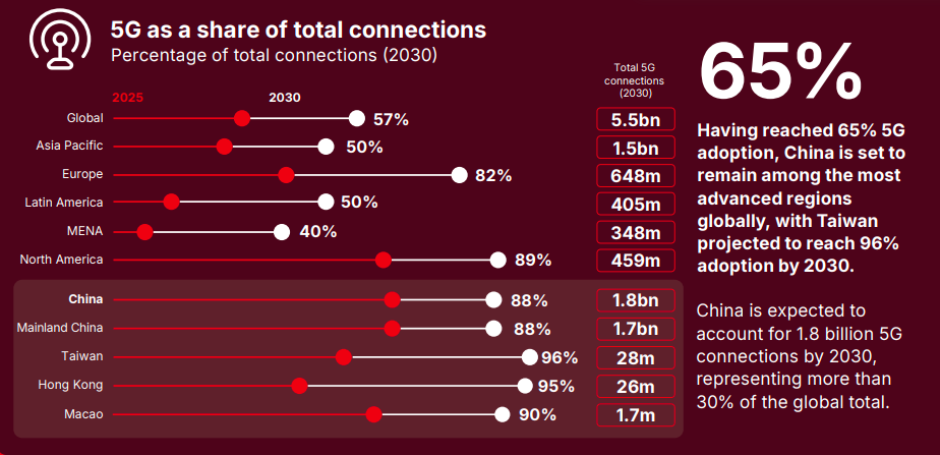
China had already achieved 65 percent 5G adoption by 2025 and is forecast to reach 88 percent of all mobile connections by 2030, with mainland China also expected to reach 1.7 billion 5G connections. Hong Kong is projected to achieve 95 percent 5G adoption, Taiwan 96 percent, and Macao 90 percent by the end of the decade. Globally, total 5G connections are forecast to reach 5.5 billion, while the Asia-Pacific region will account for 1.5 billion.
China is also leading the commercialization of 5G-Advanced. By 2025, five operators had launched commercial 5G-Advanced services, covering more than 330 cities and attracting over 30 million subscribers. The technology is supporting AI-enabled applications, immersive consumer services, industrial automation, intelligent manufacturing, and smart city deployments.
The report forecasts China’s mobile operator revenues will increase from $191.0 billion in 2025 to $222.8 billion by 2030. To support growing data traffic and AI-driven services, operators are expected to invest $194.1 billion in network capital expenditure between 2025 and 2030, reinforcing China’s leadership in advanced mobile infrastructure.
By 2025, China Mobile, China Telecom and China Unicom, together with other operators, launched 5G-Advanced, with the technology covering more than 330 cities across mainland China and serving over 30 million subscribers. The operators are using 5G-Advanced to support mobile AI, immersive consumer services, industrial intelligence, integrated sensing and enhanced urban safety applications.
The report also notes that Chinese operators are expanding non-terrestrial network (NTN) capabilities. By early 2025, they had enabled more than 8.2 million direct-to-device (D2D) users and connected over 26 million satellite-enabled devices, extending connectivity to wearables, vehicles and IoT applications.
In addition, Chinese operators have deployed large-scale AI models for network optimisation, automation and customer operations, and are now extending these capabilities to enterprise services. AI is evolving from internal operational use to cross-device, real-time intelligent services integrated with 5G-Advanced networks.
The GSMA report further states that eight Chinese operators had adopted GSMA Open Gateway APIs by December 2025, representing 26 percent of China’s mobile market by connections, supporting greater interoperability and new developer services. Collectively, China’s operators are forecast to generate $191.0 billion in revenue in 2025, rising to $222.8 billion by 2030, while investing $194.1 billion in network capex between 2025 and 2030.
GSMA also highlighted China’s expanding digital connectivity. Around 91 percent of the population is connected to the internet, while the mobile internet usage gap stands at 8 percent and the coverage gap has narrowed to just 1 percent, reflecting years of sustained investment in digital infrastructure.
Spectrum policy will play a central role in the next phase of mobile growth. The report said the upper 6 GHz band is emerging as a key capacity spectrum for 5G-Advanced following its identification for International Mobile Telecommunications (IMT) at WRC-23. Future spectrum resources in the 4.5 GHz and 7–8 GHz bands, which are under consideration for WRC-27, will be essential for expanding network capacity and enabling the transition toward 6G, while existing low-band spectrum will continue to provide nationwide coverage.
BABURAJAN KIZHAKEDATH