European mobile markets with three major operators invest more in network infrastructure, deliver faster mobile broadband performance and expand 5G coverage more rapidly than markets with four or more operators, according to a GSMA report.
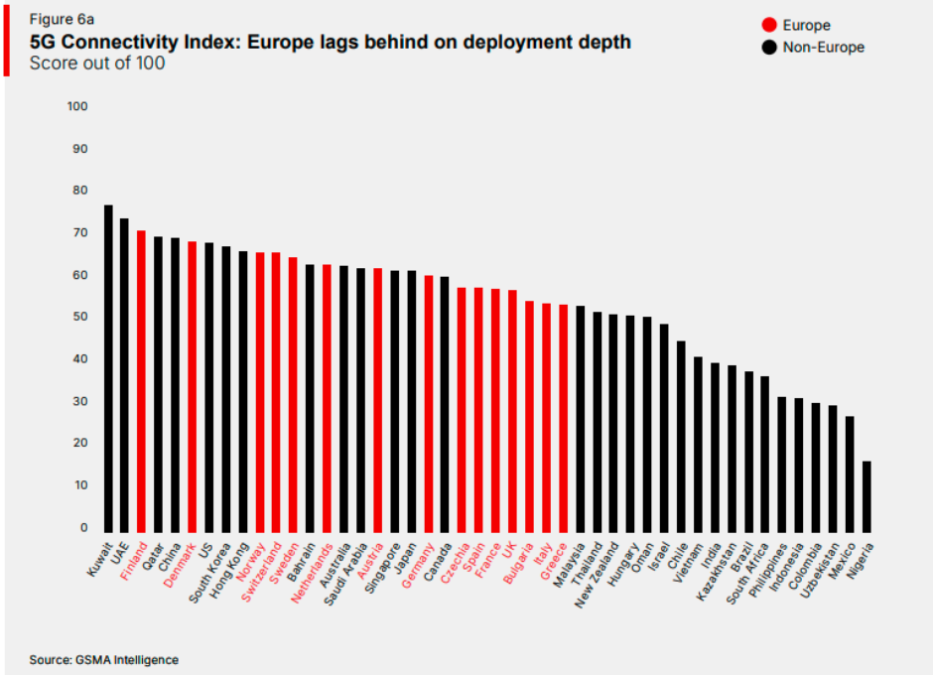
The GSMA study – prepared by Francisco Amaya (Senior Economist), Kalvin Bahia (Senior Director of Economics), Pau Castells (Head of Economic Analysis) – argues that greater operator scale is becoming increasingly important as telecom companies face rising network investment costs, declining revenue per user and growing demand for mobile data.
GSMA said Europe remains the world’s most fragmented mobile region despite the industry’s transition to the data and 5G era. Maintaining and upgrading Europe’s mobile network infrastructure will require around €270 billion between 2026 and 2036, while an additional €200 billion will be needed for the region to catch up with global digital leaders. At the same time, spectrum costs have increased from approximately 3 percent to 8 percent of operator revenues over the past decade, while revenue per MHz has fallen 54 percent since 2014.
Europe is also the only major region where market concentration has not increased significantly during the mobile data era. Since the end of 2017, 35 countries worldwide have reduced the number of mobile operators, compared with 23 countries where operator numbers increased. Markets representing around 2.9 billion mobile connections experienced fewer operators by 2025, while only 550 million connections were in markets with additional operators.
Since 2016, operators in three-player markets have invested approximately 48 percent more per mobile connection than operators in four-player markets. This higher investment has translated into 15 percent faster average download and upload speeds, 4G and 5G population coverage, and stronger 5G adoption without increasing prices for consumers. Revenue per gigabyte has declined across both three-player and four-player markets, while entry-level and high-usage mobile tariff baskets remain comparable.
Europe’s transition to the data and 5G era has been marked by declining ARPU alongside increasing mobile data usage, placing pressure on operator returns despite rising network investment needs. Average real ARPU has steadily declined since 2010, while mobile data traffic per connection has increased exponentially, highlighting a widening gap between revenue growth and network demand. Operators are carrying far more traffic per subscriber while earning less revenue per user than during the voice and SMS era.
The report also finds that operator scale has a direct impact on network performance. Since 2016, three-player mobile markets have delivered approximately 15 percent faster download and upload speeds than four-player markets, supported by 48 percent higher capital expenditure per connection. These markets also achieved faster 4G and 5G coverage expansion and higher 5G adoption.
On pricing, GSMA notes that higher ARPU in three-player markets is primarily driven by greater mobile data consumption enabled by better-quality networks, rather than higher prices. Revenue per gigabyte has continued to decline across both three-player and four-player market structures, while tariff basket analysis shows no consistent price premium for more concentrated markets.
The study further shows that European consolidation events since 2010 resulted in real ARPU reductions while improving network performance. Once network integration was completed, average download speeds increased by around 9–11 Mbps, equivalent to a 25 percent improvement over the 2010–2025 period, indicating that better network quality can be achieved without increasing consumer prices.
Europe’s slower transition to standalone 5G. By the end of 2025, no European market included in the 5G Connectivity Index had achieved more than 10 percent 5G Standalone adoption. In comparison, China reached 81 percent, India 52 percent, Singapore 41 percent, the United States 32 percent, Australia 17 percent, and the UAE 11 percent. More than 80 percent of Europeans already use mobile internet, limiting subscriber growth and making network investment efficiency increasingly dependent on operator scale.
Historical consolidation across Europe since 2010 increased operator capital expenditure per connection by approximately 33–45 percent, improved network speeds by around 9–11 Mbps, equivalent to a 25 percent increase in weighted download speeds, while reducing real ARPU and without producing sustained increases in consumer prices. The report concludes that competition policy should focus on enabling efficient operator scale rather than simply maximising the number of mobile operators, as larger operators are better positioned to finance next-generation 5G infrastructure and improve long-term consumer welfare.
BABURAJAN KIZHAKEDATH