
China’s mobile industry is entering a new growth phase as the country moves beyond large-scale 5G deployment and accelerates the commercialization of 5G-Advanced services. With more than 40 percent of global 5G connections already located in China, the country is strengthening its position as a global leader in next-generation mobile connectivity, digital transformation, and AI-driven innovation.
China’s 5G ecosystem has achieved remarkable scale, with 5G adoption reaching 65 percent. The country is expected to remain among the world’s most advanced mobile markets, while Taiwan is forecast to achieve an even higher 96 percent 5G adoption rate by 2030. By the end of the decade, China is projected to account for 1.8 billion 5G connections, representing more than 30 percent of the global total and exceeding the regional forecast of more than 1.7 billion 5G connections.
The rollout of 5G-Advanced services across more than 330 cities in mainland China is shifting the focus from expanding connectivity to delivering higher-performance, more intelligent, and differentiated digital services. These advanced networks are expected to support mobile AI applications, immersive digital experiences, enterprise digitalization initiatives, and smarter public infrastructure.
The economic contribution of mobile technologies continues to expand. Mobile services and technologies generated approximately $1.5 trillion in economic value in China during 2025, equivalent to 7.2 percent of the country’s GDP. This contribution is forecast to increase to $2.1 trillion by 2030, driven primarily by productivity gains from wider 5G adoption, deeper AI integration, and digital transformation across industries.
The sector also delivered around $160 billion in fiscal revenues during 2025, while enabling broader digitalization of business processes, government services, and transaction systems that strengthen economic efficiency and tax collection capabilities.
China’s sustained investment in digital infrastructure has narrowed the network coverage gap to around 1 percent. Internet connectivity now reaches 91 percent of the population, leaving a remaining usage gap of 8 percent that policymakers and operators are seeking to address to promote more inclusive digital participation.
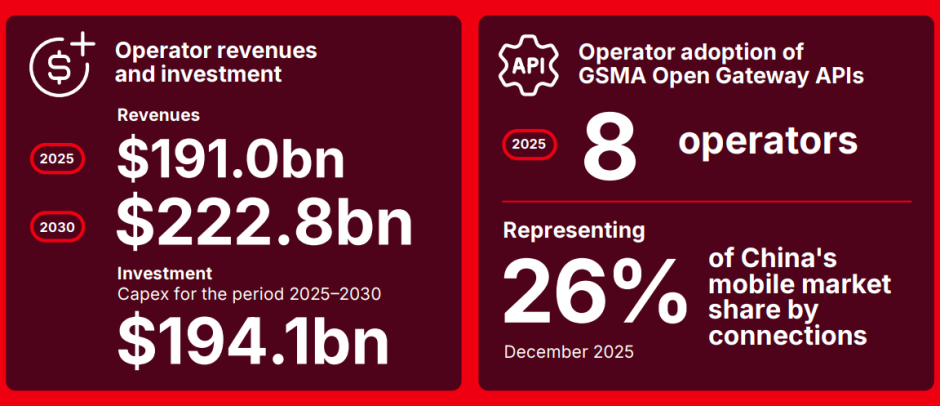
Financially, the mobile sector continues to demonstrate strong momentum. Mobile operator revenues are projected to grow from $191.0 billion in 2025 to $222.8 billion by 2030. Meanwhile, capital expenditure between 2025 and 2030 is expected to reach $194.1 billion as operators continue investing in advanced network technologies and digital infrastructure.
China also remains a dominant force in the global mobile market, accounting for 26 percent of worldwide mobile connections as of December 2025. The adoption of GSMA Open Gateway APIs is gaining traction among operators, with eight operators participating in initiatives designed to accelerate innovation, interoperability, and the development of new digital services. As China expands its 5G-Advanced footprint and integrates AI across networks and industries, the country is set to play a pivotal role in shaping the future of mobile communications, digital economies, and intelligent connectivity worldwide.
BABURAJAN KIZHAKEDATH