Turkey’s broadband market is undergoing its biggest transformation in decades as fiber internet and 5G reshape the country’s digital industry. Following the commercial launch of 5G services on April 1, 2026, Turkey has entered a new phase of connectivity where fiber broadband is replacing legacy DSL networks. Supported by the government’s National Technology Move initiative, the country’s fixed broadband market is now valued at $12.48 billion and continues to attract significant investment.
Turkey’s fixed broadband subscriber base reached 20.9 million in early 2026. Fiber-to-the-Home and Fiber-to-the-Building (FTTH/B) subscriptions increased 21.6 percent year-on-year to 9.3 million users, highlighting the accelerating migration toward high-speed internet services.
For internet customers looking for the best ISP in Turkey, Turk Telekom remains the dominant provider with 15.2 million fixed broadband subscribers. The company operates a massive 514,000-kilometer fiber backbone that serves as the foundation of the country’s telecommunications infrastructure. Turk Telekom’s fiber subscriber base has reached 9.3 million, overtaking its 9.2 million legacy xDSL users for the first time, marking a major milestone in Turkey’s broadband evolution.
Turkcell Superonline continues to position itself as the technology leader. The operator reported 2.57 million fiber subscribers and expanded fiber coverage by 405,000 households during the past year, reaching 6.3 million homes. Turkcell also launched Turkey’s first commercial 10 Gbps residential broadband service in March 2026. By integrating Wi-Fi 7 and Fiber-to-the-Room (FTTR) technology into premium packages, the company is addressing connectivity challenges in densely populated urban apartment buildings.
Vodafone Turkey serves more than 1.4 million fixed broadband subscribers and focuses on converged connectivity services. Through unified billing and bundled mobile-fiber offerings, Vodafone is leveraging its mobile customer base while selectively investing in fiber infrastructure in high-density urban markets.
Turksat’s Kablonet service remains an important alternative, with approximately 1.5 million cable broadband subscribers. While cable internet continues to perform strongly in major cities, growing fiber adoption is intensifying competition. Nationwide FTTH subscriptions increased from 8.07 million to 9.84 million across all operators, underscoring the market’s shift toward pure fiber connectivity.
Independent provider TurkNet has emerged as a disruptive force with more than 1.1 million subscribers. Its GigaFiber platform offers symmetrical 1,000 Mbps speeds and no-commitment contracts, making it particularly attractive for gamers, remote workers, and digital professionals. TurkNet’s expansion has contributed significantly to the nationwide 26.7 percent growth in FTTH subscriptions.
Turkey’s fiber expansion is being reinforced by the nationwide rollout of 5G. Rather than replacing fixed broadband, 5G is increasing demand for fiber networks because advanced mobile services require dense fiber backhaul infrastructure. This has strengthened the strategic value of fiber assets across the country.
Broadband performance continues to improve. The national average download speed reached 65.5 Mbps, while median fixed broadband speeds climbed to 56.17 Mbps. At the premium end of the market, residential users can now access services delivering up to 10,000 Mbps. Data consumption is also rising rapidly, with total traffic increasing 17.1 percent to 24.2 million terabytes. Fixed internet traffic alone grew 15.8 percent as streaming, cloud collaboration, and digital entertainment usage expanded.
Investment remains a key growth driver. Turk Telekom is maintaining capital expenditure intensity of approximately 34 percent to support network modernization and 5G deployment. Meanwhile, Turkcell and Google Cloud announced a landmark $3 billion investment aimed at expanding cloud computing and artificial intelligence capabilities in Turkey, strengthening the nation’s position as a regional digital hub.
Consumer preferences are evolving alongside network improvements. Turkish households increasingly demand symmetrical speeds, ultra-low latency, Wi-Fi 7 hardware, transparent pricing, and flexible contract terms. Inflationary pressures have also encouraged operators to introduce 12-month prepaid plans that allow customers to lock in broadband pricing and avoid future increases.
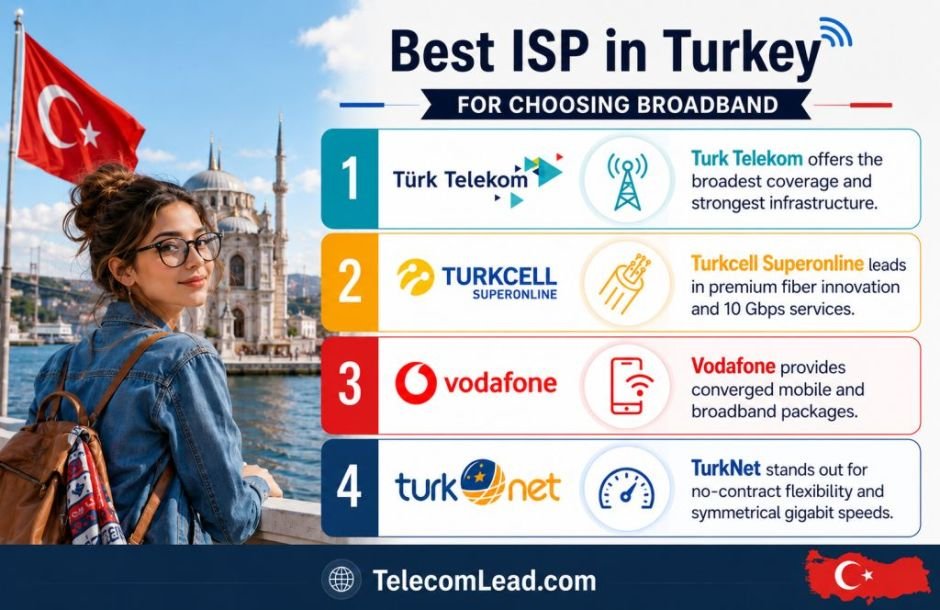
For consumers choosing an internet provider in Turkey, Turk Telekom offers the broadest coverage and strongest infrastructure, Turkcell Superonline leads in premium fiber innovation and 10 Gbps services, Vodafone provides attractive converged mobile and broadband packages, while TurkNet stands out for no-contract flexibility and symmetrical gigabit speeds. With broadband penetration currently at 23.4 percent of the population, Turkey’s fiber-driven digital transformation still offers significant room for future growth.
FASNA SHABEER