France has emerged as one of Europe’s most advanced broadband markets in 2026, driven by nationwide fiber deployment, ultra-fast internet adoption, and the gradual shutdown of legacy copper networks. With internet penetration reaching 95.2 percent, consumers are no longer choosing providers solely based on availability. Instead, reliability, speed, customer experience, Wi-Fi performance, and value-added services have become the key factors influencing ISP selection.
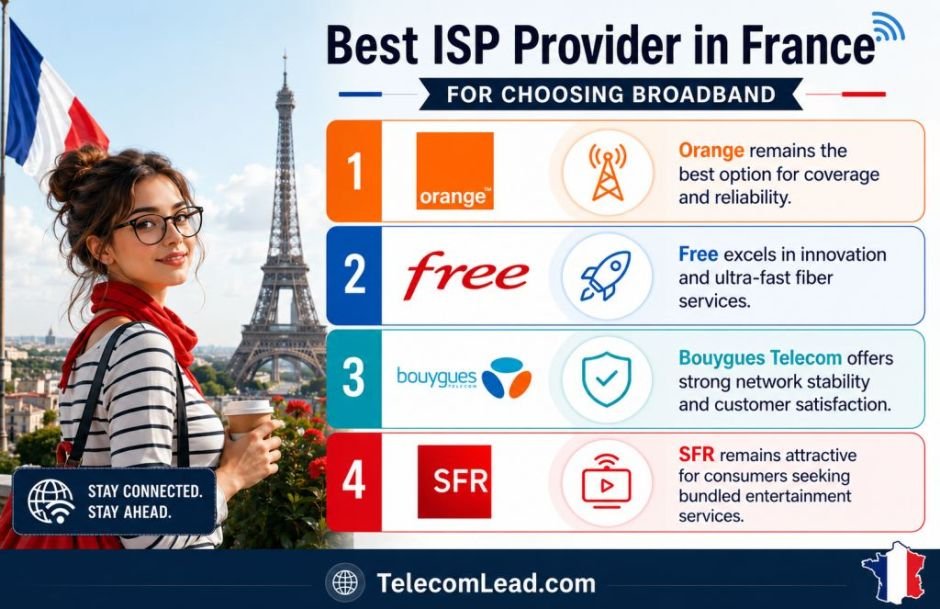
For internet customers seeking the best ISP in France, Orange remains the market leader with approximately 38 percent market share and 12.5 million fixed broadband subscribers. The operator benefits from extensive infrastructure ownership, a nationwide network of 500 retail stores, and a strong reputation for service reliability. Orange is also pursuing wholesale monetization opportunities while managing the country’s large-scale copper network shutdown.
Free, part of the Iliad Group, continues to be France’s innovation leader. With a 23 percent market share and 7.5 million broadband subscribers, Free has migrated more than 80 percent of its customer base to Fiber-to-the-Home (FTTH). Its flagship Freebox Ultra service offers symmetrical multi-gigabit speeds that place it among the most advanced residential broadband products available in Europe.
SFR serves approximately 6.3 million households and controls 19 percent of the broadband market. While the company continues to face restructuring challenges at the Altice Group level, it remains a strong player through content bundling and converged service offerings. Meanwhile, acquisition speculation surrounding SFR’s assets remains a major topic within the French telecom industry.
Bouygues Telecom has become the fastest-growing major ISP in France. With nearly 5 million subscribers and a 15 percent market share, the operator consistently performs well in independent network stability tests. Its Ambition 2026 strategy focuses on expanding business services while strengthening customer satisfaction in the fixed broadband segment.
Fiber broadband now dominates the French market, accounting for 80 percent of all active internet connections. Legacy DSL has declined to just 13 percent, while cable and fixed wireless technologies collectively represent the remaining 7 percent. This rapid migration has enabled France to become one of the world’s top-performing broadband markets.
The national median download speed has reached 346.04 Mbps, supported by widespread XGS-PON deployments. Premium residential packages increasingly offer symmetrical speeds of up to 8 Gbps, while major operators have introduced Wi-Fi 7 gateways to improve in-home connectivity. France now ranks among the global top five countries for fixed broadband performance.
Broadband pricing remains highly competitive. Budget fiber plans range from €22.99 to €27.99 per month, typically offering 1 Gbps connectivity. Mid-tier packages cost between €31.99 and €39.99 and include Wi-Fi 6E equipment and television bundles. Premium offerings range from €45.99 to €59.99 and provide up to 8 Gbps speeds with integrated streaming services. One of the strongest trends in 2026 is the rise of internet-only plans, such as Bouygues Telecom’s B&You Pure Fibre package, which delivers 2 Gbps service for €24.99 per month without traditional TV bundles.
Consumer expectations are evolving rapidly. French households increasingly demand enterprise-grade reliability, Wi-Fi 7 mesh systems, integrated anti-fraud protection, flexible no-contract plans, and simplified customer service. Expatriates are also seeking bilingual support options.
Investment priorities have shifted from large-scale fiber deployment toward network intelligence and rural coverage expansion. Orange has maintained an eCapEx-to-sales ratio of 15 percent while implementing an €800 million efficiency program tied to copper network retirement. At the same time, operators continue investing in Public Initiative Networks (RIPs) to extend fiber coverage to the final 2.6 million premises located in remote regions.
For customers choosing a broadband provider in France, Orange remains the best option for coverage and reliability, Free excels in innovation and ultra-fast fiber services, Bouygues Telecom offers strong network stability and customer satisfaction, while SFR remains attractive for consumers seeking bundled entertainment services. As France enters the final phase of copper decommissioning, fiber broadband, AI-driven network management, and 10-gigabit infrastructure are set to define the next chapter of the country’s digital economy.
FASNA SHABEER