The global semiconductor industry delivered strong momentum in early 2026, with the Semiconductor Industry Association reporting total sales of $298.5 billion in the first quarter. This represents a 25 percent increase compared to Q4 2025, highlighting accelerating demand across key technology sectors including artificial intelligence, cloud computing, and consumer electronics.
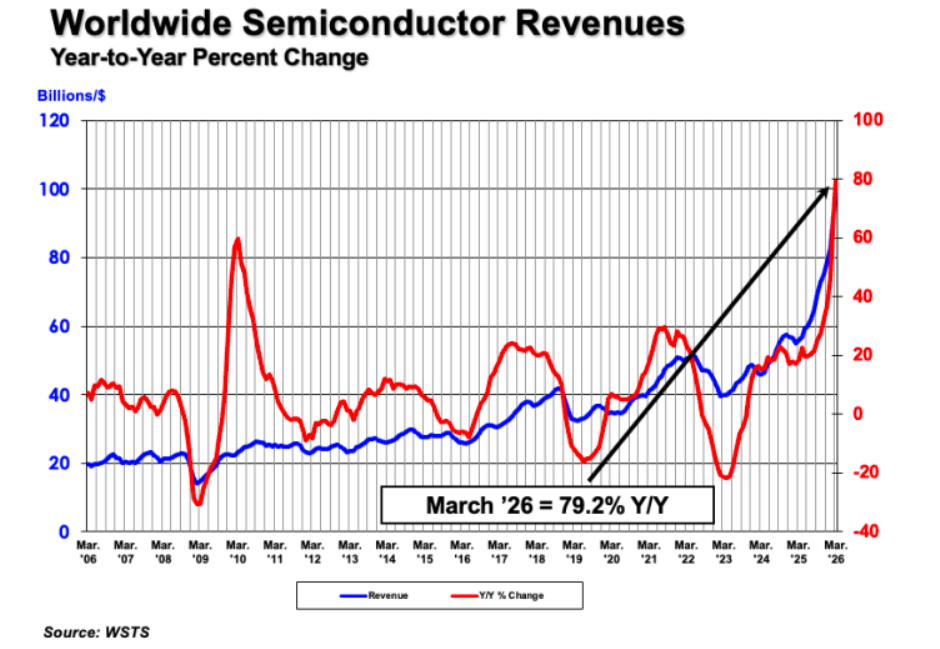
Monthly performance further underscores the industry’s rapid expansion. Global chip sales reached $99.5 billion in March 2026, marking a sharp 79.2 percent increase from $55.5 billion in March 2025 and an 11.5 percent rise from February 2026. These figures, compiled by the World Semiconductor Trade Statistics, reflect a three-month moving average and indicate sustained upward momentum rather than a short-term spike.
The semiconductor market’s growth trajectory is increasingly tied to AI infrastructure investments and next-generation computing demand. Industry leaders expect total chip sales to approach $1 trillion in 2026, driven by hyperscale data center expansion, rising adoption of AI-enabled devices, and continued digital transformation across industries.
Regionally, growth has been broad-based, with Asia Pacific leading the surge. Year-over-year sales in March jumped 108.5 percent in Asia Pacific and other regions, followed by the Americas at 83.1 percent and China at 74.8 percent. Europe also posted solid growth of 46.5 percent, while Japan recorded a more modest increase of 7.4 percent. This widespread expansion reflects resilient global demand despite macroeconomic uncertainties.
On a month-to-month basis, all major regions reported gains in March 2026. The Americas led with a 13.3 percent increase, followed by China at 12.7 percent and Asia Pacific at 9.8 percent. Europe and Japan also showed steady growth at 8.4 percent and 7.1 percent respectively, indicating consistent demand across both developed and emerging markets.
According to SIA President and CEO John Neuffer, the semiconductor sector continues to benefit from strong demand across multiple geographies and applications. Chips remain foundational to a wide range of technologies, from smartphones and automotive systems to industrial automation and advanced AI workloads.
With sustained investments in semiconductor manufacturing capacity, supply chain resilience, and advanced chip design, the industry is well positioned to maintain its growth momentum through 2026. The current trajectory suggests that semiconductors will remain at the core of global technological innovation and economic expansion.