Jamaica’s telecommunications sector has improved performance following the impact of Hurricane Melissa, with mobile and fixed broadband networks showing resilience that positions the country for the connectivity demands of the FIFA World Cup 2026. Insights from Ookla reveal that despite severe infrastructure disruption, both network types have regained speed, stability, and reliability, key indicators of readiness for large-scale global events.
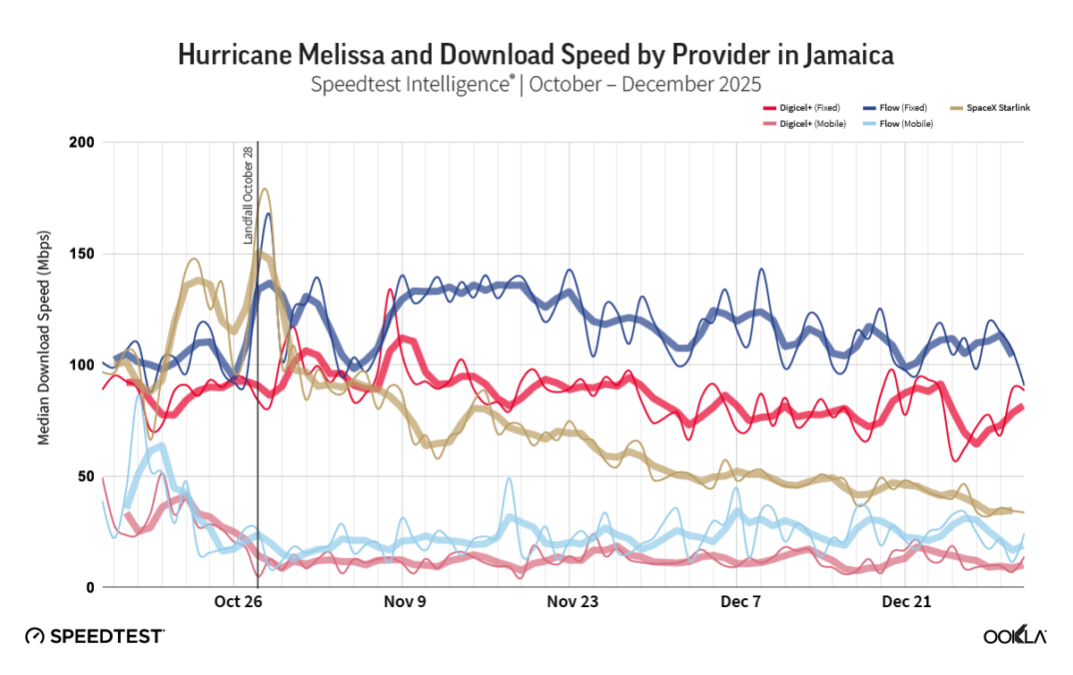
Before Hurricane Melissa made landfall in late October 2025, Jamaica’s fixed broadband networks were delivering robust performance. Digicel recorded median download speeds of around 90 Mbps, while Flow achieved approximately 100 Mbps. Following initial disruption and instability, Flow’s fixed network performance even peaked at around 130 Mbps in November, before stabilizing closer to pre-hurricane levels. By early 2026, both providers had returned to their baseline performance of around 90 to 100 Mbps, highlighting the resilience of fixed infrastructure once connectivity is restored.
Mobile network performance followed a different trajectory due to power outages, tower damage, and increased user demand. Prior to landfall, Digicel mobile delivered median download speeds of about 30 Mbps, while Flow mobile reached around 35 Mbps.
However, in the immediate aftermath of the hurricane, speeds dropped significantly, averaging around 12 Mbps for Digicel and 20 Mbps for Flow. As recovery efforts progressed, mobile speeds improved steadily, with Digicel surpassing 20 Mbps and Flow exceeding 30 Mbps in 2026, effectively returning to pre-disaster performance levels.
Latency metrics further illustrate the impact and recovery of Jamaica’s telecom infrastructure. Fixed broadband latency increased sharply during the hurricane, with Digicel+ rising from 38 ms to 64 ms and Flow from 29 ms to 51 ms.
Mobile latency also surged, with Digicel increasing from 60 ms to 96 ms and Flow from 56 ms to 76 ms. These spikes, ranging from 36 percent to 76 percent, were caused by fiber breaks and rerouting of traffic over longer distances. As fiber repairs were completed, latency improved significantly, with fixed networks returning to around 48 ms for Digicel+ and 37 ms for Flow, while mobile networks also showed gradual recovery.
The hurricane also impacted network availability and signal strength. No-service rates nearly tripled from around 3 percent before the storm to over 8 percent during peak impact, before improving to approximately 6 percent during recovery. This reflects the scale of infrastructure damage, particularly in heavily affected regions such as St. Elizabeth and Westmoreland, while also highlighting the steady restoration of connectivity.
Satellite connectivity played a crucial role in maintaining communications during the crisis. Starlink saw a fivefold increase in usage following the hurricane, providing an essential backup when terrestrial networks failed. However, as more users joined the network, speeds declined from around 90 Mbps in early November to 50 Mbps in December and approximately 35 Mbps by year-end, demonstrating the impact of increased demand on fixed satellite capacity.
Ookla’s findings emphasize that network resilience is not just about peak speeds but sustained performance under stress. Fixed broadband networks in Jamaica proved to be binary, either fully operational or offline depending on power availability, but capable of delivering consistent speeds when active. Mobile networks showed greater initial resilience due to backup power systems, though recovery was more gradual due to the distributed nature of cellular infrastructure.
The experience of Hurricane Melissa has effectively stress-tested Jamaica’s telecom ecosystem, leading to stronger infrastructure, improved redundancy, and better disaster response strategies. The integration of mobile, fixed, and satellite connectivity now provides a layered and resilient communications framework.
As Jamaica prepares for the FIFA World Cup 2026, the recovery of mobile speeds to above 20–30 Mbps, fixed broadband stability around 90–100 Mbps, and improved latency and network availability collectively indicate a telecom environment capable of supporting high-definition streaming, real-time broadcasting, and seamless digital engagement. These advancements position Jamaica as increasingly prepared to meet the connectivity demands of one of the world’s largest sporting events.
BABURAJAN KIZHAKEDATH