

The global telecom industry gathered at Mobile World Congress 2026 with strong momentum around artificial intelligence, edge computing, and cloud-driven networks. However, one of the most notable themes at the event was the relative absence of major announcements related to next-generation 6G technology.

While the conversation around AI dominated product launches and strategy discussions at the MWC 2026, 6G development appeared to take a temporary back seat as vendors and operators focused on near-term innovations and practical deployments, Dimitris Mavrakis, Senior Research Director at ABI Research, said in a blog post.
GSMA on 6G network
The GSMA said the mobile ecosystem is already preparing for 6G even as 5G deployment continues globally. Governments and industry stakeholders are working on spectrum planning for 6G, which is expected to be introduced in the 2030s.
Future networks will require wider spectrum channels, expanding from about 100 MHz used in the 5G era to around 200–400 MHz to support higher performance demands. Spectrum harmonisation efforts are already underway in bands such as 4.5 GHz and 7 GHz.
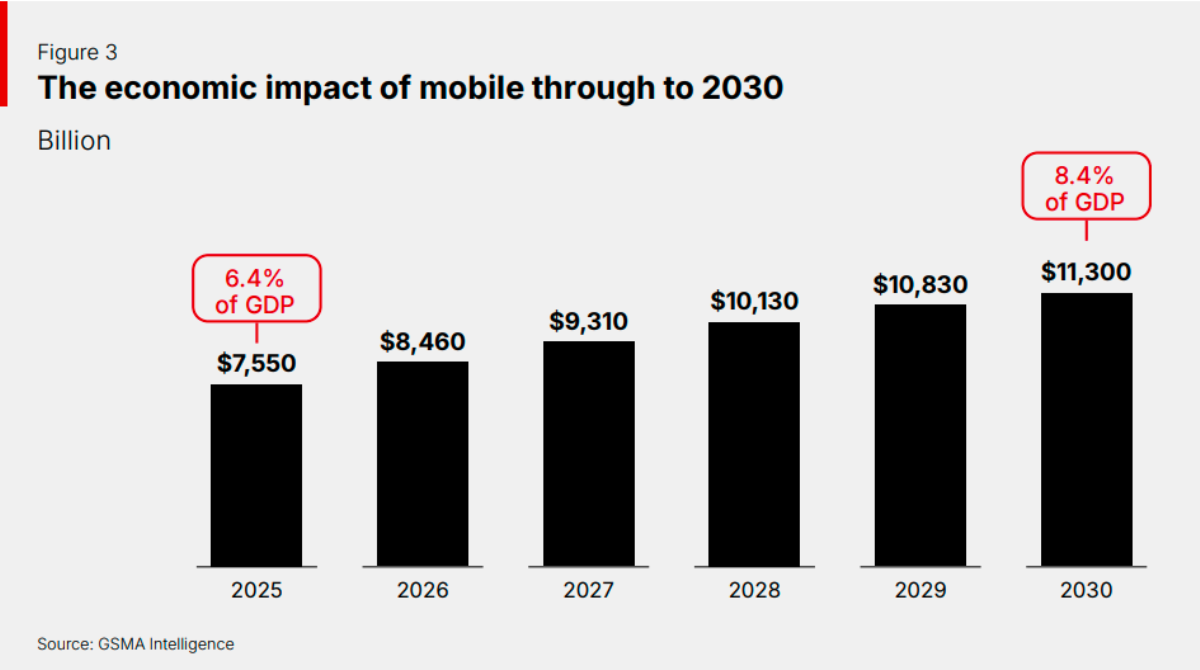
The industry body also forecasts strong growth for 5G adoption, with 57 percent of global mobile connections expected to run on 5G by 2030. At the same time, mobile operator revenues are projected to increase from $1.19 trillion in 2025 to $1.36 trillion by 2030, supported by an estimated $1.2 trillion in capital expenditure during the period.
GSMA report said 6G networks are expected to begin deployment around 2030, with major early rollouts likely in China, Japan, South Korea, the United States, the GCC states, Europe, Vietnam and India. By 2040, global 6G connections could exceed 5 billion, accounting for roughly half of all mobile connections worldwide.
The next-generation technology is expected to support emerging applications such as extended reality (XR), image- and video-driven generative AI, and potentially holographic communication, which will significantly increase uplink data requirements. To support these capabilities, around 2 GHz of mid-band spectrum will be needed by 2030, rising to about 2–3 GHz in most countries or 2.5–4 GHz in high-demand markets during the 2035–2040 period, GSMA said.
AI and Edge Computing Take Center Stage
A major trend across the exhibition floor was the growing integration of AI into telecom infrastructure. Companies showcased new AI-driven tools, automation platforms, and edge computing solutions designed to improve network efficiency and enable new services, according to ABI Research.
NVIDIA played a central role in shaping the discussion by promoting its broader strategy to bring graphics processing units (GPUs) into telecom networks. Many vendors are exploring how GPUs deployed at the edge can support AI workloads, advanced analytics, and real-time automation.
Telecom operators are evaluating use cases for these technologies, including autonomous network management, AI-driven service delivery, and support for emerging applications.
Limited but Strategic 6G Announcements
Although 6G was not the dominant theme at the event, several companies did reveal early initiatives aimed at shaping the future generation of mobile connectivity.
NVIDIA introduced a new 6G-focused initiative, while Qualcomm announced a coalition aimed at accelerating 6G research and ecosystem development. Meanwhile, AMD is leading an alliance focused on building open AI-based telecom systems that could support future 6G networks.
Despite these announcements, the industry has not yet reached a clear consensus on the architecture or capabilities that will define 6G.
Standards Timeline Still Several Years Away
The timeline for formal 6G standards remains several years away. The first normative specification from 3rd Generation Partnership Project is expected in Release 21, which is anticipated around 2029.
Historically, similar timelines have applied to previous generations. For example, in the years leading up to the first 5G standards, industry events focused more on technologies such as LTE enhancements, smartphones, and emerging applications rather than the new generation itself.
This suggests that the relatively quiet 6G presence at MWC 2026 does not necessarily indicate a slowdown in development.
Key Technologies Under Study for 6G
Although standards are still evolving, researchers and technology vendors are already studying several key capabilities that could define the next generation of wireless networks.
One of the most promising concepts is Integrated Sensing and Communication (ISAC), which would allow networks to sense and analyze their environment without requiring input from user devices.
Other innovations include advanced higher-order Multiple Input Multiple Output (MIMO) systems with larger antenna arrays designed to enable near-field communication and provide greater capacity in dense urban environments.
Another important area of research is the integration of AI and machine learning into the air interface and network automation processes, enabling more intelligent and adaptive communication systems.
Device Makers vs Network Vendors
The industry also appears to be experiencing a strategic divide between device manufacturers and network infrastructure providers.
Qualcomm has been particularly vocal about advancing 6G, as the company’s chipset business depends heavily on the evolution of mobile devices and next-generation connectivity standards.
In contrast, Ericsson has focused more on network infrastructure innovation. The company recently introduced purpose-built silicon with integrated neural network accelerators designed to power future telecom networks without relying heavily on external GPU platforms.
These differing priorities highlight the broader debate between device-driven and network-driven innovation in the development of 6G.
Industry Focus Shifts to Automation and Cloud Platforms
While 6G discussions were limited, other transformative developments received significant attention at the event.
Closed-loop network automation, where systems operate without human intervention, is becoming a realistic goal for telecom operators. At the same time, cloud-based infrastructure is emerging as the foundation for next-generation mobile networks.
These platform-level developments could ultimately serve as the underlying architecture for future 6G capabilities, including AI-driven services and integrated sensing technologies.
More 6G Activity Expected at Future Events
Industry analysts believe the current lull in major 6G announcements is temporary. As technical challenges are addressed and research matures, the pace of innovation is expected to accelerate.
Many experts expect Mobile World Congress 2027 to showcase significantly more 6G-related demonstrations, partnerships, and strategic initiatives as the industry moves closer to the next generation of mobile connectivity.
BABURAJAN KIZHAKEDATH