

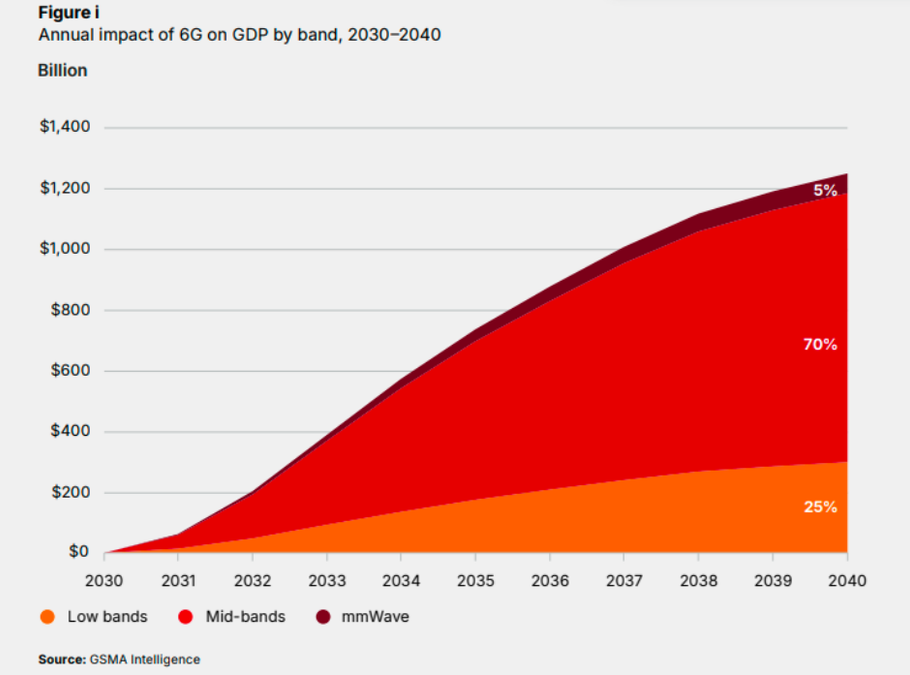
The global 6G mobile network industry could generate an additional $1.24 trillion in economic value annually by 2040, equivalent to 0.7 percent of global GDP, according to a new GSMA Intelligence report, Vision 2040: The Economic Benefits of 6G, published in November 2026.

The GSMA report on 6G mobile network industry identifies spectrum availability, artificial intelligence, industrial automation, network coverage and enterprise adoption as major factors determining the economic success of 6G.
GSMA Intelligence also warns that inadequate spectrum allocation could reduce the economic contribution of 6G by as much as $520 billion in 2040, representing 42 percent of its potential benefits.
Here are the 10 major findings and recommendations from the report, with a focus on economic value, spectrum requirements, network investments and industry opportunities.
1. 6G Could Generate $1.24 Trillion in Additional Economic Value by 2040
GSMA Intelligence estimates that 6G will contribute $1.24 trillion to global GDP in 2040, representing 0.7 percent of worldwide economic output.
This represents additional economic activity beyond the contribution that existing mobile technologies, including 5G, would deliver without 6G.
The economic benefits are expected to increase progressively between 2030 and 2040 as operators deploy commercial networks, enterprises adopt new applications and consumers upgrade to compatible devices.
The report identifies AI-native connectivity, industrial automation, intelligent sensing, enhanced mobile broadband and satellite integration as five major sources of economic growth.
Unlike earlier mobile generations, 6G is expected to support AI processing and autonomous systems as fundamental network capabilities.
2. Spectrum Shortages Could Cost the Global Economy $520 Billion
GSMA Intelligence estimates that insufficient spectrum availability could reduce the additional economic contribution of 6G from $1.24 trillion to approximately $720 billion in 2040.
The resulting $520 billion reduction would represent 42 percent of the potential economic benefits.
The constrained scenario assumes that operators receive only 72 percent of the required low-band spectrum and 50 percent of the necessary mid-band spectrum.
Spectrum shortages could restrict network capacity, coverage, reliability and the commercial deployment of advanced AI applications.
The report identifies the World Radiocommunication Conference 2027 (WRC-27) as an important milestone for decisions affecting the future availability of harmonised 6G spectrum.
3. Mid-Band Spectrum to Generate $880 Billion in 6G Economic Benefits
Mid-band spectrum is expected to account for approximately $880 billion, or 70 percent, of the additional economic contribution of 6G in 2040.
Low-band spectrum is projected to contribute approximately $300 billion, representing 25 percent of the total.
Millimetre-wave spectrum is expected to generate approximately $70 billion, or 5 percent.
Mid-band frequencies are particularly important because they provide a combination of network capacity and coverage suitable for densely populated cities, industrial facilities and enterprise applications.
Low-band spectrum will remain essential for rural coverage, indoor connectivity and massive Internet of Things deployments.
Millimetre-wave frequencies will support specialised applications requiring high capacity, including sensing and connectivity in dense environments.
4. GSMA Calls for at Least 2 GHz of Mid-Band Spectrum by 2030
GSMA Intelligence recommends making at least 2 GHz of mid-band spectrum available by around 2030 to support the introduction of 6G.
By 2035–2040, global average mid-band spectrum requirements are expected to reach 2–2.5 GHz.
Countries experiencing particularly high mobile data demand could require between 2.4 GHz and 3.3 GHz of mid-band spectrum.
The report identifies the upper 3.5 GHz band, including 3.8–4.2 GHz, the 4.5 GHz band and frequencies within the 6–8 GHz range as potential sources of additional capacity.
GSMA also recommends making the 600 MHz band available for 6G coverage and considering 500 MHz spectrum where additional low-band capacity is necessary.
These recommendations have significant implications for telecom regulators and operators planning long-term spectrum investments.
5. Manufacturing Sector to Gain $250 Billion from 6G
Manufacturing is expected to become the largest beneficiary of 6G, generating approximately $250 billion in additional economic value in 2040.
This represents 20 percent of the total projected global 6G economic contribution.
The financial services sector follows with an estimated $240 billion contribution, representing 19 percent of the total.
Together, manufacturing and finance are expected to account for almost 40 percent of the economic benefits.
Other sectors are also projected to benefit significantly.
| Industry | Additional GDP contribution in 2040 |
| Manufacturing | $250 billion |
| Finance | $240 billion |
| Wholesale and retail | $160 billion |
| Construction | $160 billion |
| ICT | $150 billion |
| Services | $130 billion |
| Public administration | $120 billion |
| Agriculture | $40 billion |
The manufacturing opportunity will be driven by industrial automation, connected machinery, robotics and reliable low-latency communications.
Financial services will benefit from AI-enabled transaction processing, risk assessment and automation.
6. Finance and ICT to Record the Highest Relative Economic Gains
Although manufacturing will generate the largest absolute economic contribution, finance and ICT are expected to experience the highest gains relative to their respective industry GDP.
GSMA Intelligence estimates that 6G could increase financial sector GDP by 1.9 percent in 2040.
The ICT sector could experience a 1.8 percent increase.
The projected relative contributions for other sectors include services at 0.9 percent, manufacturing at 0.6 percent, wholesale and retail at 0.6 percent, construction at 0.5 percent and agriculture at 0.3 percent.
The higher relative gains in finance and ICT reflect the potential for AI to automate repetitive tasks, improve information processing and support new digital services.
For telecom operators, these findings highlight the commercial importance of enterprise connectivity and AI-enabled network services.
7. Greater China to Lead 6G Economic Contribution at $390 Billion
Greater China is projected to generate the largest regional economic benefit from 6G, reaching $390 billion in 2040.
This represents approximately 1.2 percent of the region’s projected GDP.
North America is expected to generate $290 billion, equivalent to 0.7 percent of GDP.
Europe follows with an estimated $225 billion contribution, also representing 0.7 percent of GDP.
South Asia, including India, is projected to generate $55 billion in additional economic value, equivalent to 0.5 percent of regional GDP.
Regional 6G economic contribution in 2040
$0 billion$150 billion$300 billion$450 billionGreater ChinaNorth AmericaEuropeDeveloped Asia PacificLatin America & CaribbeanSouth AsiaSoutheast AsiaMiddle East & North Africa*GCC statesEurasiaSub-Saharan AfricaOther Asia Pacific
Source: GSMA Intelligence, Vision 2040. Figures are projections.
*Middle East and North Africa excludes GCC states. Values are rounded regional estimates.
Other regional contributions include Latin America and the Caribbean at $70 billion, Southeast Asia at $45 billion, GCC states at $25 billion and Sub-Saharan Africa at $15 billion.
The differences reflect economic size, digital infrastructure, enterprise adoption, workforce capabilities and expected 6G deployment.
8. Commercial 6G Networks Expected Around 2030
GSMA Intelligence identifies 2030 as the expected introduction period for 6G technology, following the commercial launch of 5G in 2018.
The transition will introduce three major capabilities beyond existing mobile network generations.
First, 6G will be AI-native, integrating machine learning into radio operations, network management and resource allocation.
Second, integrated sensing and communication will allow mobile infrastructure to detect movement, location and physical objects using radio signals.
Third, 6G will integrate terrestrial mobile networks with non-terrestrial networks, including satellites.
These capabilities are expected to support five major application groups: AI connectivity, massive IoT and ultra-reliable low-latency communications, enhanced mobile broadband and fixed wireless access, integrated sensing, and non-terrestrial connectivity.
The report expects AI connectivity to become the largest use-case contributor to 6G’s economic benefits.
9. 6G Sensing Could Improve Location Detection from Metres to Centimetres
GSMA Intelligence identifies integrated sensing and communication as a major technological advancement.
According to the report, sensing resolution could improve from approximately 1.5 metres on a typical 5G carrier to tens of centimetres using upper mid-band and millimetre-wave frequencies.
This improvement would allow mobile networks to detect and monitor objects without requiring every object to carry a connected device.
Potential applications include vehicle safety, drone monitoring, industrial automation, smart infrastructure and healthcare monitoring.
For mobile operators, integrated sensing could create new enterprise service opportunities by allowing existing network infrastructure to provide environmental and movement information alongside communications services.
The technology could also reduce the need for separate sensing infrastructure in certain industrial applications.
10. Spectrum Policy and 6G Adoption Will Determine Economic Returns
GSMA Intelligence identifies three broad factors influencing the economic success of 6G: technology adoption, regulatory frameworks and macroeconomic conditions.
The report highlights research showing that a 10 percent increase in 5G adoption is associated with an estimated 0.15 percent increase in GDP.
For 6G, the economic impact will depend on network deployment, device affordability, enterprise investment and the availability of applications that can use advanced network capabilities.
Spectrum pricing, licence duration, network infrastructure costs, electricity tariffs, equipment expenses and regulatory requirements will also influence operator investment decisions.
GSMA recommends clear spectrum roadmaps, harmonised frequency allocations and timely spectrum availability to give telecom operators greater confidence in long-term network investments.
The report emphasises that spectrum availability alone will not guarantee economic growth. Enterprises must also adopt the technology and integrate new capabilities into their operations.
6G Outlook: Spectrum and AI Will Shape Telecom Investment Through 2040
The GSMA Intelligence findings indicate that the economic value of 6G will extend far beyond faster mobile broadband.
Mid-band spectrum alone could support $880 billion in additional annual economic value by 2040, while manufacturing and financial services together could generate approximately $490 billion.
Greater China, North America and Europe are expected to account for the largest regional contributions, while South Asia represents a $55 billion opportunity.
For telecom operators, the report reinforces the importance of securing adequate spectrum, expanding network capacity and developing enterprise services built around AI, automation and integrated sensing.
However, the $1.24 trillion estimate remains a modelled projection rather than a guaranteed outcome. Actual economic benefits will depend on spectrum policy, network investment, technology adoption and broader economic conditions.
BABURAJAN KIZHAKEDATH