

Investment in 5G Standalone (5G SA) is becoming a foundation for next-generation telecom networks, offering lower latency, stronger quality-of-service control, and enabling advanced capabilities such as network slicing and improved traffic management. 5G Standalone connects devices directly to a 5G core without relying on LTE infrastructure, improving network efficiency and responsiveness, Ookla said in its report.

5G SA adoption
However, global adoption remains uneven. China leads with about 80 percent 5G SA sample share, while India is nearing 50 percent adoption largely driven by a single operator. The United States is approaching one-third penetration, whereas much of Europe remains in the low single digits as operators continue focusing on returns from earlier non-standalone deployments.
Several factors influence 5G SA adoption, including the complexity of deploying standalone cores, delays in enabling compatible devices, the need to migrate subscribers to SA-enabled plans, and the availability of balanced spectrum resources. As a result, the gap between advanced and lagging markets is widening, shaping the competitive landscape of the global telecom industry in 2026.
Network latency
5G Standalone significantly improves network latency, which is essential for applications that require real-time responsiveness. While fast download speeds remain important for activities such as video streaming and large file downloads, many advanced use cases – including cloud collaboration, industrial automation, interactive gaming, and AR-based workflows – depend heavily on low and stable latency.
5G Standalone networks deliver about 23 percent lower latency compared with non-standalone 5G deployments. Some markets show even stronger improvements. Hong Kong has recorded around 43 percent lower latency due to reduced signaling overhead and faster multi-server responsiveness, while France has achieved about 31 percent improvement as traffic is routed fully through the 5G core, enhancing both latency and network consistency.
Download speed
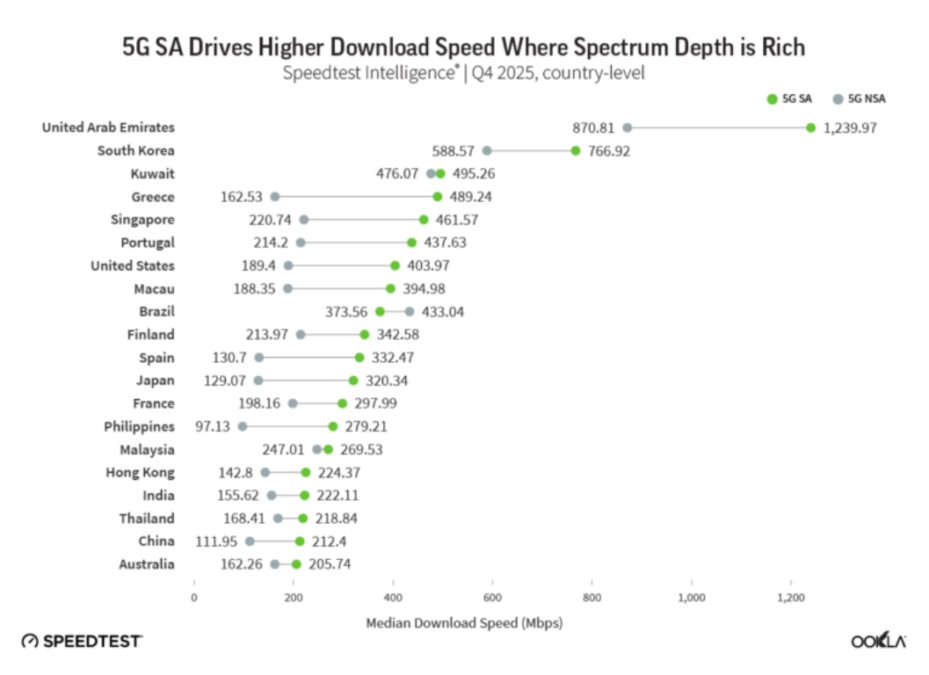
5G Standalone networks continue to deliver strong download speeds, though performance improvements often depend more on spectrum strategy – such as carrier aggregation and mid-band spectrum deployment – than on architecture alone. In Q3 2025, the UAE recorded around 1.2 Gbps median 5G SA download speeds due to extensive mid-band deployment and strong carrier aggregation. South Korea achieved over 700 Mbps with its mature 3.5 GHz mid-band network, while the United States surpassed 300 Mbps as operators expanded multi-band standalone deployments.
Network performance
However, network architecture alone does not guarantee better user experience. Performance varies depending on factors such as spectrum mix, carrier aggregation strategies, and core network placement. Mid-band spectrum boosts capacity but may face indoor coverage challenges without low-band support, while efficient routing and proximity to content delivery networks can significantly influence latency. As a result, while 5G SA delivers clear improvements – particularly in latency – the best outcomes occur when network architecture, spectrum planning, and traffic routing are optimized together.
Monetization
5G Standalone technology is improving network performance with lower latency, more predictable uplink speeds, faster downloads, and greater core network control. However, these technical advances do not automatically translate into higher revenues for telecom operators, and monetization challenges remain different for consumer and enterprise markets.
In the consumer segment, users care more about stable and reliable connectivity than the underlying network architecture. Benefits such as consistent uplink performance for content uploads, reliable hotspot connectivity in crowded areas, and automatic mobile backup during broadband outages can improve user experience. However, consumers rarely pay extra specifically for standalone 5G; revenue typically comes from reliability features, premium service tiers, or backup connectivity services.
For enterprises, the value of 5G Standalone is clearer because businesses focus on operational impact rather than peak speeds. Features such as predictable low latency, network slicing, traffic isolation, and integration with private or hybrid networks support industrial automation, robotics, and mission-critical applications. Enterprise customers are willing to pay for performance guarantees and service-level agreements that ensure reliability and continuity. As a result, enterprise deployments, especially private and hybrid 5G networks, are increasingly contributing to telecom revenue growth. For operators moving into 2026, the key challenge is turning the technical advantages of 5G Standalone into sustainable revenue streams.
In 2025, telecom networks increasingly came to be viewed as critical national infrastructure, similar to energy, transportation, and cloud systems. Recent events such as power outages, subsea cable disruptions, and cloud service failures highlighted how vulnerable connectivity can be when different layers of infrastructure fail. These incidents reinforced the need for stronger resilience across telecom networks.
Network resilience now depends on several factors, including backup power at cell sites, redundant transport routes to prevent single points of failure, reliable core network software, and stable cloud infrastructure that supports telecom operations. Policymakers are responding with new regulatory frameworks that emphasize network security, coordination, and infrastructure protection.
Different regions are adopting their own strategies. Europe is advancing policies focused on network resilience and security, China is integrating telecom infrastructure with domestic AI development, India is building local telecom technology capabilities while expanding 5G coverage, the United States is prioritizing supply chain security and semiconductor ecosystems, and Gulf countries are linking digital transformation and AI readiness with rapid 5G Advanced deployment. As a result, telecom strategy is increasingly tied to national resilience planning, industrial policy, and long-term economic competitiveness.
5G Standalone forms the foundation for the evolution toward 5G Advanced, which introduces software-driven improvements such as stronger uplink performance, improved energy efficiency, and more advanced network automation and analytics. Early deployments of 5G Advanced are already emerging in China and some Gulf countries, with more launches expected in 2026.
At the same time, discussions around 6G are accelerating, with commercial deployment expected closer to 2030. However, many telecom operators are still focused on migrating to 5G Standalone and solving monetization challenges, meaning that 6G may evolve more as an efficiency and ecosystem upgrade rather than simply a major speed leap.
Future networks will increasingly need to integrate with a broader digital ecosystem that includes hyperscale cloud providers, private wireless networks, neutral host infrastructure, and non-terrestrial connectivity.
As the telecom industry moves into 2026, competition will depend less on headline speed claims and more on real-world network performance. Consistency, resilience during disruptions, and alignment with enterprise needs and national infrastructure priorities will play a major role in determining how operators convert technological progress into long-term value.
BABURAJAN KIZHAKEDATH