

Verizon Communications reported revenue of $34.31 billion in Q3 2026, up 1.5 percent year over year, driven by growth in wireless and broadband services. The US telecom operator added 406,000 postpaid phone connections, increased its fiber broadband subscriber base by 44.2 percent to 11.07 million and raised its 2026 postpaid phone subscriber growth forecast to 1.1 million–1.2 million.

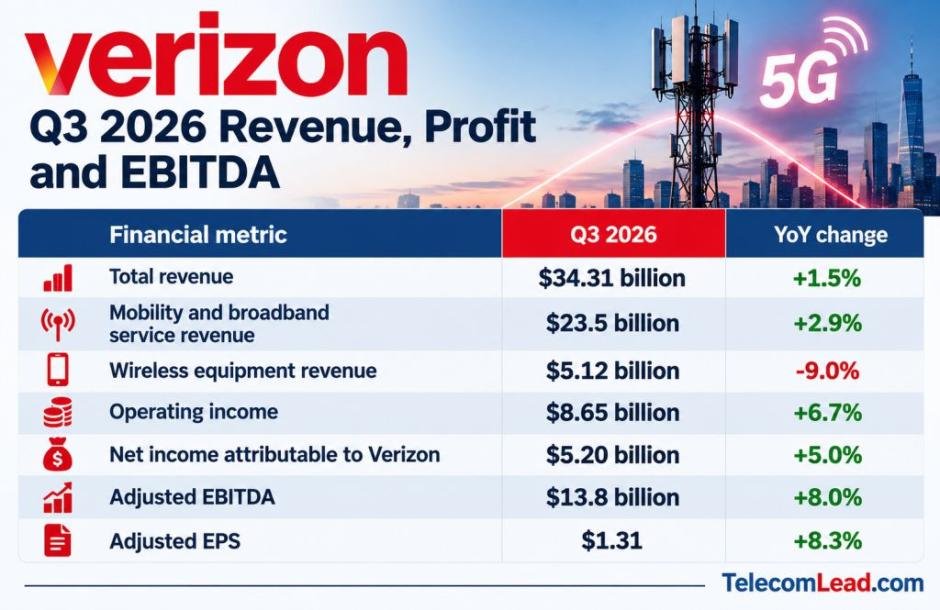
Verizon’s mobility and broadband service revenue increased 2.9 percent to approximately $23.5 billion, while adjusted EBITDA rose 8 percent to $13.8 billion. Adjusted earnings per share increased 8.3 percent to $1.31.
The company maintained its annual capital expenditure guidance of $16 billion–$16.5 billion, reflecting continued investment in wireless and fiber broadband infrastructure.
Verizon Q3 2026 Revenue, Profit and EBITDA
Verizon’s financial performance improved as service revenue growth and operating efficiency supported profitability.
Wireless equipment revenue declined 9 percent, reflecting weaker device sales revenue.
Verizon Consumer generated revenue of $26.43 billion, up 1.3 percent, while Verizon Business revenue increased 2.6 percent to $7.02 billion.
Consumer segment EBITDA increased 6.5 percent to $11.97 billion, while Business segment EBITDA rose 13 percent to $1.94 billion.
According to Verizon’s quarterly financial results, the company is prioritizing profitable growth, improved customer acquisition and stronger cash generation.
Verizon Wireless Subscribers Reach 147.1 Million
Verizon ended September 2026 with 147.10 million wireless retail connections, an increase of 0.7 percent year over year.
Postpaid wireless connections reached 126.83 million, including 94.52 million postpaid phone connections.
| Subscriber metric | Q3 2026 | YoY growth |
| Total wireless retail connections | 147.10 million | +0.7% |
| Postpaid wireless connections | 126.83 million | +0.7% |
| Postpaid phone connections | 94.52 million | +1.4% |
| Core prepaid connections | 19.34 million | +1.4% |
| Postpaid phone net additions | 406,000 | 44,000 in Q3 2025 |
Verizon’s 406,000 postpaid phone net additions represented a substantial improvement from 44,000 a year earlier.
The company also reported 137,000 postpaid account net additions, an improvement of 313,000 year over year.
However, Verizon lost 52,000 core prepaid phone connections during the quarter, highlighting continued pressure in the prepaid segment.
Verizon Churn Improves, but Postpaid ARPA Declines
Verizon’s postpaid phone churn improved to 0.94 percent from 0.98 percent in Q3 2025, indicating stronger customer retention.
However, average revenue per postpaid account declined 1.9 percent to $168.08.
| Customer performance metric | Q3 2026 | Q3 2025 |
| Postpaid phone churn | 0.94% | 0.98% |
| Core prepaid churn | 3.80% | 3.73% |
| Postpaid ARPA | $168.08 | $171.27 |
| Core prepaid ARPU | $33.51 | $32.70 |
| Postpaid upgrade rate | 2.6% | 3.3% |
Core prepaid ARPU increased 2.5 percent to $33.51, suggesting better revenue generation per prepaid connection.
Verizon also reported 3.3 million postpaid device upgrades, down 20.3 percent year over year.
The results indicate that Verizon is improving customer retention and subscriber acquisition, although postpaid account monetization remains under pressure.
Verizon Fiber Broadband Subscribers Jump 44.2%
Verizon’s total broadband customer base increased 33.5 percent to 17.44 million connections.
Fiber broadband connections surged 44.2 percent to 11.07 million, supported by expansion of its fiber business and the acquisition of Frontier Communications.
| Broadband metric | Q3 2026 | YoY growth |
| Fiber broadband connections | 11.07 million | +44.2% |
| FWA broadband connections | 6.37 million | +18.1% |
| Total broadband connections | 17.44 million | +33.5% |
| Quarterly fiber net additions | 155,000 | 61,000 in Q3 2025 |
| Quarterly FWA net additions | 159,000 | -39.1% |
Verizon added 314,000 broadband connections during Q3 2026, compared with 322,000 a year earlier.
Fiber broadband net additions increased significantly, while fixed wireless access subscriber additions slowed.
The acquisition of Frontier Communications, completed on January 20, 2026, expanded Verizon’s fiber broadband operations.
The reported 44.2 percent increase in fiber broadband connections therefore includes acquisition-related expansion and should not be interpreted entirely as organic growth.
Verizon 5G FWA Subscribers Reach 6.37 Million
Verizon’s fixed wireless access broadband customer base increased 18.1 percent to 6.37 million connections.
However, quarterly FWA net additions declined 39.1 percent to 159,000 from 261,000 a year earlier.
The slowdown indicates weaker customer acquisition momentum in wireless home broadband despite continued growth in the installed subscriber base.
Verizon’s 5G and fiber networks support its strategy of providing broadband connectivity to residential and enterprise customers.
The company’s 5G Home Internet services represent an important part of its fixed wireless broadband offering.
The Q3 earnings materials do not separately disclose total 5G mobile subscribers, 5G population coverage or fiber route kilometres.
Verizon Capex Reaches $11.9 Billion in Nine Months
Verizon invested $11.9 billion in capital expenditure during the first nine months of 2026, compared with $12.3 billion during the corresponding period of 2025.
The company maintained its full-year 2026 Capex guidance of $16 billion–$16.5 billion.
| Financial metric | 9M 2026 | 9M 2025 |
| Capital expenditure | $11.9 billion | $12.3 billion |
| Operating cash flow | $29.9 billion | $28.0 billion |
| Free cash flow | $18.0 billion | $15.8 billion |
| Dividends paid | $8.8 billion | $8.6 billion |
Free cash flow increased approximately 14 percent, supported by higher operating cash generation and lower capital expenditure.
Verizon also spent approximately $4.38 billion acquiring wireless licenses during the nine-month period, compared with $340 million a year earlier. Spectrum acquisitions are reported separately from Capex.
Total debt reached $166.2 billion at September 30, 2026, while the net unsecured debt-to-adjusted EBITDA ratio stood at 2.3 times.
Verizon Raises 2026 Subscriber and Earnings Guidance
Verizon increased its 2026 outlook for postpaid phone subscriber additions, adjusted earnings growth and free cash flow.
| Performance indicator | Updated 2026 guidance |
| Postpaid phone net additions | 1.1 million–1.2 million |
| Mobility and broadband service revenue growth | Upper half of 2.5%–3% |
| Adjusted EPS growth | 7%–7.5% |
| Capital expenditure | $16 billion–$16.5 billion |
| Free cash flow growth | Approaching 12% |
The revised postpaid phone forecast represents an increase from Verizon’s previous expectation of additions in the upper half of the 750,000–1 million range.
The company also increased its adjusted EPS growth forecast from 6–7 percent to 7–7.5 percent.
Verizon’s updated outlook reflects improving wireless subscriber momentum and stronger financial performance.
Its 2026 guidance includes the financial contribution from Frontier Communications following completion of the acquisition.
The company’s 2026 financial disclosures provide additional information on its financial performance, network investments and business risks.
Verizon’s Growth Outlook
Verizon’s Q3 2026 results demonstrate improving wireless subscriber acquisition, stronger fiber broadband scale and higher profitability.
The most significant achievements include 406,000 postpaid phone net additions, 44.2 percent growth in fiber broadband connections and an 8 percent increase in adjusted EBITDA.
However, declining postpaid ARPA, slower FWA subscriber additions and lower wireless equipment revenue remain challenges.
Verizon’s ability to sustain postpaid subscriber growth, expand fiber broadband revenue and maintain its $16 billion–$16.5 billion annual Capex discipline will be important for its financial performance in 2027.
BABURAJAN KIZHAKEDATH