

Telekom Germany has emerged as Europe’s most consistent mobile network in the first half of 2026, highlighting how competition among telecom operators is shifting from headline download speeds toward reliable, repeatable network performance.

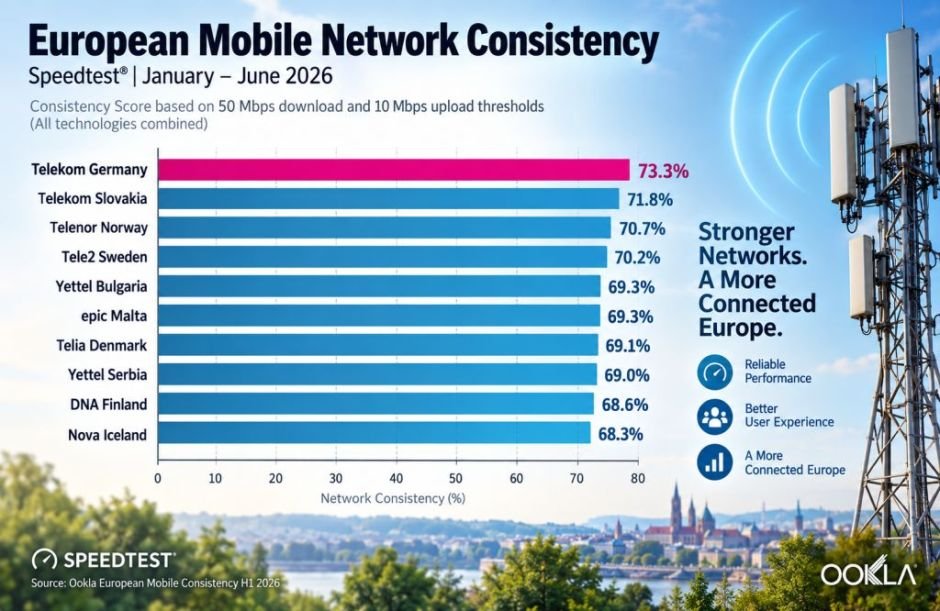
According to the Ookla European Mobile Consistency H1 2026 report, Telekom Germany achieved a 73.3 percent Consistency Score, the highest among the European mobile networks measured. Telekom Slovakia ranked second with 71.8 percent, followed by Telenor Norway at 70.7 percent.
Ookla’s consistency benchmark measures the percentage of mobile tests that achieve at least 50 Mbps download and 10 Mbps upload speeds. Unlike peak-speed rankings, the metric indicates how frequently subscribers receive performance capable of supporting demanding everyday digital services.
Top 10 European Mobile Networks for Consistency
Telekom Germany’s 73.3 percent result placed it five percentage points ahead of the tenth-ranked operator, showing how closely Europe’s leading networks are competing.
Only 5 percentage points separated Telekom Germany from Yettel Serbia. The narrow gap indicates that operators are increasingly differentiated by incremental improvements in capacity, coverage density, spectrum utilization and network optimization rather than dramatic differences in basic connectivity.
Ookla’s H1 2026 Speedtest benchmark places Telekom Germany first for European mobile network consistency at 73.3 percent, ahead of Telekom Slovakia at 71.8 percent and Telenor Norway at 70.7 percent. Scores across the top 10 range from 68.3 percent to 73.3 percent.
Investment
Deutsche Telekom Group is aiming for an estimated Capex of €16.63 billion in 2027 against €16.79 billion of capex in 2026. Investment priorities include 5G, fibre, network capacity, cloud infrastructure and modernisation across Germany and its international businesses.
Slovak Telekom invested more than €150 million in network modernisation during 2025, taking 5G population coverage to 99.1 percent. Separately, it committed nearly €165 million for spectrum. Mobile data traffic increased 30.1 percent, while 5G traffic expanded 2.4 times and represented 33.5 percent of total traffic by December 2025.
Telenor expects its Nordic operations, including Norway, to maintain Capex at 14 percent of sales in 2026. In Q1 2026, Telenor Nordics invested NOK 1.814 billion, up 3.7 percent, with spending primarily directed toward IT and network modernisation. Telenor plans to gradually reduce Nordic capex intensity to below 13 percent in 2028 and 11–12 percent by 2030 as major network upgrades mature.
Tele2 Sweden expects 2026 Capex excluding spectrum and leases of about SEK 3.03 billion. Tele2 guides for a 10–11 percent capex-to-sales ratio in 2026. The operator spent SEK 3.24 billion in 2025, principally on 5G, Swedish fixed-network upgrades and IT. Its 5G network has reached approximately 99 percent population coverage.
Europe Reaches 96.8% 5G Coverage, but Mid-Band Deployment Lags
The consistency rankings arrive as Europe moves closer to ubiquitous basic 5G availability. However, high population coverage does not necessarily translate into equally strong capacity or user experience.
The European Commission Digital Decade 2026 5G Observatory report shows that basic 5G household coverage has reached 96.8 percent, while rural 5G coverage stands at 87.9 percent.
The bigger challenge is the deployment of capacity-rich mid-band spectrum.
Coverage using the important 3.4–3.8 GHz spectrum bands reaches only 74.8 percent of households, leaving a gap of 22 percentage points compared with overall 5G coverage.
The European Commission also reports that 5G standalone base stations account for only 20.9 percent of all mobile base stations across the European Union.
These figures expose the difference between having a 5G signal and delivering high-quality 5G performance. European operators have largely solved the first-stage coverage challenge, but network densification, mid-band spectrum deployment and standalone architecture remain major investment priorities.
5G Standalone Is Europe’s Next Network Challenge
The 5G standalone gap is particularly important because SA networks provide the architecture required for many of the capabilities promised during the initial 5G investment cycle.
GSMA Intelligence estimates that 5G standalone reaches only 2 percent of Europe’s population, compared with almost 50 percent in India and 80 percent in Greater China.
This gap could become increasingly significant as telecom operators attempt to monetize 5G beyond consumer mobile broadband.
5G SA can provide the foundation for network slicing, lower-latency applications, enterprise private networks, industrial connectivity and advanced IoT services. It could also become increasingly relevant as operators prepare networks for AI-driven automation and applications requiring predictable performance.
For Europe, accelerating 5G SA therefore represents both a network-quality challenge and a potential revenue opportunity.
Europe Faces €205 Billion Mobile Network Investment Gap
Delivering these improvements will require substantial capital.
A 2026 GSMA study estimates that Europe needs approximately €475 billion in mobile network investment through 2035 if it is to achieve connectivity levels comparable with other leading digital markets.
However, the industry is expected to have access to only around €270 billion, creating a potential €205 billion funding gap.
The GSMA study on Europe’s €475 billion connectivity investment requirement estimates that approximately €35 billion will be required to extend 5G coverage to the entire European population.
Another €38 billion would be required to strengthen network resilience, while €28 billion would support AI-related services and innovation.
Together, those three areas represent €101 billion of investment requirements, demonstrating that the next stage of European telecom spending extends well beyond conventional coverage expansion.
Why Consistency Matters More as 5G Coverage Approaches 100%
When network coverage was limited, operators could compete primarily on the size of their 4G or 5G footprints. With European basic 5G household coverage already at 96.8 percent, that distinction is becoming less powerful.
Performance consistency offers another way to differentiate networks.
European Mobile Competition Moves From Coverage to Quality
Ookla’s H1 2026 ranking illustrates the next phase of European mobile competition.
Europe already has 96.8 percent basic 5G household coverage, but rural coverage remains at 87.9 percent, mid-band 3.4–3.8 GHz coverage is 74.8 percent, and 5G standalone base stations account for only 20.9 percent of the EU mobile base-station footprint.
At the same time, Europe faces an estimated €475 billion mobile investment requirement through 2035 against approximately €270 billion of available investment capacity, leaving a €205 billion gap.
Against this backdrop, Telekom Germany’s 73.3 percent consistency leadership is significant. It demonstrates that the competitive benchmark is moving beyond who has the fastest network or the largest 5G footprint toward how reliably operators can deliver high-quality connectivity to customers every day.
As basic 5G coverage approaches saturation, investment in mid-band capacity, network densification, 5G standalone, resilience and AI-enabled network capabilities is likely to have a growing influence on European operator rankings — and ultimately on their ability to monetize the next generation of mobile services.
FASNA SHABEER