

Sky Italia is deepening its push into telecommunications by taking greater control of its mobile business, positioning broadband and mobile connectivity as strategic tools to strengthen customer loyalty and complement its core pay-TV operation.

The company, which launched Sky Wifi fixed broadband in 2020 and entered retail mobile in 2024, has now shifted to mobile virtual network operator (MVNO) status. Under the new model, Sky will directly manage its mobile proposition while using Fastweb’s underlying mobile network infrastructure.
The move represents more than another mobile tariff launch. It gives Sky greater control over pricing, packaging, billing and the customer relationship, allowing the company to combine TV, fixed broadband and mobile services into a broader household proposition.
According to GlobalData, the strategy reflects an important shift in the relationship between media and telecommunications: premium content remains central to Sky, but content alone may no longer be sufficient to drive customer growth, retention and profitability.
Sky Mobile Becomes Part of a Wider Connectivity Strategy
Sky’s expansion into telecom has developed progressively.
Sky Wifi established the company as a fixed-broadband provider in 2020. Sky subsequently entered Italy’s mobile market in 2024 through Sky Mobile powered by Fastweb.
The strategy entered a new phase in September 2026 when the company announced the new Sky Mobile MVNO proposition, saying it would directly manage the mobile offering.
Sky is therefore moving from primarily providing entertainment toward managing a wider household relationship encompassing TV, broadband and smartphones.
Natasha Rybak, Principal Analyst – Telecoms Practice at GlobalData, said the move should be viewed as an ecosystem strategy rather than an attempt to compete directly with Italy’s largest mobile network operators.
“In a digital-dominant economy where media and connectivity are increasingly intertwined, content alone is no longer enough to reliably drive growth and profitability,” Rybak said.
She said Sky can use connectivity to improve loyalty, customer lifetime value and its control over direct customer relationships.
That distinction is important. Sky does not need to become one of Italy’s largest mobile operators for its MVNO strategy to succeed. Mobile can instead make its existing television and broadband relationships more valuable.
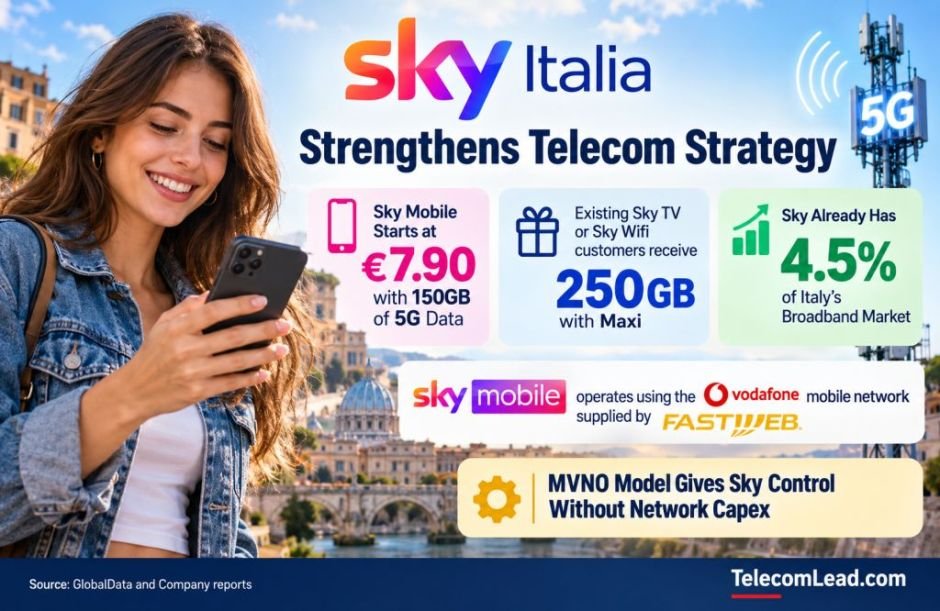
Sky Mobile Starts at €7.90 with 150GB of 5G Data
Sky’s revised mobile portfolio is built around two straightforward 5G plans.
Sky Mobile Maxi, priced at €7.90 per month, provides 150GB of mobile data, unlimited minutes and 200 SMS.
Sky Mobile Ultra, at €9.90 per month, increases the allowance to 250GB while retaining unlimited minutes and 200 SMS.
However, the more strategically important part of the offer is what happens when customers already subscribe to another Sky service.
Existing Sky TV or Sky Wifi customers receive 250GB with Maxi, while the Ultra plan moves to unlimited data.
Sky is also using tenure-based incentives to reward existing customers. Ultra customers who have been with Sky for at least six years can receive six months free, while customers with shorter relationships can receive two months free.
The structure demonstrates that Sky Mobile is designed partly as a customer-retention product.
Rather than competing exclusively on the headline price of a SIM, Sky is giving its most valuable TV and broadband customers additional mobile benefits.
Rybak said the competitive realignment lies in how Sky is positioning mobile as a loyalty instrument, using multi-service benefits and tenure-based rewards to support retention and incremental revenue.
Sky Already Has 4.5% of Italy’s Broadband Market
Sky’s telecom strategy also benefits from an established position in fixed broadband.
Data from Italian communications regulator AGCOM shows that Sky Italia represented 4.5 percent of Italy’s broadband and ultrabroadband accesses at the end of December 2025.
Its position is stronger in fibre.
According to the AGCOM Communications Observatory, Sky accounted for 6.1 percent of Italy’s FTTH connections, behind Fastweb+Vodafone, TIM, Wind Tre and Iliad.
Italy’s total FTTH connections increased 19.6 percent year on year, illustrating the continuing migration toward fibre broadband.
Fastweb+Vodafone held 29.5 percent of FTTH accesses, followed by TIM at 27.2 percent, Wind Tre at 16 percent, Iliad at 7.1 percent and Sky Italia at 6.1 percent.
Sky’s existing broadband footprint is important to the mobile strategy because it creates an installed customer base to which mobile subscriptions can be cross-sold.
The commercial objective increasingly becomes selling more services to each household rather than acquiring a completely new customer for every product.
Fastweb-Vodafone Network Strengthens Sky Mobile Proposition
Sky’s decision to take greater control of mobile does not mean that it is building a national cellular network.
Sky Mobile operates using the Vodafone mobile network supplied by Fastweb.
The network relationship has become more significant following the combination of Fastweb and Vodafone Italia. From January 1, 2026, the companies became a single corporate entity under Fastweb S.p.A.
The Fastweb and Vodafone Italia combination created an operator with more than 20 million mobile lines and 5.8 million fixed lines.
Its infrastructure includes more than 20,000 mobile radio sites, with 5G reaching around 87 percent of the Italian population, and a proprietary fixed network spanning more than 74,000 kilometres.
The combination gives Sky access to substantial mobile infrastructure without requiring the capital expenditure associated with building and operating its own radio access network.
Sky says its mobile customers receive 99 percent 4G coverage in Italy, while 5G is included without an additional charge in covered locations. The service supports download speeds of up to 2 Gbps, according to Sky Mobile service information.
This creates an interesting division of responsibilities: Fastweb supplies the underlying network while Sky increasingly controls the commercial proposition and customer experience.
The Real Opportunity Is Household ARPU, Not Mobile Alone
The economics of the strategy should therefore be viewed beyond the €7.90 or €9.90 monthly mobile subscription.
A customer taking only Sky TV represents one revenue relationship. A household combining Sky TV, Sky Wifi and one or more Sky Mobile subscriptions potentially generates significantly more recurring revenue while becoming more deeply integrated into the Sky ecosystem.
This gives Sky several opportunities: increase household revenue per user, reduce churn, cross-sell services, improve customer lifetime value and spread customer acquisition costs across several products.
Mobile can therefore be valuable even if its standalone margins are relatively modest.
The strategic progression can be viewed simply:
Sky TV → Sky TV + Sky Wifi → Sky TV + Sky Wifi + Sky Mobile
Each additional service potentially increases the cost and inconvenience of switching away from the Sky ecosystem.
This convergence model has long been important to traditional telecom operators. What makes Sky’s strategy interesting is that the company approaches convergence from the opposite direction: it began with premium television and entertainment before adding broadband and mobile connectivity.
MVNO Model Gives Sky Control Without Network Capex
Becoming an MVNO also offers a middle ground between simply reselling another operator’s service and owning a complete mobile network.
Sky can gain greater influence over tariffs, customer management, promotions and service integration without investing billions of euros in spectrum licences and radio infrastructure.
That capital-light approach makes sense for a company whose main competitive assets remain content, brand recognition and existing household relationships.
But greater control also brings greater responsibility.
Billing problems, provisioning issues, number portability, customer support and mobile service management increasingly become part of the Sky customer experience.
“MVNO status gives Sky Italia more freedom but also demands more accountability,” Rybak said.
Successful execution, she added, depends on whether the additional control results in a genuinely integrated customer experience rather than simply lower prices.
Competition in Italy Will Remain Intense
Sky nevertheless enters a highly competitive mobile environment dominated by established network operators and numerous virtual operators.
Its challenge will be differentiation.
Because Sky does not own the radio network supporting Sky Mobile, competing primarily on network superiority would be difficult. Price competition also carries obvious limitations in an already aggressive Italian mobile market.
Sky’s stronger differentiators are likely to be TV + broadband + mobile bundles, unlimited-data incentives, loyalty rewards, integrated billing and the existing Sky customer relationship.
That explains why the additional data allowances and free months offered to existing customers may be more strategically significant than the headline €7.90 starting price.
Sky is effectively using mobile as another reason for households to remain inside its ecosystem.
Sky’s Bigger Bet Is Convergence
Sky Italia’s MVNO transition ultimately represents a wider strategic shift rather than simply the launch of another mobile service.
Premium television and exclusive content remain important assets, but Sky increasingly wants to own more of the digital relationship surrounding that content.
Sky Wifi gave it a position in home broadband. Sky Mobile extends the relationship to the smartphone. Direct MVNO management gives it greater control over how those services are packaged and sold.
The company now has a 4.5 percent share of Italian broadband connections and 6.1 percent of FTTH accesses, while its mobile proposition operates over a Fastweb network backed by more than 20 million mobile lines and over 20,000 radio sites.
The key test will not necessarily be how many mobile subscribers Sky can take from Italy’s biggest telecom operators.
A more important measure will be whether mobile helps Sky reduce churn, raise household ARPU and convert more customers into multi-product subscribers.
If that happens, the €7.90 mobile plan will have a strategic value far beyond the revenue generated by the SIM itself. For Sky Italia, connectivity is increasingly becoming the infrastructure supporting the customer relationship, while content remains the asset that makes that relationship distinctive.
BABURAJAN KIZHAKEDATH