

SK Telecom reported a 13.1 percent increase in revenue to KRW 4.497 trillion in the third quarter of 2026, supported by recovery in mobile services, growth in 5G subscribers, broadband expansion and increasing demand for artificial intelligence (AI) solutions.

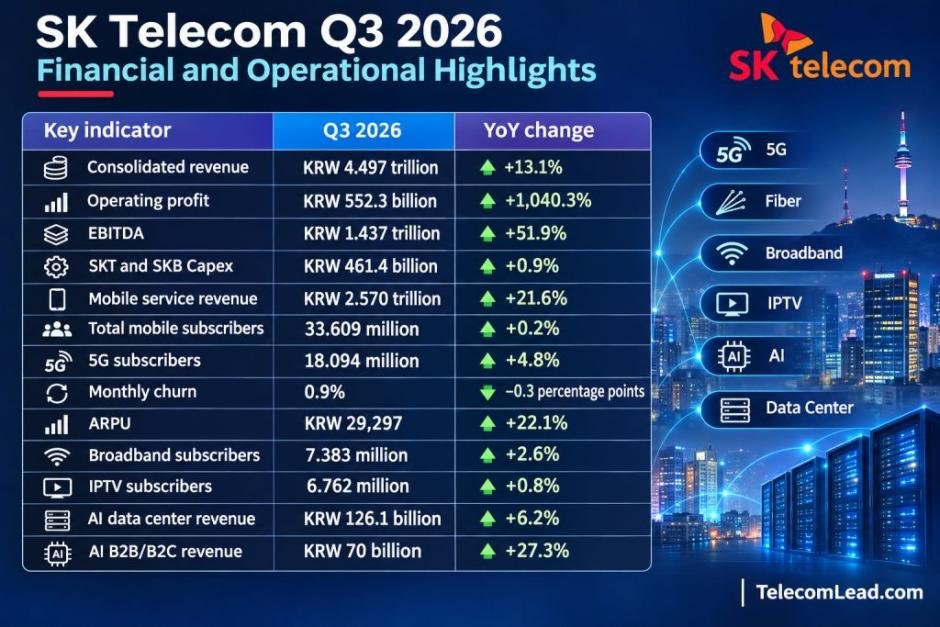
South Korea’s leading telecom operator recorded operating profit of KRW 552.3 billion, representing a 1,040.3 percent increase from KRW 48.4 billion a year earlier. The sharp recovery reflected the low comparison base created by customer compensation measures in 2025, alongside improved profitability in its fixed-line business.
Net income reached KRW 411.8 billion, compared with a net loss of KRW 166.7 billion in Q3 2025. EBITDA increased 51.9 percent to KRW 1.437 trillion, while the EBITDA margin improved to 32 percent from 23.8 percent.
Sequentially, revenue increased 3.2 percent, although operating profit declined 2.4 percent.
SK Telecom Capex Reaches KRW 461.4 Billion in Q3 2026
SK Telecom and SK Broadband reported combined capital expenditure (Capex) of KRW 461.4 billion during Q3 2026, representing a 0.9 percent increase from KRW 457.1 billion in the corresponding quarter of 2025.
Capex declined 5.3 percent from KRW 487 billion in Q2 2026.
Separately, SK Hyper invested KRW 148.6 billion in data center development, highlighting the company’s expanding focus on AI infrastructure.
Including this separately disclosed investment, the two Capex figures total KRW 610 billion, although SK Telecom reports them separately.
The operator is pursuing investments in telecom infrastructure, broadband services and AI data centers as it seeks to diversify revenue beyond traditional mobile connectivity.
SK Telecom Mobile Revenue Grows 21.6 Percent to KRW 2.57 Trillion
SK Telecom’s mobile service revenue increased 21.6 percent to KRW 2.5697 trillion from KRW 2.1134 trillion a year earlier.
The increase primarily reflected the comparison with Q3 2025, when the company introduced its Customer Appreciation Package.
Mobile service revenue increased marginally by 0.2 percent from the preceding quarter.
SK Telecom’s standalone revenue increased 18.4 percent to KRW 3.1563 trillion, while standalone operating profit reached KRW 413.5 billion, reversing an operating loss of KRW 52.2 billion a year earlier.
Marketing expenses increased 4.4 percent to KRW 750.8 billion, compared with KRW 719.4 billion in Q3 2025.
The operator is shifting toward customer lifetime value-based marketing, emphasizing subscriber retention and profitability rather than aggressive customer acquisition.
SK Telecom 5G Subscribers Rise 4.8 Percent to 18.09 Million
SK Telecom’s 5G subscriber base increased 4.8 percent year over year to 18.094 million at the end of September 2026, compared with 17.260 million a year earlier.
The operator added approximately 834,000 5G subscribers over 12 months and 121,000 during the third quarter.
5G penetration among handset subscribers reached approximately 83 percent, compared with 79 percent in Q3 2025.
SK Telecom’s 5G market share stood at approximately 45.5 percent, according to its investor presentation.
However, the overall handset subscriber base declined sequentially to 21.916 million from 21.970 million, partly reflecting the termination of long-term inactive connections.
Total MNO subscribers reached 30.942 million, down 0.4 percent year over year, while total mobile subscribers, including MVNO connections, increased 0.2 percent to 33.609 million.
LTE subscribers declined 10.7 percent to 4.403 million as customers continued migrating toward 5G services.
SK Telecom Churn Improves to 0.9 Percent; ARPU Rises 22.1 Percent
SK Telecom reported monthly subscriber churn of 0.9 percent in Q3 2026, compared with 1.2 percent a year earlier.
The improvement of 0.3 percentage points indicates stronger customer retention, although churn increased from 0.8 percent in Q2 2026.
Average revenue per user (ARPU) increased 22.1 percent to KRW 29,297 from KRW 23,999 in Q3 2025.
Sequentially, ARPU increased 0.7 percent from KRW 29,098.
ARPU including MVNO connections reached KRW 27,314, representing 21.2 percent annual growth.
However, the substantial year-over-year ARPU increase should be viewed in the context of the unusually weak Q3 2025 comparison, rather than as evidence of an equivalent increase in underlying customer spending.
The combination of improving churn and growing 5G penetration supports SK Telecom’s strategy of increasing revenue from its existing subscriber base.
SK Broadband Revenue Rises to KRW 1.17 Trillion
SK Broadband reported revenue of KRW 1.1728 trillion in Q3 2026, representing 2.6 percent growth from KRW 1.1426 trillion a year earlier.
Operating profit increased 51 percent to KRW 134.7 billion, supported by fixed-line performance and cost efficiencies.
Fixed-line revenue increased 7.4 percent to KRW 305.5 billion, driven by growth in Giga broadband subscribers.
Broadband subscriptions increased 2.6 percent to 7.383 million from 7.196 million a year earlier, representing approximately 187,000 additional subscribers.
The company added 35,000 broadband subscribers during Q3 2026.
Pay-TV revenue declined 0.3 percent to KRW 476.2 billion, while enterprise revenue increased 0.4 percent to KRW 278.8 billion.
IPTV subscribers increased 0.8 percent to 6.762 million, but cable TV subscribers declined 3.8 percent to 2.647 million.
Total pay-TV subscribers declined 0.5 percent to 9.409 million.
These figures indicate that broadband and IPTV growth helped offset continued pressure on traditional cable television services.
SK Telecom Fiber and Broadband Expansion Strategy
SK Telecom’s fixed-line business continues to benefit from demand for high-speed broadband and Giga Internet services.
The 7.4 percent increase in fixed-line revenue highlights the importance of higher-speed connectivity in the company’s revenue mix.
Growth in broadband subscriptions and enterprise connectivity provides opportunities to expand bundled services, digital entertainment and business solutions.
However, SK Telecom’s Q3 2026 presentation does not disclose specific fiber-to-the-home coverage figures, new fiber route kilometers or fiber-related Capex.
SK Telecom AI Revenue Grows 27.3 Percent as Cloud Demand Increases
SK Telecom reported 27.3 percent annual growth in AI B2B and B2C revenue to KRW 70 billion in Q3 2026, compared with KRW 55 billion a year earlier.
Revenue increased 14.2 percent sequentially from KRW 61.3 billion, supported by orders for cloud services.
The company’s AI portfolio includes AI Cloud, AI Contact Center (AICC), AI Factory, generative AI, AI Marketing, A.dot, commerce and advertising services.
AI data center revenue increased 6.2 percent to KRW 126.1 billion from KRW 118.8 billion a year earlier, supported by higher data center utilization and growing submarine cable traffic.
However, AI data center revenue declined 7.4 percent sequentially because of a temporary gap in GPU-as-a-Service revenue during the transition to new long-term contracts.
The results demonstrate growing demand for AI services, although the data center business remains exposed to contract timing and infrastructure utilization.
SK Telecom Plans to Expand AI Data Center Capacity Beyond 318 MW
SK Telecom is planning a substantial expansion of its AI infrastructure through SK Horizon, whose spin-off was approved in August 2026.
The company currently operates eight data centers with a combined capacity of 137 MW.
SK Telecom plans to expand capacity to more than 318 MW from 2030 onward through new facilities in Ulsan and the Seoul metropolitan area.
This represents an increase of more than 181 MW over its existing capacity.
The company is also planning to expand its submarine cable infrastructure from the existing SJC2 system to at least three systems from 2032 onward, including expansion involving E2A and Asia.
These investments are designed to strengthen the company’s position in AI computing infrastructure, cloud connectivity and international data transmission.
SK Telecom Digital Transformation and Enterprise Strategy
SK Telecom is increasingly positioning AI and digital services as growth opportunities alongside its traditional mobile and broadband operations.
Its enterprise portfolio includes leased lines, voice, enterprise solutions, cloud services, AI contact centers and generative AI applications.
Enterprise revenue remained relatively stable at KRW 278.8 billion during Q3 2026, indicating that AI services are growing faster than the broader enterprise connectivity business.
The company is also expanding consumer-facing AI applications through A.dot, commerce and digital advertising.
SK Telecom’s strategy combines recurring telecom revenue with higher-growth AI infrastructure and digital services, although the earnings presentation does not provide separate revenue figures for every digital product.
Outlook: AI Infrastructure and 5G Monetization Remain Key Growth Opportunities
SK Telecom’s Q3 2026 performance reflects a recovery in profitability, continued 5G adoption and steady broadband growth.
The operator’s 18.09 million 5G subscribers, 0.9 percent monthly churn and KRW 29,297 ARPU demonstrate the importance of customer retention and monetization.
At the same time, planned AI data center expansion beyond 318 MW and growing enterprise AI revenue indicate a broader strategy to generate new income from computing infrastructure and digital services.
The key challenge will be sustaining revenue and profit growth after the favorable comparison effects of 2025 diminish, while managing capital expenditure and delivering returns from its AI infrastructure investments.
BABURAJAN KIZHAKEDATH