

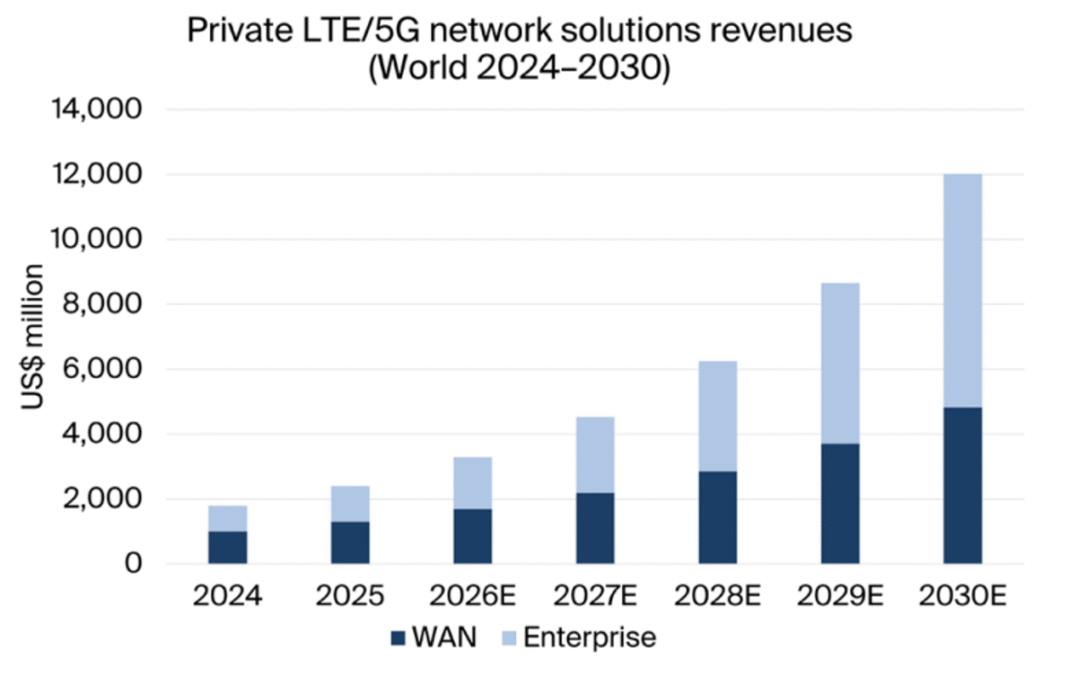
The global market for private LTE and 5G network solutions is entering a high-growth phase, fueled by enterprise digital transformation, dedicated spectrum availability, and rising demand for mission-critical connectivity. According to industry estimates from Berg Insights, the market reached approximately $2.4 billion in 2025 and is projected to reach $12.0 billion by 2030, expanding at a CAGR of 38 percent.

Private Cellular Market Gains Strong Momentum
Private LTE and 5G networks, also known as non-public networks (NPNs) under 3GPP standards, are dedicated cellular networks designed for the exclusive use of enterprises and government organizations. These networks use LTE or 5G radio infrastructure such as base stations, small cells, and RAN equipment to deliver secure voice and data connectivity to enterprise devices.
In 2025, the Enterprise segment generated about $1.1 billion in revenue, while Wide Area Networks (WAN) accounted for $1.3 billion. These figures exclude adjacent revenue streams such as installation, integration services, and cross-selling opportunities, indicating even larger overall ecosystem value.
Growth over the next five years will be driven by new deployments, expansion of existing networks, and migration from LTE to 5G as enterprises add new applications and capacity.
Enterprise Use Cases Driving Demand
Private LTE and 5G networks offer several advantages that make them attractive for industrial and mission-critical environments:
- Strong security and reliability
- High bandwidth and low latency
- Seamless mobility and handoffs
- Integration with public cellular networks for extended coverage
The market is transitioning from a supply-driven phase to one increasingly led by organic enterprise demand. Industries such as manufacturing, utilities, transportation, logistics, mining, ports, airports, and public safety are adopting private cellular networks to support automation, robotics, AI, and real-time analytics.
The increasing availability of dedicated spectrum, a rapidly expanding device ecosystem, and the rise of latency-sensitive applications are accelerating adoption globally.
6,500 Private Networks Deployed Worldwide
Private LTE and 5G deployments are scaling rapidly as organizations move from trials to full production rollouts. By the end of 2025, there were an estimated 6,500 private LTE and 5G networks deployed globally, up from 4,700 in the previous year.
The market is broadly divided into two segments:
Enterprise Networks
These deployments typically cover factories, campuses, industrial sites, ports, and city districts. They represent the fastest-growing segment due to Industry 4.0 adoption and enterprise digital transformation.
Wide Area Networks (WAN)
WAN deployments cover large geographic regions and are typically owned by government agencies, utilities, and public safety organizations for mission-critical communications.
Competitive Landscape and Industry Shift
Major RAN vendors Ericsson, Nokia, and Huawei have made significant progress as end-to-end solution providers. Nokia currently leads the private cellular market among the major vendors, with around 960 customers and more than 2,000 private network deployments as of the end of 2025.
However, the industry is undergoing notable restructuring. Nokia announced plans to divest its flagship Digital Automation Cloud (DAC) solution in late 2025 to focus on larger business segments. The same year also saw cloud giants AWS and Microsoft divest their private network offerings, signaling a shift in industry strategy and opening opportunities for specialized vendors.
Growing Ecosystem of Vendors
The private cellular ecosystem now includes nearly 60 vendors across RAN equipment and core network software.
Key RAN and small-cell providers include:
Airspan Networks, Askey, AW2S, Baicells, Benetel, BLiNQ Networks, Cablefree, Celona, Firecell, GXC, JMA Wireless, Mavenir, Microamp, Samsung Networks, Sercomm, Star Solutions, Telrad, XCOM RAN and ZTE.
Important core network software providers include:
AttoCore, Blue Arcus, Cisco, Cumucore, Druid Software, Expeto, Hewlett Packard Enterprise (HPE), Highway 9, IPLOOK, Onomondo, Obvios and Pente Networks.
This diverse vendor landscape is enabling flexible deployment models and accelerating adoption across industries.
Outlook: Strong Growth Ahead
The private LTE and 5G network market is poised for sustained expansion as enterprises increasingly prioritize resilient and secure connectivity for digital transformation initiatives. As deployments scale and 5G adoption grows, private cellular networks are expected to become a foundational component of enterprise IT and operational technology infrastructure worldwide.
BABURAJAN KIZHAKEDATH