

Optus has delivered stronger 5G performance at the Australian Open 2026, based on Speedtest Insights data collected between January 1 and February 1, 2026. Analysis focused on Reference Signal Received Power (RSRP) and Reference Signal Received Quality (RSRQ), which measure signal strength and network quality.

Results showed Optus achieved good to excellent 5G coverage across most areas of Melbourne Park, with signal strength of -90 dBm or stronger. By comparison, Telstra and Vodafone recorded weaker performance, with a larger share of locations experiencing signal strength of -90 dBm or lower, indicating relatively poorer coverage during the event.
Average 5G signal quality at Melbourne Park showed Optus and Vodafone performing equally, both recording an average RSRQ of -11 dB, while Telstra followed slightly behind at -12 dB. Vodafone’s comparable quality despite weaker signal strength suggests strong interference management and network optimization.
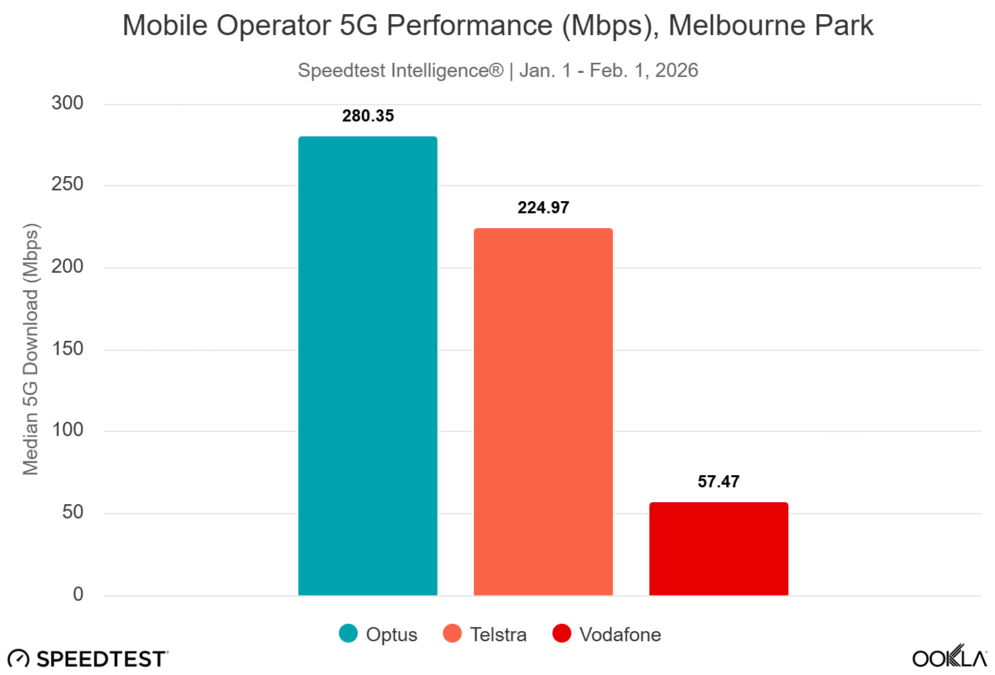
In terms of speed, Optus and Telstra delivered 5G download speeds above 220 Mbps, with Optus leading at 280.35 Mbps, about 25 percent faster than Telstra’s 224.97 Mbps, and also topping upload speeds at 74.43 Mbps. Vodafone lagged significantly with a download speed of 57.47 Mbps, Ookla report said.
The performance gap reflects differences in spectrum strategy. Optus and Telstra relied heavily on C-band spectrum, accounting for around half of their connections, which enabled higher throughput in the high-density event environment. Optus also made greater use of lower mid-band spectrum. Vodafone, by contrast, depended mainly on lower mid-band frequencies, helping maintain connectivity but limiting capacity and speed.
The 2026 Australian Open set a new global Grand Slam attendance record, drawing 1.36 million fans to Melbourne Park between January 12 and February 1, including 220,000 visitors during Opening Week. The massive crowds created a major stress test for mobile networks across the 27-hectare venue.
The event demonstrated that 5G spectrum capacity is crucial for delivering strong performance in high-density environments. As digital demand at large sporting events continues to grow, the effective use of mid-band spectrum will remain the key factor separating basic coverage from true network leadership.
BABURAJAN KIZHAKEDATH