

Oman’s mobile telecom market has been reshaped over the past five years by 5G investment, regulatory intervention, and intensifying competition following Vodafone’s market entry.

Omantel, Ooredoo, and Vodafone have expanded mobile network coverage and improved service quality, lifting the country’s mobile broadband performance, although outcomes vary significantly depending on spectrum depth, rollout strategies, and operating models, according to the latest Ookla report said.
5G rollout accelerates across Oman
Telecom service providers first introduced 5G services in late 2019 to support fixed wireless access (FWA), and launched full 5G mobile services in 2021. Since then, mobile operators have steadily increased infrastructure spending. Mobile capital expenditure rose from OMR 87.1 million in 2021 to OMR 124.3 million in 2024, according to the Telecommunications Regulatory Authority.
These investments expanded Oman’s 5G footprint from 1,587 sites with population coverage of 44.9 percent in 2021 to 5,893 sites covering 91 percent of the population in 2024. While this remains below the 99 percent population coverage reported in Qatar and the UAE, the progress is notable given Oman’s larger geography and more challenging terrain for network deployment.
Broadband performance improves, global ranking rises
Network expansion has delivered clear gains in user experience. Speedtest Intelligence data shows that median 5G download speeds in Oman increased from 191.03 Mbps in Q4 2022 to 259.94 Mbps in Q4 2025. Performance across all mobile technologies improved even more sharply, more than doubling to reach 121.84 Mbps by the end of 2025.
As a result, Oman climbed five places in the Speedtest Global Index to reach 18th position between January and December 2025, highlighting stronger broadband competitiveness.

Omantel leads on early deployment and spectrum depth
Omantel was the first operator to launch 5G mobile services in February 2021. By the end of 2024, it had deployed nearly 2,300 5G sites alongside about 3,800 4G sites. The operator has also trialed 5G Advanced and activated a second 5G carrier with 100 MHz in the 2.5 GHz band.
Omantel invested OMR 80.9 million in its network in 2024, focused mainly on 5G rollout and 4G expansion. This enabled 5G population coverage of 92 percent and 4G coverage of 98 percent. Its strong spectrum position and early rollout have helped Omantel consistently deliver the highest or near-highest 5G download speeds in Oman.
Ooredoo closes the coverage gap
Ooredoo launched 5G mobile services in April 2021 and intensified investment to narrow the coverage gap with Omantel. In the first nine months of 2025, 84 percent of its OMR 38 million capital expenditure was directed toward network expansion.
This strategy lifted Ooredoo’s 5G population coverage from 79 percent in 2024 to 97 percent by September 2025. The operator also boosted capacity at high-traffic sites to support growing fixed wireless access demand. Median 5G download speeds reached 321.67 Mbps in Q4 2025, driven largely by the activation of an additional 80 MHz carrier in the 2300 MHz band.
Vodafone drives competition but faces spectrum limits
Vodafone’s entry in March 2022 disrupted a market long dominated by Omantel and Ooredoo. The operator adopted an asset-light model, leasing tower infrastructure from Oman Tower Company and initially relying on national roaming over Ooredoo’s 4G network while building its own footprint.
By May 2025, Vodafone had deployed a cloud-based 5G network across more than 2,572 sites, achieved over 98 percent population coverage, and connected one million users to its 5G network. Its cloud-native core positions the operator for a future standalone 5G launch.
However, Vodafone’s more limited spectrum portfolio has constrained performance. The operator relies mainly on 40 MHz in the 2.5 GHz band and 10 MHz in the 700 MHz band using dynamic spectrum sharing with LTE. As network load increased, median 5G download speeds declined slightly to 87.9 Mbps in Q4 2025, well below incumbent levels.
Spectrum strategy shapes performance
Spectrum depth remains the main differentiator in network performance. Omantel and Ooredoo both hold 100 MHz in the prime 3.3 to 4.2 GHz band, while Omantel has additional 2.5 GHz capacity and Ooredoo strengthened throughput using 2300 MHz spectrum.
Because 5G in Oman is largely deployed in non-standalone mode, 4G spectrum holdings also influence 5G performance. Ookla data shows Omantel and Ooredoo benefit from more diversified 4G spectrum usage than Vodafone, supporting stronger anchoring and higher throughput.
Operators are now exploring additional bands to enhance coverage and capacity. Omantel is evaluating 900 MHz and 2100 MHz for 5G, while Ooredoo is testing 1800 MHz and 800 MHz. Access to low-band spectrum is expected to improve coverage and session continuity, particularly when aggregated with mid-band frequencies.
Vodafone captures share through pricing and digital focus
Despite spectrum constraints, Vodafone has rapidly built scale. Competitive prepaid and postpaid pricing, simple bundles, and transparent tariffs attracted price-sensitive users in a saturated market. A digital-first operating model, with app-based onboarding and customer management, reduced costs and resonated with younger and tech-savvy users.
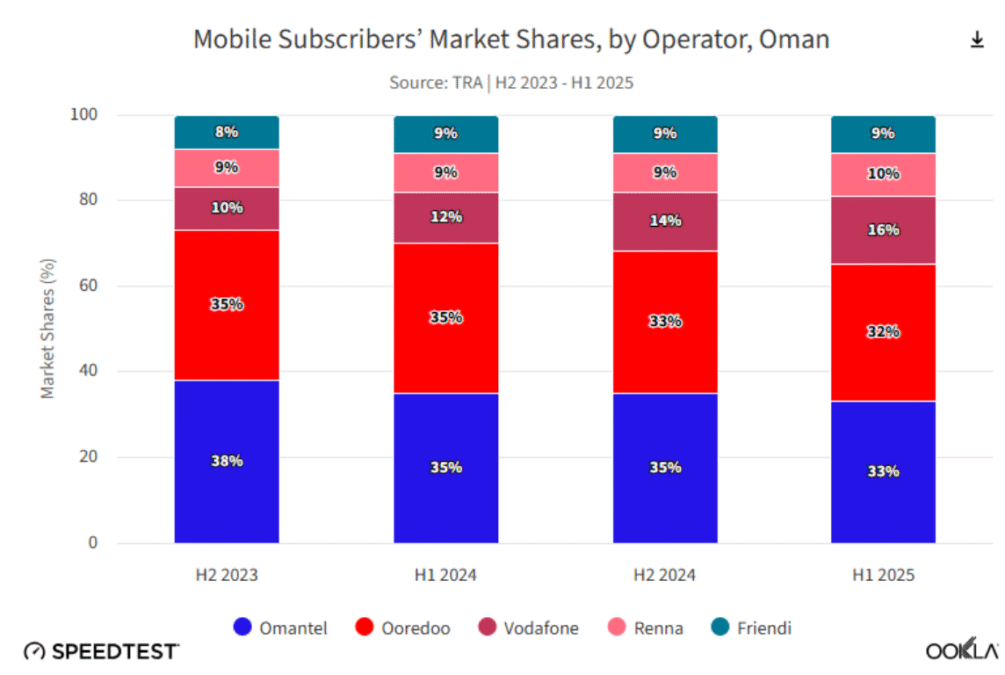
Vodafone targeted high-churn and underserved segments, including youth and digital natives, differentiating itself from the more traditional positioning of incumbents. Within three years, it grew its market share to 16 percent by the end of June 2025.
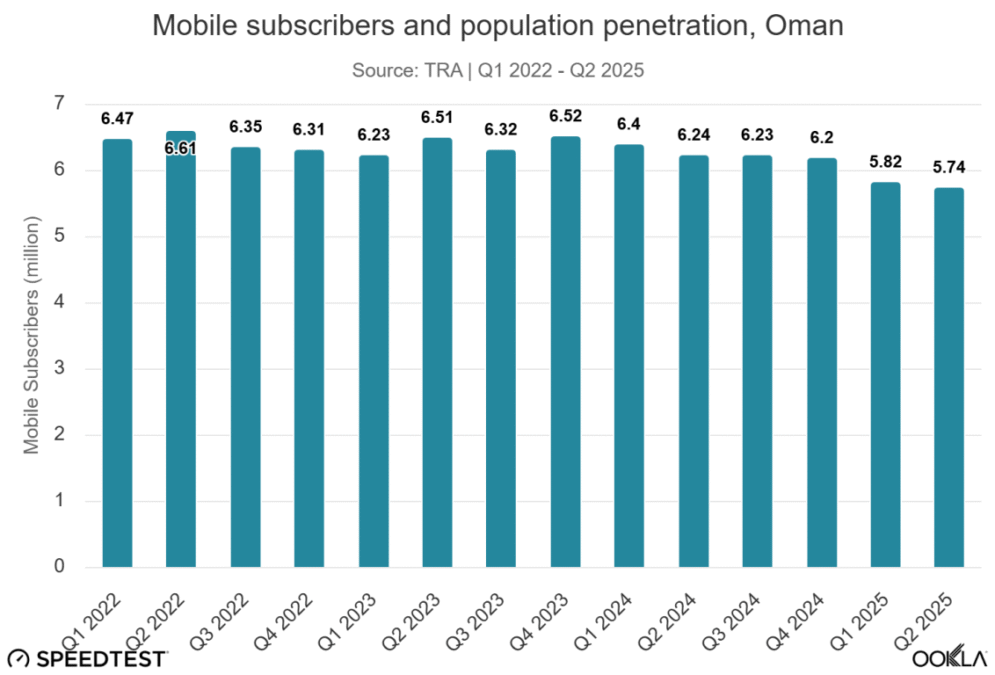
Over the same period, total mobile subscribers in Oman increased from 5.7 million in Q1 2022 to more than 6.6 million in Q2 2025, pushing mobile penetration to 125.5 percent. The apparent decline in population penetration at the end of 2024 reflects adjustments to official population figures rather than weaker demand.
Regulatory reforms underpin market transformation
Regulatory action by the Telecommunications Regulatory Authority has been central to Oman’s mobile transformation. The regulator introduced a 3G network sunset roadmap, freeing valuable spectrum for 4G and 5G and promoting infrastructure sharing. This lowered barriers to entry and supported Vodafone’s launch.
In 2019, Omantel and Ooredoo were each allocated 100 MHz in the 3.4 to 3.7 GHz band to support early 5G deployment. The TRA later allocated 26 GHz spectrum in March 2024 for 5G and future 6G trials, waiving spectrum fees during the experimentation phase.
The phased shutdown of 3G networks, largely completed by mid-2025, enabled operators to refarm low-band spectrum for more efficient technologies. More than 5,600 base stations were deactivated or upgraded, and the regulator blocked imports of devices lacking 4G and VoLTE support to ensure service continuity.
Passive infrastructure sharing and sale-and-leaseback policies, supported by the establishment of Oman Tower Company, reduced capital intensity and encouraged investment in active networks. Vodafone emerged as the main beneficiary, enabling rapid rollout while incumbents redirected capital toward capacity and performance.
Outlook
By Q4 2025, Omantel and Ooredoo clearly led on network performance, each delivering median 5G download speeds above 320 Mbps. Vodafone, while trailing on speed, has firmly established itself as a credible third operator. Overall, stronger competition, regulatory support, and sustained investment have improved service quality and elevated Oman’s position in global mobile broadband rankings, with further gains expected as operators prepare for standalone 5G.
BABURAJAN KIZHAKEDATH