

North Africa is entering a new digital era as countries fast-track 5G deployment, inspired by the early rollouts in Tunisia and Egypt.

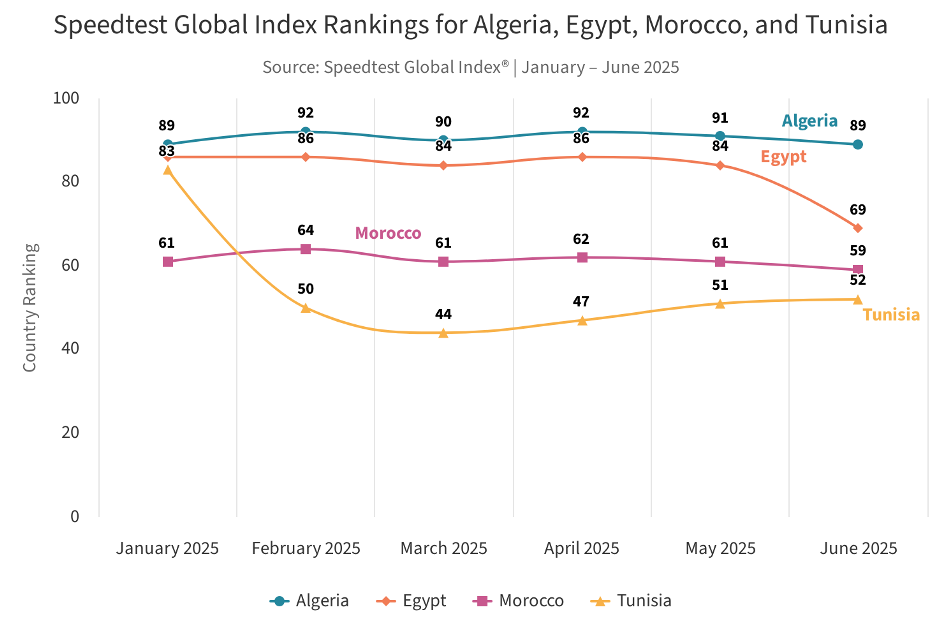
Tunisia became the first in the region to launch 5G in February 2025, deploying 700 MHz and 3500 MHz spectrum through its three operators — Tunisie Telecom, Orange Tunisie, and Ooredoo Tunisie, Ookla said in its report.
The launch propelled Tunisia to the top of the Speedtest Global Index in North Africa, with median download speeds surpassing 300 Mbps and latency dropping below 12 ms. By June 2025, speeds settled at around 200 Mbps, reflecting rising adoption and network load but still showcasing strong performance.
Egypt, North Africa’s largest mobile market with 116 million subscribers, followed in June 2025, using 2500 MHz spectrum across its four operators: Telecom Egypt, e& Egypt, Orange, and Vodafone. Initial rollouts targeted major cities like Cairo and Alexandria, with Vodafone covering 2,000 sites nationwide.
Operators offered 5G without new tariffs, instead incentivizing adoption with discounts and free activation. Egypt’s mobile download speed more than doubled to 82.49 Mbps, with 5G speeds exceeding 100 Mbps, boosting its Speedtest Global Index ranking by 17 places to 69th and closing the gap with Tunisia and Morocco.
Meanwhile, Algeria and Morocco are gearing up to launch 5G by the end of 2025. Algeria awarded licenses in July and plans to begin service in eight pilot provinces, including Algiers and Oran, before nationwide expansion. With 60–70 percent of smartphones in Algeria already 5G-capable, adoption could scale quickly once coverage grows.
Morocco, driven by the Africa Cup of Nations in late 2025 and the 2030 FIFA World Cup, has committed to ambitious rollout targets. Maroc Telecom, Orange, and inwi secured spectrum licenses in July, pledging to cover 45 percent of the population by 2026 and 85 percent by 2030. The effort is backed by major infrastructure ventures, including new tower installations and expanded fiber networks under the Digital Morocco 2030 plan.
Although fixed wireless access (FWA) offerings have been introduced in both Tunisia and Egypt, high equipment costs and similar pricing to fiber and VDSL limit consumer adoption. However, 5G’s broader promise lies in its socio-economic impact — driving innovation in agriculture, logistics, smart cities, and digital services. With supportive policies, North African countries can leverage 5G to attract investment, create jobs, and strengthen their positions as emerging digital economies in the MENA region.
Baburajan Kizhakedath