
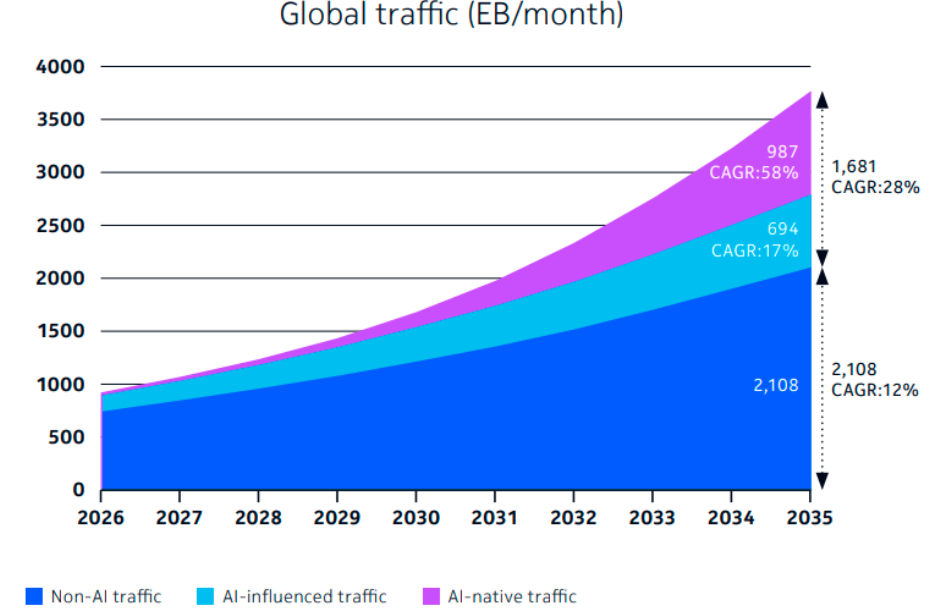
Global network traffic is projected to increase nearly fourfold to 3,789 exabytes (EB) per month by 2035, with artificial intelligence accounting for 44 percent of total traffic, according to Nokia’s Global Network Traffic Report 2026.
The report identifies generative AI, agentic AI, autonomous vehicles, industrial robots, connected cameras and fixed wireless access (FWA) as major drivers of network demand over the next decade.
Nokia expects AI to transform telecom network architecture, requiring operators to invest in uplink capacity, low-latency connectivity, edge computing, metro networks and distributed AI infrastructure.
Here are the 10 key findings from Nokia’s 2026 network traffic report, highlighting the implications for telecom operators, cloud providers and enterprise connectivity.
1. Global Network Traffic to Reach 3,789 EB per Month by 2035
Nokia forecasts global network traffic will increase nearly fourfold between 2026 and 2035, reaching 3,789 EB per month.
AI-native and AI-influenced applications will generate approximately 1,681 EB per month by 2035, representing 44 percent of total global traffic.
AI-related traffic is projected to grow at a compound annual growth rate (CAGR) of 28 percent, compared with 12 percent for non-AI traffic.
For telecom operators, this growth will require continued expansion of network capacity across mobile access, fiber broadband, transport infrastructure and cloud connectivity.
2. AI-Native Traffic to Grow 60 Times to 987 EB per Month
AI-native traffic is forecast to increase 60 times from 2026 levels, reaching 987 EB per month by 2035, representing 26 percent of total global traffic.
Nokia expects AI-native traffic to expand at a CAGR of 58 percent.
Cloud AI workflows will account for 548 EB per month, while enterprise access AI will contribute 258 EB and consumer access AI another 181 EB.
AI-influenced traffic, including additional consumption generated by AI recommendation systems, will contribute another 694 EB per month.
These projections indicate that telecom operators must prepare for traffic growth not only from consumer AI applications but also from cloud-based interactions between AI models, agents and enterprise systems.
3. Agentic AI Traffic to Surge 160 Times to 585 EB per Month
Agentic AI will become one of the fastest-growing network traffic categories, expanding 160 times between 2026 and 2035.
Nokia forecasts agentic AI traffic will reach 585 EB per month by 2035, growing at a CAGR of 76 percent.
Cloud-based agentic AI workflows will generate 462 EB per month, while agentic access traffic will account for 123 EB.
Unlike conventional AI applications, agentic systems execute complex tasks through multiple interactions involving AI agents, databases, software tools and external services.
This creates additional traffic within cloud and transport networks, even when the user makes only a single request.
The expansion of agentic AI will increase demand for data center interconnectivity, cloud networking and high-capacity transport infrastructure.
4. Physical AI Traffic to Increase 105 Times as Robots and Autonomous Vehicles Expand
Physical AI traffic is expected to increase approximately 105 times by 2035, reaching 67 EB per month at a CAGR of 68 percent.
Nokia forecasts the installed base of humanoid robots will reach 17.1 million units by 2035, while commercial drones and robotaxis will reach 6.8 million and 2.5 million units, respectively.
The installed base of cameras, including surveillance, monitoring and body-worn devices, is projected to reach approximately 1.7 billion.
Physical AI applications will generate substantial data from cameras, sensors, robots, drones and autonomous vehicles.
These devices will increasingly depend on continuous connectivity for fleet coordination, remote operations, monitoring and cloud-based analytics.
For telecom operators, physical AI creates opportunities in private 5G networks, industrial connectivity, edge computing and enterprise services.
5. AI Will Increase Uplink Traffic and Change Mobile Network Design
Nokia expects AI applications to challenge the traditional download-heavy design of mobile networks.
By 2035, more than 90 percent of physical AI traffic will originate in the uplink, as intelligent machines continuously transmit video, sensor readings and operational data.
The report also indicates that GenAI voice-conversation sessions can generate 90 percent of their traffic in the uplink, while smart glasses streaming video to cloud AI systems can produce an uplink-to-downlink ratio of 3:1.
In cells with particularly high AI adoption, uplink traffic could account for 24 percent of total access traffic.
Telecom operators will therefore need to strengthen uplink capacity, optimize radio spectrum resources and improve network performance for applications involving real-time video, autonomous machines and industrial automation.
6. Edge and Metro Networks to Handle 36 Percent of AI-Native Traffic
Nokia forecasts that 36 percent of AI-native traffic will be processed at the network edge and metro core by 2035, reflecting the emergence of distributed AI infrastructure, also known as the AI grid.
The edge will handle 9 percent of AI-native traffic, while metro core infrastructure will process 27 percent.
Regional core and centralized cloud infrastructure will continue to handle the remaining 64 percent, particularly compute-intensive generative AI applications and enterprise AI services.
The shift toward distributed AI processing will create opportunities for telecom operators to monetize edge data centers, low-latency connectivity, AI inference infrastructure and enterprise cloud services.
7. AI Traffic Will Multiply 3.3 Times Across Network Infrastructure
Nokia estimates that AI-related traffic exchanged with access networks will reach 1,134 EB per month by 2035.
However, interactions between AI models, cloud platforms, agents and network infrastructure will amplify this traffic to approximately 3,720 EB per month when traffic carried across individual network links is counted.
This represents a 3.3-fold amplification of AI-related access traffic.
More than 70 percent of this network-link traffic is projected to traverse communication service provider transport networks.
The findings indicate that operators must expand not only access network capacity but also metro transport, backbone infrastructure and connectivity between cloud data centers.
8. Global Access Traffic to Reach 3,242 EB per Month
Under its moderate-growth scenario, Nokia forecasts global access traffic will reach 3,242 EB per month by 2035, growing at a CAGR of 15 percent.
The company also provides a conservative scenario of 2,498 EB per month and an aggressive scenario of 4,657 EB per month.
Consumer fixed access traffic, including FWA, will remain the largest category at 2,121 EB per month under the moderate scenario.
Consumer mobile traffic will reach 524 EB per month, while enterprise access traffic will increase to 597 EB per month.
Video streaming, social networking, gaming, AI applications and enterprise digital transformation will continue driving broadband consumption.
These forecasts highlight the importance of continued investment in fiber, 5G and high-capacity transport networks.
9. Fixed Wireless Access to Generate 304 EB per Month by 2035
Fixed wireless access will become an increasingly important source of traffic for cellular operators.
Nokia projects consumer FWA traffic will reach 304 EB per month by 2035 under its moderate scenario, accounting for more than one-third of total consumer cellular traffic.
Combined consumer mobile and FWA traffic will reach 828 EB per month.
Asia-Pacific is expected to generate more than half of global FWA traffic, supported by large-scale deployments in markets including India.
North America is projected to contribute approximately 17 percent of global FWA traffic.
For operators such as Reliance Jio and Bharti Airtel, expanding 5G FWA services presents an opportunity to increase broadband penetration and generate additional revenue from residential and enterprise customers.
However, growing FWA consumption will also require careful spectrum planning, network densification and capacity management.
10. Enterprise Network Traffic to Reach 597 EB per Month as Industrial IoT Expands
Enterprise access traffic is forecast to reach 597 EB per month by 2035 under Nokia’s moderate scenario, growing at a CAGR of 18 percent.
Under conservative and aggressive scenarios, enterprise traffic could reach 382 EB and 908 EB per month, respectively.
Industrial IoT and extended reality applications will account for 55 percent of enterprise access traffic by 2035, exceeding traditional enterprise office traffic.
Meanwhile, enterprise access AI traffic alone is expected to reach 258 EB per month, growing at a CAGR of 59 percent.
Industrial IoT AI will contribute 70 percent of enterprise access AI traffic, supported by connected cameras, robots, autonomous vehicles, sensors and industrial automation systems.
The expansion of industrial AI will increase demand for private wireless networks, reliable uplink connectivity, edge computing and managed enterprise network services.
What Nokia’s Network Traffic Forecast Means for Telecom Operators
Nokia’s 2026 report indicates that AI will become a major factor influencing telecom capital expenditure and network architecture over the next decade.
While consumer broadband and video services will continue generating substantial traffic, AI-driven workloads will introduce different requirements involving uplink performance, latency, network reliability and distributed computing.
Operators will need to balance investments in 5G capacity, fiber infrastructure, FWA expansion, transport networks and edge computing.
The growth of agentic AI and physical AI could also create new enterprise revenue opportunities beyond conventional connectivity services.
For telecom operators, the central challenge will be converting rapidly expanding AI traffic into sustainable revenue while managing the capital expenditure required to support increasingly complex network workloads.
BABURAJAN KIZHAKEDATH