

The performance of mmWave 5G networks in the United States continues to stand out as one of the most compelling aspects of next-generation connectivity. While mid-band spectrum has become the backbone of nationwide 5G coverage, mmWave remains the technology’s high-performance layer, delivering exceptional speeds in dense urban environments and high-traffic venues.
Verizon Leads mmWave Performance and Availability
The evolution of mmWave 5G in the U.S. is largely driven by Verizon, which has built the most extensive high-band network footprint. The operator’s early acquisition of Straight Path and aggressive spectrum investments have translated into measurable performance advantages.

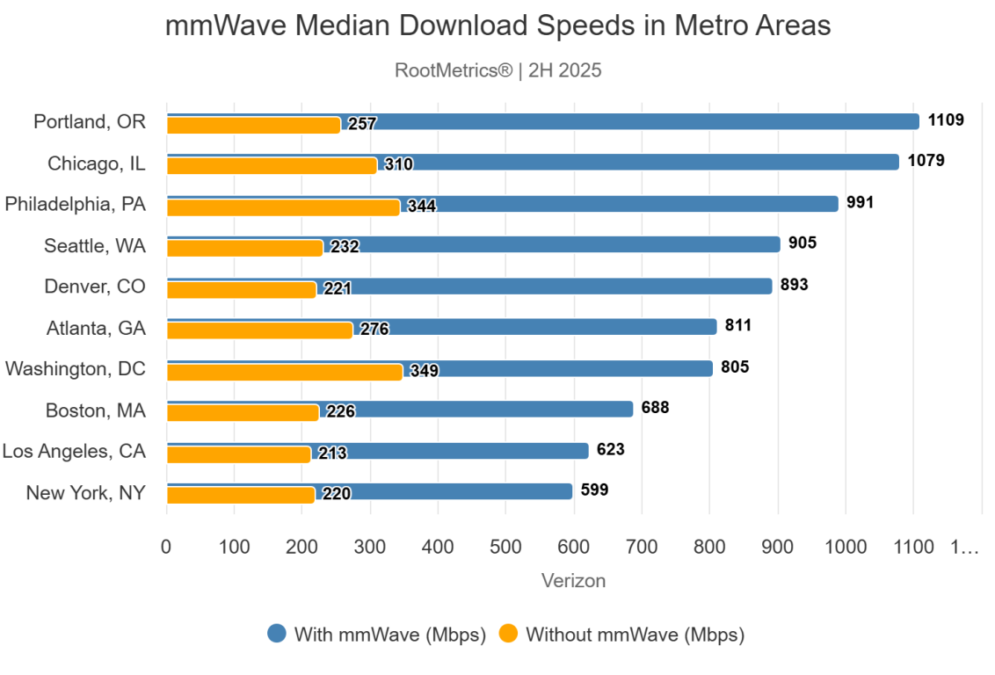
RootMetrics testing highlights that Verizon’s mmWave presence expanded significantly, with availability increasing from 75 metropolitan markets in early 2024 to 91 markets by the second half of 2025. In comparison, AT&T trails with deployments in far fewer markets, while T-Mobile has largely deprioritized mmWave.
Despite this expansion, mmWave still represents a small fraction of overall network usage. It appeared in 2.2 percent of Verizon’s test samples, compared to just 0.2 percent for AT&T, underscoring its role as a targeted capacity solution rather than a broad coverage layer, Ooka said in its report.
Exceptional Speeds Surpassing 1 Gbps
The defining strength of mmWave 5G lies in its performance. With access to massive spectrum bandwidth – often up to 800 MHz – operators can deliver extremely high data rates.
In real-world testing, mmWave connections frequently achieved download speeds exceeding 1 Gbps, far surpassing both low-band and mid-band 5G. These ultra-fast speeds make mmWave ideal for bandwidth-intensive use cases such as:
Stadiums and large venues
Dense downtown corridors
Fixed wireless access (FWA) services
High-capacity urban hotspots
Both Verizon and AT&T benefit from wide channel allocations, though Verizon’s broader deployment and use of 28 GHz spectrum provide more consistent high-speed performance.
Coverage Constraints Define User Experience
While performance is unmatched, mmWave’s biggest limitation is coverage. Due to its high-frequency spectrum, signals have very short propagation ranges and limited ability to penetrate buildings.
Most mmWave connections occur within 150 meters of a transmission site, and signals rarely extend beyond 900 meters. This sharply contrasts with mid-band spectrum, which can reach several kilometers.
Performance also drops rapidly with distance. As users move away from a small cell, speeds decline significantly, reinforcing the need for dense infrastructure deployment.
Urban Hotspots Drive mmWave Adoption
mmWave performance is most visible in major U.S. cities, where operators concentrate deployments in high-traffic areas.
Cities such as Denver, Atlanta, Philadelphia, and Boston have emerged as leading mmWave markets for Verizon, where around 60 percent of outdoor test samples connected to mmWave in dense zones. For AT&T, cities like Philadelphia, Chicago, and Los Angeles show the strongest presence, though at lower levels of penetration.
These deployments highlight a clear strategy – mmWave is not designed for blanket coverage but for targeted, high-capacity zones where network congestion is highest.
Spectrum Depth Fuels Performance Gains
The technical foundation of mmWave’s performance advantage is its access to large contiguous spectrum blocks. Unlike traditional cellular bands, which are limited to tens of MHz, mmWave deployments aggregate hundreds of MHz.
Verizon’s use of up to 800 MHz in the 28 GHz band enables multi-gigabit throughput under optimal conditions. AT&T also leverages significant spectrum holdings in the 39 GHz band, though propagation characteristics differ slightly due to higher frequency ranges.
This spectrum depth is the key reason mmWave can deliver “wireless fiber”-like performance, even if only over short distances.
Strategic Role in the 5G Ecosystem
mmWave 5G has transitioned from being the centerpiece of early 5G hype to a specialized but critical component of network strategy. Operators now position it as a complement to mid-band and low-band layers rather than a standalone solution.
The U.S. remains the global leader in mmWave deployment, even as many countries prioritize mid-band spectrum. Ongoing investments, combined with increasing device support, suggest that mmWave will continue to play a vital role in:
Enhancing peak network performance
Supporting high-density environments
Enabling next-generation applications
Conclusion: Performance Powerhouse with Targeted Impact
mmWave 5G networks in the U.S. demonstrate a clear trade-off between speed and coverage. While their reach is limited, their performance is unmatched, offering gigabit-level connectivity that few other wireless technologies can achieve.
BABURAJAN KIZHAKEDATH