

Mobile technologies and services are becoming a cornerstone of Latin America’s digital economy, generating $600 billion in economic value in 2025, equivalent to 8.6 percent of the region’s GDP. According to the latest GSMA Intelligence analysis, the mobile ecosystem supported nearly 3 million jobs, including 1.6 million direct jobs and 1.2 million indirect jobs, while contributing $50 billion in public revenues. By 2030, the sector’s economic contribution is forecast to rise to $700 billion, expanding at a 3.2 percent CAGR, supported by wider adoption of 5G, AI and IoT technologies.

5G to Account for Half of Mobile Connections by 2030
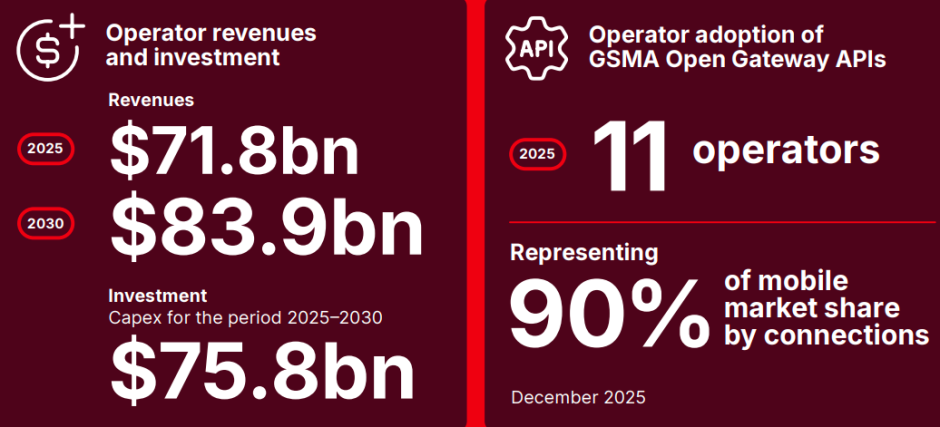
Latin America’s telecom market is entering a major investment cycle as operators expand 5G coverage and modernize digital infrastructure. Half of all mobile connections in the region are expected to be on 5G by 2030, while industry revenues are projected to increase from $71.8 billion in 2025 to $83.9 billion in 2030. To support this transition, mobile operators are expected to invest $75.8 billion in capital expenditure between 2025 and 2030, strengthening network capacity, spectrum utilization and cloud-native infrastructure.
AI Moves from Pilot Projects to Commercial Operations
Artificial intelligence has become a core operational technology for telecom operators across Latin America. Customer care represents 78 percent of all AI deployments, the highest share among global regions, with operators using AI agents, chatbots and generative AI to improve customer experience, reduce handling times and lower operating costs.
The region has also achieved one of the highest implementation rates globally, with 85 percent of AI deployments already operating in live production, compared with a global average of 66 percent. However, only 8 percent of deployments currently focus on network operations, while just 9 percent target new revenue generation, well below the 20-30 percent seen in Europe and Asia-Pacific, reflecting the region’s stronger emphasis on operational efficiency and cost optimization.
Major Telecom Operators Accelerate 5G, AI and Network Investments
Latin America’s leading telecom operators are investing aggressively in AI, automation, fiber and 5G network infrastructure to improve efficiency and prepare for next-generation digital services.
America Movil, the region’s largest telecom operator, has expanded automation across its OSS/BSS platforms, streamlining provisioning and billing operations across multiple subsidiaries. Through Claro Chile, the company has deployed generative AI-powered customer service agents, post-call analytics, automated SIM blocking for lost or stolen devices, and AI models that predict Net Promoter Score (NPS). The company reports significant reductions in customer handling times while operating AI-powered customer support 24 hours a day, seven days a week.
Telefonica Vivo Brazil is advancing autonomous networking through closed-loop automation and intent-based networking in its virtualized 5G core. The operator automatically detects and resolves physical network incidents while automating network capacity creation. During 2026, Vivo also began testing agentic AI rApps with Ericsson and Amazon Web Services (AWS), enabling engineers to manage network operations using natural language interfaces and accelerating progress toward autonomous AI-driven networks.
TIM Brasil has expanded its partnership with Nokia to upgrade its nationwide 5G network following its initial deployment in São Paulo. Nokia is supplying its latest AI-RAN-ready AirScale portfolio, designed to improve nationwide coverage, strengthen indoor connectivity, increase network scalability and reduce energy consumption through more efficient radio infrastructure.
Millicom (Tigo) continues expanding fiber broadband and 5G-ready infrastructure across markets including Colombia, Paraguay, Guatemala, Honduras, Bolivia and Panama. The company is investing in converged mobile and fixed networks while expanding digital financial services and enterprise connectivity.
Telecom Argentina (Personal) is strengthening 5G readiness, expanding fiber broadband coverage and investing in cloud-based enterprise services while integrating AI-enabled digital platforms to improve customer engagement and network performance.
Entel Chile and Entel Peru continue investing in nationwide 5G expansion, enterprise digital transformation services, cloud connectivity and IoT platforms to support industrial digitalization and business customers.
Liberty Latin America, through brands including Liberty Puerto Rico, Flow and BTC, is expanding fiber-to-the-home, mobile broadband and enterprise cloud services while modernizing networks to support higher-capacity 5G and digital applications across the Caribbean and Latin America.
Oi Brazil, following its restructuring, remains focused on expanding wholesale fiber infrastructure through V.tal, supporting broadband growth and providing fiber backhaul for mobile operators deploying advanced 5G services.
Global Cloud Providers Increase Regional Investments
Telecom network expansion is being complemented by large-scale investments from hyperscale cloud providers. Amazon Web Services (AWS) has announced a $4 billion investment in cloud infrastructure and data centers in Chile. Microsoft plans to invest approximately $1.3 billion in cloud and AI infrastructure in Mexico over the next three years, while Google is investing more than $850 million to establish a second data center in Uruguay. These projects will provide the computing infrastructure required for AI applications, enterprise digital transformation and advanced cloud services.
Mobile Connectivity to Power the Next Phase of Economic Growth
As operators continue investing $75.8 billion in network infrastructure and 5G reaches 50 percent of all mobile connections by 2030, Latin America’s telecom industry is expected to become an even stronger engine of economic growth. Combined with increasing adoption of AI, IoT, fiber broadband and cloud computing, the mobile ecosystem is projected to generate $700 billion in economic value by 2030, reinforcing its role as one of the region’s most important drivers of productivity, digital inclusion and long-term economic development.
BABURAJAN KIZHAKEDATH