

Jio Platforms, the digital and telecom business of Reliance Industries, has made a historic stock market debut on October 28, 2026, with its shares opening at a 21.36 percent premium following India’s largest initial public offering (IPO) of ₹30,213 crore.

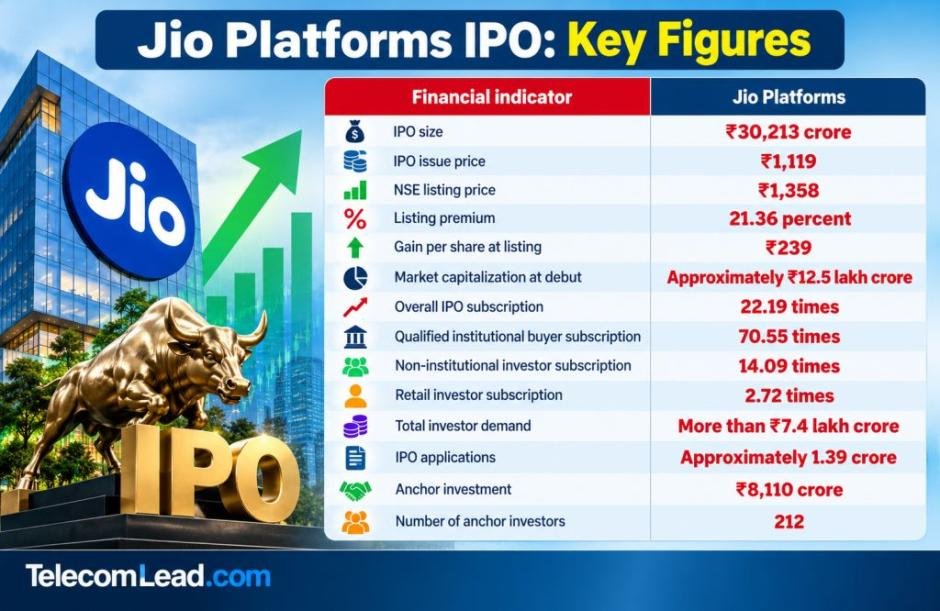
Jio Platforms shares opened at ₹1,358 on the National Stock Exchange (NSE) and Bombay Stock Exchange (BSE), compared with the IPO issue price of ₹1,119. The ₹239 increase per share reflected strong investor demand for India’s largest telecom operator and its expanding digital services business.
The listing valued Jio Platforms at approximately ₹12.5 lakh crore, making it India’s second-most valuable listed company after Reliance Industries. Jio also overtook Bharti Airtel and HDFC Bank in market capitalization.
The IPO marked Reliance Industries’ first major stock market listing in two decades and delivered the strongest debut premium among India’s five largest IPOs by issue size.
Jio IPO Attracts ₹7.4 Lakh Crore Investor Demand
Jio Platforms’ ₹30,213 crore IPO attracted bids worth more than ₹7.4 lakh crore, demonstrating substantial investor interest in India’s telecommunications and digital infrastructure market.
The IPO opened on October 21 and closed on October 23, 2026. It was fully subscribed within approximately 100 minutes of opening.
The offering was subscribed 22.19 times overall, with qualified institutional buyers leading demand at 70.55 times their allocated portion.
Non-institutional investors subscribed 14.09 times, while retail investors subscribed 2.72 times.
The IPO received approximately 1.39 crore applications, setting a new participation benchmark for India’s primary market.
Ahead of the public offering, Jio Platforms raised approximately ₹8,110 crore from 212 anchor investors.
The IPO consisted entirely of fresh equity shares. Part of the proceeds will support debt repayment at Jio’s telecom subsidiary, with the balance allocated to general corporate purposes.
Jio Platforms Revenue Rises 14.6 Percent to ₹1.47 Lakh Crore
Jio Platforms’ financial performance has strengthened investor confidence in its business model.
For the financial year ended March 2026, the company reported revenue of approximately ₹1.47 lakh crore, representing annual growth of 14.6 percent.
Net profit increased 15.1 percent to approximately ₹30,049 crore.
The telecommunications business accounted for approximately 90 percent of revenue and profit, highlighting the importance of Reliance Jio’s mobile network operations.
| Financial metric | FY2025–26 |
| Revenue | ₹1.47 lakh crore |
| Revenue growth | 14.6 percent |
| Net profit | ₹30,049 crore |
| Net profit growth | 15.1 percent |
| Telecom contribution to revenue | Approximately 90 percent |
| Telecom contribution to profit | Approximately 90 percent |
Jio’s expanding subscriber base, increasing mobile data consumption and opportunities for tariff increases are expected to remain important drivers of future earnings.
Reliance Jio Subscriber Base Crosses 533 Million
Jio Platforms’ stock market valuation is supported by the scale of its telecommunications business.
Reliance Jio had approximately 533.3 million subscribers as of June 2026, making it India’s largest mobile operator.
The company accounted for nearly 60 percent of India’s mobile data traffic, reflecting the scale of its 4G and 5G network infrastructure.
According to brokerage estimates, Jio held approximately 41.7 percent of India’s wireless subscriber market, excluding machine-to-machine connections, in August 2026.
Jio’s monthly data consumption per subscriber was approximately 27 percent higher than Airtel’s, while monthly subscriber churn stood at around 1.6 percent.
These figures indicate strong network utilization and opportunities to generate additional revenue from mobile broadband, premium 5G services and digital applications.
Jio vs Airtel: Broadband and Market Valuation
Jio’s IPO has also intensified investor comparisons with Bharti Airtel.
At its stock market debut, Jio Platforms achieved a market capitalization of approximately ₹12.5 lakh crore, compared with Airtel’s ₹12.18 lakh crore.
Jio also maintained a substantial lead in fixed broadband subscribers.
As of June 2026, Jio had approximately 28.6 million fixed broadband subscribers, compared with Airtel’s 14.7 million.
India’s home broadband penetration was estimated at approximately 21 percent, indicating considerable potential for further subscriber growth.
Jio is positioned to benefit from expanding demand for fiber broadband, 5G fixed wireless access, connected homes and enterprise connectivity.
Jio’s 5G Investment Cycle Creates Opportunities for Higher Cash Flow
One important factor supporting Jio Platforms’ investment outlook is the expected moderation in capital expenditure following its nationwide 5G deployment.
Brokerage Nomura estimates that Jio’s capital expenditure declined to approximately 23 percent of revenue in FY2026 from 35 percent in FY2025.
Lower capital expenditure intensity could improve free cash flow generation as the company monetizes its existing network infrastructure.
Jio’s net debt-to-equity ratio, including deferred payment obligations, declined from 0.56 times in FY2024 to 0.37 times in FY2026.
Nomura expects Jio Platforms to become net debt-free by FY2029.
However, future investments in network expansion, spectrum, artificial intelligence, cloud infrastructure and enterprise services could influence the company’s capital requirements.
Jio Platforms Expands Beyond Telecom into AI and Cloud
Jio Platforms is seeking to establish itself as a broader digital technology company rather than relying exclusively on mobile connectivity.
Its business portfolio includes mobile broadband, fixed broadband, digital entertainment, enterprise networking, cloud computing and artificial intelligence.
The company is also developing technologies related to 5G and 6G radio networks, telecom core infrastructure, satellite communications and agentic AI through its JioBrain initiative.
These investments could create new revenue opportunities in enterprise technology, cloud services, AI applications and digital infrastructure.
Jio’s large consumer base provides a distribution advantage for launching new digital services.
However, telecom remains the dominant contributor to current revenue and earnings. Investors will therefore be watching whether newer technology businesses can generate meaningful financial returns.
Nomura, Motilal Oswal and Elara Capital Initiate Buy Ratings
Several brokerages initiated coverage of Jio Platforms following its IPO.
| Brokerage | Rating | Share price target |
| Nomura | Buy | ₹1,340 |
| Motilal Oswal | Buy | ₹1,350 |
| Elara Capital | Buy | ₹1,367 |
Nomura highlighted Jio’s leadership in wireless subscribers, mobile data traffic and home broadband.
The brokerage identified potential telecom tariff increases, premium 5G services and higher average revenue per user (ARPU) as important earnings drivers.
Motilal Oswal emphasized Jio’s role in transforming India’s telecom market from voice-centric services to mobile data consumption.
Elara Capital highlighted the company’s transition toward a digital platform business supported by integrated technology infrastructure.
However, all three published price targets were below Jio’s ₹1,358 opening price, except Elara Capital’s ₹1,367 target.
This indicates that the strong listing premium had already incorporated much of the near-term upside implied by those valuations.
Meta, Google and Global Investors Back Jio Platforms
Jio Platforms has attracted substantial investment from global technology and financial institutions.
Meta holds approximately 9.9 percent of Jio Platforms, while Google owns approximately 7.7 percent.
Other investors include KKR and international investment funds.
In 2020, Jio Platforms raised more than $20.5 billion from 13 investors, helping finance its digital infrastructure expansion and strengthen its balance sheet.
Reliance Industries continues to retain majority ownership of Jio Platforms following the IPO.
The presence of major international investors reflects confidence in the long-term opportunities presented by India’s telecommunications, cloud computing and digital services markets.
What Will Drive Jio Platforms Share Price After IPO?
Following its 21.36 percent listing premium, Jio Platforms’ future stock market performance will depend increasingly on revenue growth, profitability, cash flow and returns from new technology investments.
The company’s immediate growth opportunities include mobile tariff increases, higher ARPU, subscriber additions, fixed broadband expansion and monetization of its nationwide 5G infrastructure.
Longer-term opportunities include enterprise connectivity, cloud computing, AI platforms and digital services.
However, competition from Bharti Airtel, Vodafone Idea and BSNL, regulatory obligations, spectrum costs and future capital expenditure requirements remain important considerations.
Jio Platforms’ ₹30,213 crore IPO and ₹12.5 lakh crore debut valuation establish a new benchmark for India’s telecom and digital technology sector. The next test will be whether its more than 533 million subscribers and expanding digital services portfolio can deliver earnings growth sufficient to support its premium market valuation.
BABURAJAN KIZHAKEDATH