

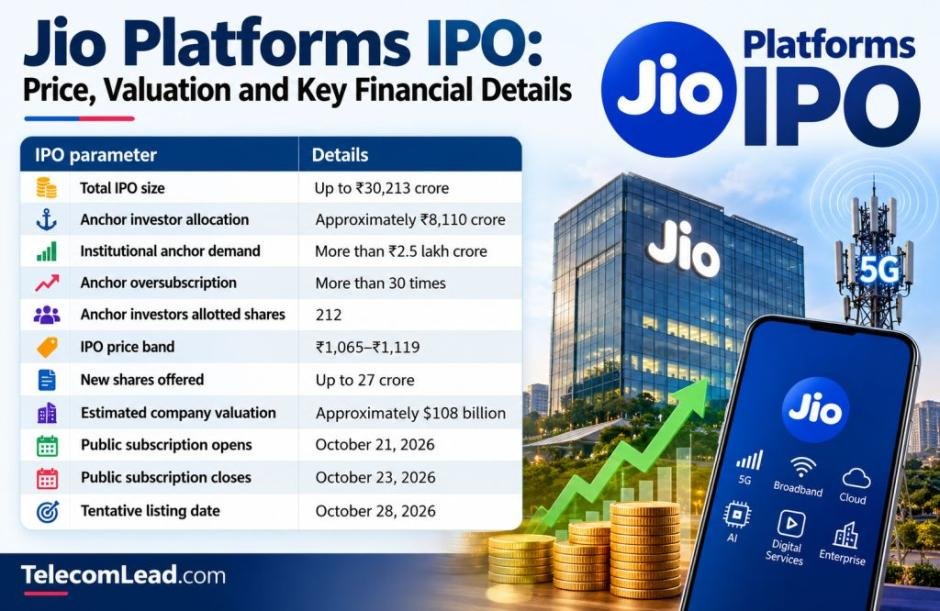
Jio Platforms’ ₹30,213 crore initial public offering (IPO), expected to become India’s largest-ever public issue, has attracted institutional bids exceeding ₹2.5 lakh crore for its anchor investor allocation, representing more than 30 times the shares available.

Global investment firms BlackRock, Fidelity, Singapore’s GIC and Abu Dhabi Investment Authority (ADIA) were among the institutions seeking exposure to Reliance Industries’ telecom and digital services subsidiary, Reuters news report said.
The overwhelming institutional demand comes ahead of the public subscription opening on October 21, 2026. Jio Platforms has fixed its IPO price band at ₹1,065–₹1,119 per share, targeting a valuation of approximately $108 billion.
The offering provides investors with direct exposure to India’s largest mobile operator by subscriber base and its expanding businesses in broadband, cloud computing, artificial intelligence and enterprise digital services.
Jio IPO Anchor Book Receives More Than 30 Times Demand
Jio Platforms allocated approximately ₹8,110 crore worth of shares to anchor investors on October 19, 2026, following exceptionally strong institutional demand.
According to the stock exchange filing, the company allotted 7.247 crore equity shares at ₹1,119 each, the upper end of the IPO price band, to 212 anchor investors.
Institutional bids exceeded ₹2.5 lakh crore, significantly surpassing the shares available under the anchor allocation.
The demand represents one of the largest institutional responses to an Indian public offering, reflecting interest in Jio’s telecom subscriber base, digital infrastructure and potential revenue opportunities beyond traditional mobile connectivity.
Anchor investors receive their allocations before the public subscription period, providing an early indication of institutional demand. However, oversubscription in this category does not automatically guarantee similar demand from retail investors or strong performance after listing.
BlackRock, Fidelity, GIC and ADIA Among Major Jio IPO Investors
Jio Platforms attracted participation from leading international asset managers, sovereign wealth funds, Indian mutual funds and insurance companies.
Prominent global institutions participating in the anchor book included BlackRock, Fidelity Investments, Capital Group, T. Rowe Price, JPMorgan Asset Management, Franklin Templeton, Schroders and Janus Henderson.
Sovereign wealth funds and government-backed investment institutions included Singapore’s GIC, Abu Dhabi Investment Authority, Qatar Investment Authority and Norway’s Norges Bank Investment Management.
Domestic institutional participation included Life Insurance Corporation of India (LIC), SBI Mutual Fund, ICICI Prudential Mutual Fund, HDFC Mutual Fund and other major investment managers.
LIC received the largest reported anchor allocation of approximately ₹500 crore, followed by New World Fund at ₹486 crore and the Government of Singapore at ₹341 crore.
Indian mutual funds received approximately ₹2,785 crore across 95 schemes managed by 25 fund houses, representing 34.34 percent of the anchor book.
Insurance companies and pension funds received approximately ₹1,090 crore, accounting for 13.44 percent of the allocation.
The IPO is expected to exceed the ₹27,800 crore public offering of Hyundai Motor India in October 2024, previously India’s largest IPO.
Jio’s offering also marks a major capital-market milestone for Reliance Industries, whose last group IPO was Reliance Petroleum in 2006.
Jio Plans to Use IPO Proceeds for Telecom Debt Repayment
A substantial portion of the IPO proceeds is expected to strengthen the balance sheet of Reliance Jio Infocomm, the telecom subsidiary operating Jio’s mobile and broadband networks.
Jio Platforms plans to allocate up to ₹27,500 crore from net proceeds toward repayment or prepayment of borrowings at Reliance Jio Infocomm.
The remaining proceeds will support general corporate purposes.
Reducing debt could improve Jio’s financial flexibility as the operator continues investing in 5G network capacity, fiber broadband, digital platforms and emerging technologies.
The transaction also creates a separately listed entity for Reliance’s telecom and digital businesses while allowing Reliance Industries to retain majority ownership.
Jio’s 533 Million Subscribers Support Its IPO Valuation
Jio Platforms enters the public market with a substantial position in India’s telecom industry.
The company reported approximately 533.3 million subscribers as of June 2026 and accounted for nearly 60 percent of India’s mobile data traffic, according to reported company figures.
Since launching commercial mobile services in 2016, Jio has expanded its business through aggressive network investment, affordable data services and nationwide digital infrastructure.
Its principal competitors include Bharti Airtel, Vodafone Idea and state-owned BSNL.
However, Jio Platforms extends beyond mobile telecommunications. Its businesses encompass fixed broadband, digital entertainment, cloud services, enterprise technology and artificial intelligence.
This diversification is important to its valuation because investors are evaluating the company not only as a telecom operator but also as a broader digital infrastructure and technology platform.
Cloud, AI and Enterprise Services Could Influence Jio’s Growth
Jio’s expansion into cloud computing and artificial intelligence provides additional areas for investors to assess its long-term revenue potential.
The company can use its existing telecom network, fiber infrastructure, customer relationships and digital platforms to support new services for enterprises and consumers.
Enterprise connectivity, cloud infrastructure, digital applications and AI-enabled services offer opportunities to diversify revenue beyond mobile subscriptions.
Nevertheless, these opportunities involve significant infrastructure investment, technology development and competition from established domestic and international technology providers.
Investors will need to assess whether Jio can convert its infrastructure scale and customer reach into sustainable revenue growth and profitability.
Jio IPO Could Become a Major Benchmark for India’s Telecom Sector
The proposed listing creates an opportunity for public-market investors to value Jio Platforms independently from Reliance Industries’ energy, retail and other businesses.
At an estimated valuation of $108 billion, Jio would rank among India’s largest listed companies by market capitalization.
The offering could also provide a new valuation reference for India’s telecom industry, particularly as operators seek to improve average revenue per user, expand broadband connections and monetize 5G investments.
For Bharti Airtel and Vodafone Idea, Jio’s market valuation may influence how investors compare subscriber growth, revenue generation, capital expenditure and returns on network investment across operators.
However, differences in profitability, debt, ownership structures and business diversification mean that market capitalizations alone cannot establish which telecom company offers the strongest financial performance.
Retail Subscription and Listing Performance Are the Next Tests
Following the strong anchor investor response, attention now shifts to the public subscription period from October 21 to October 23.
The next indicators will include demand from qualified institutional buyers, non-institutional investors, retail investors and eligible shareholders.
Investors will also monitor the final issue subscription, allotment and trading performance when Jio Platforms is scheduled to list on October 28, subject to the final timetable.
The ₹2.5 lakh crore anchor demand demonstrates substantial institutional appetite for Jio Platforms. Whether that demand translates into a successful public offering and sustained market valuation will depend on investor confidence in Jio’s telecom earnings, debt reduction, network investment strategy and ability to generate additional revenue from cloud, AI and digital services.
BABURAJAN KIZHAKEDATH