

Deutsche Telekom reported a 2.9 percent increase in revenue to €119.1 billion in 2025, supported by strong momentum in the United States and continued fiber expansion in Germany. In the fourth quarter of 2025, revenue rose 2.5 percent to €31.72 billion.

Adjusted net profit increased 3.7 percent to €9.7 billion in 2025.
Capital expenditure climbed 5.6 percent to €16.864 billion in 2025, while Q4 Capex surged 15.8 percent to €4.65 billion, reflecting investments in 5G and fiber networks. Deutsche Telekom is aiming for Capex of €17 billion in 2026 and a decrease in 2027.
In 2025, Deutsche Telekom’s Capex was €4.9 billion in Germany, €10.7 billion in the United States and €2 billion in Europe. In Germany, Deutsche Telekom’s Capex will grow slightly in 2026 and 2027. In the United States, Deutsche Telekom’s Capex will decrease in 2026 and 2027. In Europe, Deutsche Telekom’s Capex will be stable in 2026 and 2027.
“We have extended our network leadership, are improving all areas of our business through the systematic integration of artificial intelligence, and remain on course for success,” said Tim Hottges, CEO of Deutsche Telekom.
Deutsche Telekom AI and Digital Progress
Deutsche Telekom is on track to achieve its €0.8 billion DT ex US efficiency target from AI and automation initiatives outlined at its 2024 Capital Markets Day. The target includes €0.7 billion from AI and automation and €0.1 billion from network scaling.
In 2025, the company significantly expanded its AI ecosystem through partnerships with Perplexity, ElevenLabs, and Picsart, introducing AI-powered podcast features and advanced image editing capabilities for customers.
On the consumer side, digital engagement continues to grow:
Over 17.4 million users across its apps
Magenta Moments reaching about 5.8 million monthly active users
OneTV growing to around 6.6 million customers
T-Life app surpassing 100 million installs with approximately 24 million monthly active users
73 percent of postpaid phone upgrades completed digitally, mostly unassisted
Introduction of AI-based “live translate” in the T-Mobile network
In digital infrastructure, Deutsche Telekom partnered with NVIDIA to launch one of Europe’s largest AI factories within six months, strengthening AI capabilities and digital sovereignty. The company also expanded its digital healthcare portfolio through the acquisition of Synedra and appointed a dedicated Healthcare COO.
Internally, AI adoption is accelerating:
The AI knowledge bot “askT” answered 5 million requests in Germany in Q4
Introduction of an “AI toolbelt” to redesign workflows and drive internal AI usage
More than 5,000 employees use AI coding assistants, boosting engineering capacity by around 8 percent, with about 22 percent of code AI-generated
In network and operations:
Launch of “RAN Guardian,” the world’s first AI agent to enhance customer experience and enable self-healing networks
100 percent AI-based quality control in fiber rollout in Germany
40 percent of fiber installation appointments in Q4 scheduled via voice bot
Customer service automation also expanded:
AI-driven “FragMagenta” voice and chat solutions deflected 3.4 million calls in 2025
AI tools rolled out to service agents, including automated briefings, chatbot support and call summaries, with more than 1,400 agents live by December
Germany: Fiber Momentum Offsets Broadband Stagnation
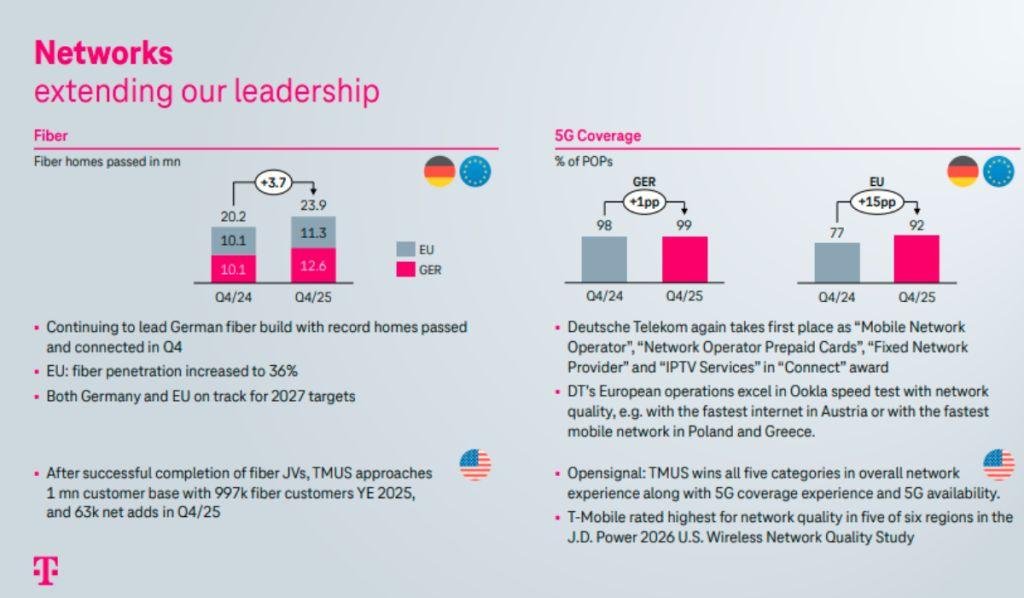
Revenue in Germany declined marginally by 0.4 percent to €25.61 billion in 2025. However, Deutsche Telekom accelerated its FTTH rollout, expanding coverage to 12.6 million homes passed. More than 2 million households are now connected via direct fiber, including 584,000 additions during 2025.
The broader broadband market remained largely stagnant. Deutsche Telekom lost 49,000 broadband lines during the year and added just 2,000 in Q4.
In mobile, service revenues in Germany increased 2.4 percent in Q4, maintaining market leadership. Branded contract customer additions reached 282,000 in the fourth quarter and exceeded 1 million for the full year.
Operational data shows steady mobile growth but continued fixed-line erosion:
Mobile customers rose 8.7 percent to 74,490 thousand.
Contract mobile customers increased by 1,208 thousand to 27,740 thousand.
Fixed-network lines declined 2.1 percent to 16,796 thousand.
Broadband lines edged down by 49 thousand to 15,103 thousand.
Optical fiber customers increased by 157 thousand to 13,370 thousand.
TV customers grew by 109 thousand to 4,747 thousand.
Unbundled local loop lines dropped 18.3 percent to 1,541 thousand.
Germany demonstrated strong mobile and fiber traction, while legacy copper-based services continued to decline.
United States: T-Mobile US Powers Group Growth
T-Mobile US remained the primary growth engine. Revenue increased 4.1 percent to €78.097 billion in 2025.
T-Mobile US added 2.4 million postpaid customers in Q4 and 7.8 million for the full year. High value postpaid phone customers increased by 962,000 in the fourth quarter and by 3.3 million across 2025.
The 5G Home Internet service reached 8.5 million households and is projected to grow to 15 million by 2030.
Customer metrics highlight strong expansion:
Total customers increased 9.9 percent to 142,388 thousand.
Postpaid customers surged 11.8 percent to 116,445 thousand.
Prepaid customers grew 2.1 percent to 25,943 thousand.
Postpaid growth continued to reinforce premium revenue expansion and profitability in the US market.
Europe: Mixed Trends After Portfolio Changes
Revenue in Europe increased 2.5 percent to €12.65 billion in 2025. Organic contract mobile additions totaled 236,000 in Q4. However, the total customer base declined by 1.9 million to 25.6 million due to the sale of the Romanian mobile business effective October 1, 2025.
Broadband customers increased by 77,000 in Q4, while TV customers rose by 50,000.
Segment data indicates mixed performance:
Mobile customers declined 5.1 percent to 47,172 thousand.
Contract mobile customers fell 4.6 percent to 25,590 thousand.
Fixed-network lines decreased slightly to 8,023 thousand.
Broadband customers rose 3.1 percent to 7,395 thousand.
TV customers increased 1.3 percent to 4,468 thousand.
While mobile weakened due to portfolio changes, broadband and TV services showed resilience.
T-Systems: Strong Order Growth
T-Systems closed 2025 with strong momentum. Order entry increased 4.2 percent year-on-year to €4.2 billion. Total revenue in the Systems Solutions segment rose 2.5 percent to €4.1 billion, reflecting growing demand for digital transformation and enterprise IT services.
Outlook
Deutsche Telekom’s 2025 results underline a strategy focused on network leadership, fiber rollout, AI integration, and premium mobile growth. Strong US performance and expanding fiber adoption in Germany remain central to sustaining revenue and profit growth, while Europe continues to adjust following portfolio optimization.
BABURAJAN KIZHAKEDATH