

Connected vehicles are emerging as a recurring revenue opportunity for telecom operators and automakers, driven by embedded SIM connectivity, vehicle software subscriptions, fleet management, over-the-air updates and connected safety services.

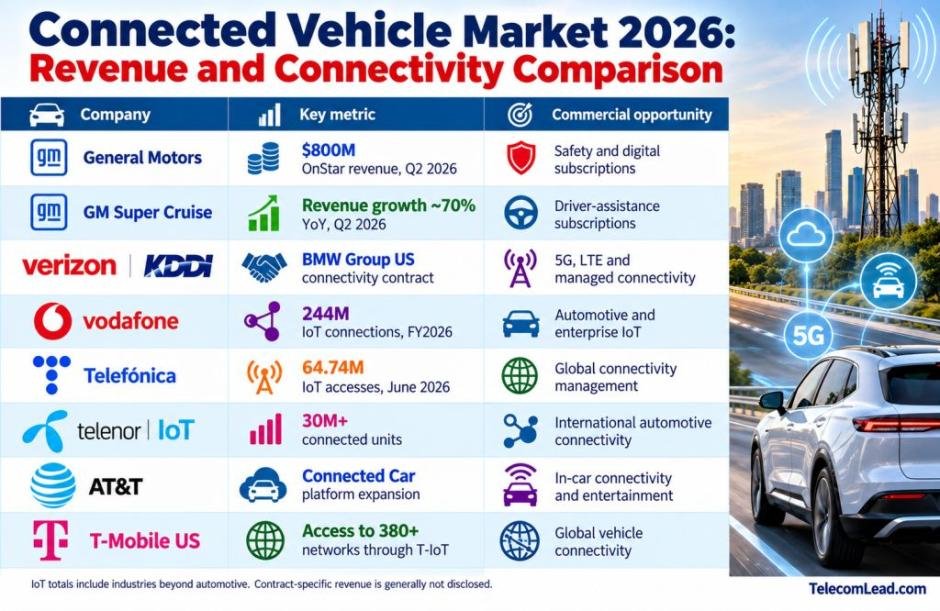
General Motors expects more than $3 billion in OnStar revenue during 2026, while Vodafone manages 244 million IoT connections and Telefónica serves nearly 65 million IoT accesses across industries.
According to Omdia’s September 2026 connected-vehicle forecast, the global installed base of connected vehicles is projected to increase from 473.7 million in 2025 to more than 1.05 billion by 2035.
The expansion creates opportunities for telecom operators to generate revenue throughout a vehicle’s operating life rather than only when it is manufactured.
General Motors: OnStar Revenue Heads Toward $3 Billion
General Motors provides one of the clearest examples of connected-vehicle monetization.
GM reported $800 million in recognized OnStar revenue during Q2 2026, increasing more than 20 percent year over year.
Deferred revenue reached $6.3 billion, increasing nearly 50 percent. This represents revenue to be recognized over future periods as contracted services are delivered, rather than additional revenue earned in the quarter.
GM expects more than $3 billion in realized OnStar revenue during 2026 and approximately one million additional subscribers, taking its subscriber base toward 13 million.
The company’s Super Cruise driver-assistance business also expanded.
Super Cruise revenue increased approximately 70 percent year over year, while the service added around 70,000 subscribers during Q2.
GM reported a 30–40 percent attachment rate after the initial three-year prepaid subscription period.
OnStar served more than 12 million global subscribers across 22 markets by September 2026.
These figures demonstrate how automakers can generate recurring income from connected safety, assistance and software-enabled services after vehicle delivery.
The financial details are available in GM’s Q2 2026 earnings presentation.
Verizon and KDDI: BMW Contract Creates Long-Term Connectivity Opportunity
Verizon Business secured an agreement in July 2026 to provide US connectivity for newly manufactured BMW Group vehicles through a partnership with KDDI.
The arrangement supports BMW, MINI and other BMW Group vehicles using Verizon’s 5G standalone and LTE networks.
KDDI provides its Global Communications Platform, enabling international connectivity management.
The services support BMW ConnectedDrive, telematics, remote diagnostics and connected digital functions.
The commercial structure illustrates how telecom operators can participate in the automotive value chain through network access and managed connectivity.
For example, a hypothetical contract covering one million vehicles at $2 monthly connectivity revenue per vehicle would generate $24 million in annual revenue.
At $4 monthly, the same installed base would generate $48 million annually.
These are illustrative calculations, not disclosed BMW, Verizon or KDDI contract values.
Neither the operator nor the automaker has publicly disclosed a specific annual revenue contribution or connected-vehicle volume for this agreement.
Vodafone and Geely: Automotive Connectivity Meets Cloud Services
Vodafone Business expanded its partnership with Geely Technology Europe in June 2026.
The collaboration covers Internet in the Car, Mobile Private Networks and Cloud Connect.
These technologies support vehicle diagnostics, software updates, secure data transfers and communication between vehicles and cloud platforms.
Vodafone reported 244 million IoT connections in FY2026, adding 9.5 million connections during the year.
Automotive demand contributed to growth, although Vodafone’s IoT base also includes industrial, enterprise and other connected devices.
The partnership creates opportunities beyond basic SIM connectivity.
For example, automakers may require managed connectivity for vehicle manufacturing facilities, secure cloud access for software updates and international network services for vehicles operating across borders.
These services can generate multiple enterprise revenue streams from the same automotive customer.
Telefónica and Thales: 64.7 Million IoT Connections Support Global eSIM Services
Telefónica Tech and Thales announced a multi-operator IoT eSIM solution in July 2026, using the GSMA SGP.32 standard.
The solution integrates with Telefónica’s Kite managed connectivity platform, enabling enterprises to provision and manage operator profiles across markets.
Telefónica reported 64.739 million IoT accesses at June 30, 2026, compared with 44.052 million a year earlier.
That represents approximately 46.9 percent annual growth.
The expansion demonstrates the scale of demand for managed connectivity, although the figures are not limited to vehicles.
For automakers, global eSIM management can simplify connectivity provisioning across manufacturing markets and vehicle destinations.
It can also reduce dependence on manually replacing SIM cards when connectivity arrangements change.
Telenor IoT: 30 Million Connected Units Across Global Markets
Telenor IoT reported more than 30 million connected units worldwide in February 2026.
Its IoT Drive automotive platform supports deployments in more than 190 countries and territories.
Telenor says it provides connectivity for the overseas operations of eight of China’s 10 largest automotive manufacturers.
The business model combines international mobile connectivity, SIM management and lifecycle services.
Automakers benefit from centralized connectivity management, while telecom providers can earn recurring revenue from vehicles operating over multiple years.
Telenor’s IoT Drive automotive connectivity platform illustrates the importance of international network partnerships in connected-vehicle deployments.
AT&T: Connected Car Platform Adds Entertainment and Billing Services
AT&T expanded its Connected Car platform in June 2026 through collaborations involving Cisco and LiveOne.
The initiative combines mobile connectivity, billing capabilities and in-car entertainment services.
Selected vehicles can access Slacker Radio through the platform.
For AT&T, the opportunity extends beyond wholesale automotive connectivity to digital service integration and customer billing.
Automakers can use the platform to introduce additional paid features without building every connectivity and payment component independently.
AT&T has not disclosed separate 2026 revenue attributable to the announced platform expansion.
T-Mobile: Global Automotive Connectivity Across 380 Networks
T-Mobile US is targeting software-defined vehicles through its connected-vehicle and T-IoT offerings.
The platform provides access to more than 380 networks globally, supporting international connectivity requirements.
Potential applications include vehicle diagnostics, software updates, fleet monitoring and connected infotainment.
T-Mobile’s business opportunity includes connectivity management and enterprise services for automotive manufacturers and mobility providers.
However, the company has not disclosed separate automotive revenue or a vehicle subscription count for the offering.
Connected Vehicle Subscription Economics: Revenue per Vehicle
Telecom operators and automakers can monetize connected vehicles through different commercial models.
| Monthly revenue per vehicle | 1M connected vehicles | 10M connected vehicles |
| $1 | $12M annually | $120M annually |
| $3 | $36M annually | $360M annually |
| $5 | $60M annually | $600M annually |
| $10 | $120M annually | $1.2B annually |
These scenarios represent gross recurring revenue before network costs, platform fees, customer acquisition expenses, taxes and revenue sharing.
They do not represent reported automotive connectivity tariffs.
The commercial value depends on whether the telecom operator supplies basic connectivity, a managed platform or a wider bundle of digital services.
What Will Drive Connected Vehicle Revenue Through 2035?
Three business models are becoming important.
Embedded connectivity: Automakers purchase managed cellular access to support telematics, diagnostics and connected vehicle functions.
Paid digital services: Automakers monetize safety features, driver assistance, entertainment and software subscriptions.
Connectivity platforms: Telecom operators generate enterprise revenue from eSIM management, cloud integration, security and international network access.
The projected expansion beyond one billion connected vehicles by 2035 creates a substantial addressable market.
However, connected-vehicle growth does not automatically translate into high telecom revenue per vehicle. Wholesale connectivity pricing, automaker bargaining power and platform competition can limit margins.
GM’s OnStar results demonstrate the scale of automotive digital-service revenue, while Verizon, Vodafone, Telefónica, Telenor, AT&T and T-Mobile are positioning themselves to supply the connectivity and management platforms behind those services.
For telecom operators, the key performance indicators will be connected vehicles under contract, monthly revenue per vehicle, contract duration, platform-service revenue and operating margin.
FASNA SHABEER