

Telecom operators are moving from rule-based network automation to AI-driven autonomous operations, with Level 4 deployments emerging across RAN, core, transport and service assurance in 2026.

Telecom operators are moving beyond conventional network automation as AI agents, closed-loop systems, digital twins and intent-driven operations begin to detect problems, diagnose root causes, make decisions and execute network actions with limited human intervention.
TM Forum says 75 percent of operators plan to increase autonomous-network investment, while 81 percent target Level 4 or above by 2030. Around 20 percent expect to reach Level 4 or above by 2027.
The transition is important because Level 4 represents much more than automated scripts. Networks increasingly interpret operational intent, predict problems and execute corrective actions within predefined policies.
The industry’s progression is therefore moving from automation to AI-assisted operations, closed-loop remediation and agentic autonomy.
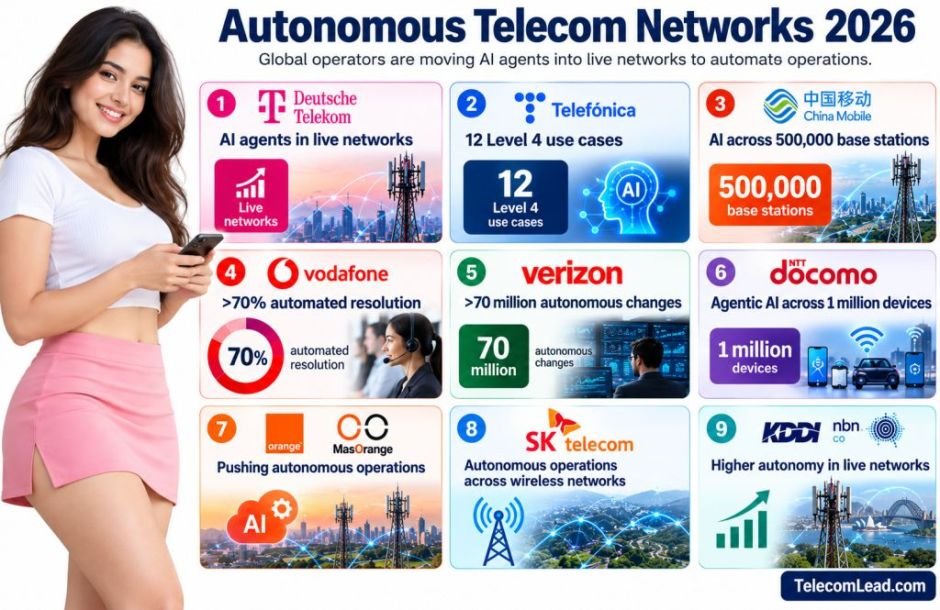
Deutsche Telekom Moves AI Agents into Live Networks
Deutsche Telekom is one of the clearest examples of operators applying autonomous technologies to live mobile networks.
Its RAN Guardian Agent has autonomously triggered more than 100 remediation actions and reduced the time required to manage major network events from hours to around one minute, an improvement of more than 95 percent.
The system identified 237,000 events in 2026. During Germany’s February carnival season, it monitored 611 mobile sites supporting around 130 major events and parades and automatically optimized sites experiencing peak loads.
Deutsche Telekom is extending the approach through MINDR, a multi-agent system designed to diagnose and resolve problems across network domains.
The initiative demonstrates how AI agents are changing telecom network operations from human-led troubleshooting toward machine-led detection and remediation.
Telefonica Reaches 12 Level 4 Use Cases
Telefonica has moved Level 4 autonomy beyond isolated trials.
The operator finished 2025 with 12 operational Level 4 use cases across Spain, Brazil and Germany. Applications include autonomous 5G Core operations, IP-network fault resolution, fiber-capacity planning, software changes and multi-domain 4G/5G customer-impact correlation.
Telefonica also has more than 400 AI and automation use cases in production.
Its roadmap targets an average autonomy level of 3.75 by 2028 and Level 4 by 2030, making Telefonica’s Autonomous Network Journey one of the industry’s largest structured programs.
China Mobile Scales AI Across 500,000 Base Stations
China Mobile is applying autonomous-network intelligence across an enormous infrastructure footprint.
Its Network Graph Model, developed with ZTE, has achieved more than 90 percent root-cause analysis accuracy and reduced mean time to repair by 20 percent.
Deployment is expanding across 10 provinces and 12 cities, covering more than 500,000 base stations in 2026.
The system combines knowledge graphs, large language models and multi-agent collaboration to automate network analysis and operational decision-making.
China Mobile is also working on AI-agent communication and cross-domain coordination as the operator pushes Level 4 capabilities from individual scenarios toward broader network operations.
Vodafone Automates More Than 70% of Resolution
Vodafone’s FY26 results demonstrate the operational impact of AI-driven automation.
Its Zero Touch Operation platform combines generative AI with real-time diagnostics to achieve more than 70 percent automated resolution.
Vodafone’s SuperTOBi platform has also achieved more than 70 percent end-to-end resolution, while centralized network management has contributed to a 76 percent reduction in cost per Mbps.
The results illustrate an important change in telecom automation: AI is moving from producing recommendations for engineers to participating directly in operational workflows.
Verizon Executes More Than 70 Million Autonomous Changes
Verizon provides another example of automation operating at very large scale.
Its automation platforms have executed more than 70 million network configuration changes autonomously.
Verizon is now pursuing Level 4 cognitive automation in which AI systems identify anomalies, determine probable root causes and execute corrective actions.
The operator has also developed a large telecom digital twin as part of its strategy to move toward Level 4 autonomy across its wireless infrastructure. TM Forum highlighted Verizon’s work on using a digital twin to support Level 4 operations at DTW Ignite 2026.
NTT DOCOMO Uses Agentic AI Across One Million Devices
NTT DOCOMO has brought agentic AI into commercial network maintenance.
Its platform analyzes traffic and alarm information from more than one million network devices, including base stations and core-network equipment.
DOCOMO said the technology reduced response time for complex failures by more than 50 percent.
The deployment demonstrates the potential for agentic AI in telecom networks to analyze huge volumes of operational data before automatically coordinating troubleshooting activities.
Orange and MasOrange Push Autonomous Operations
Orange is also shifting routine network operations toward AI-supported autonomous processes.
Its strategy is designed to allow network engineers to concentrate on complex problems while AI copilots and agents handle more routine operational activities.
MasOrange provides an even more advanced deployment example. The Spanish operator deployed a large-scale commercial AI-assisted autonomous network in Alicante and Valencia, with the implementation assessed at Level 4. The deployment focuses on automated network operation, service stability and customer experience.
This is significant because Level 4 deployments are no longer concentrated only in Asian telecom markets or laboratory environments.
SK Telecom Targets Autonomous Operations Across Wireless Networks
SK Telecom is making autonomous network operations part of its broader AI Native strategy.
The Korean operator plans to move from human-centered network operations toward AI-driven systems covering wireless quality management, traffic control, network equipment and facilities operations.
SK Telecom’s 2026 network architecture also includes AI-assisted orchestration for anomaly detection, pattern recognition, fault prediction, diagnosis, decision-making and automated execution.
Its longer-term target is TM Forum Autonomous Network Level 4 by 2030.
SK Telecom is additionally leading Korea’s Hyper-AI Network Infrastructure Demonstration Project. The program will build AI-RAN pilot networks and test network autonomy, orchestration and distributed AI computing for applications including autonomous transport, industrial monitoring and robotics through 2027.
KDDI and NBN Co Demonstrate Higher Autonomy
KDDI has demonstrated AI-driven optimization in the live RAN.
An AI uplink optimization field trial improved 4G uplink throughput by 9.6 percent and 5G throughput by 3.1 percent, despite 10 percent higher uplink traffic. The use case achieved an autonomy assessment of Level 3.86, putting it close to Level 4.
NBN Co and Ericsson, meanwhile, achieved an Australia-first TM Forum Level 4 autonomy validation for service assurance.
The AI agent could translate service intent into executable tasks, predict degradation, determine root causes and execute mitigation without human intervention during the standard operational workflow.
Digital Twins Become the Next Building Block
Digital twins are emerging as another foundation for autonomous networks.
A September 2026 TM Forum survey of 128 communications service providers found that 72 percent plan to use digital twins to enable autonomous networks and agentic AI, while 13 percent already use them.
Digital twins give AI systems a virtual representation of network conditions, allowing operators to predict the impact of configuration changes before implementing them in live infrastructure.
They could become critical to Level 4 autonomous network deployment because operators need safeguards before allowing AI agents to make increasingly consequential network decisions.
Telecom Networks Are Moving Beyond Automation
The evidence from 2026 shows that autonomous networking is no longer primarily a research concept.
Deutsche Telekom, Telefonica, China Mobile, Vodafone, Verizon, NTT DOCOMO, Orange, MasOrange, SK Telecom, KDDI and NBN Co are applying AI to network optimization, fault management, service assurance, traffic control and configuration.
However, most operators have not reached Level 4 across their entire networks. Instead, Level 4 is emerging use case by use case and domain by domain.
The next major step will be connecting autonomous RAN, core, transport, cloud and service-assurance systems. That transition from isolated closed loops to cross-domain AI agents capable of coordinating network-wide decisions will determine how quickly telecom operators move from highly automated networks to genuinely autonomous networks.
FASNA SHABEER