

AT&T delivered solid performance in Q1 2026, with growth across revenue, subscribers, broadband, fiber, and 5G, supported by its investment-led strategy and continued network expansion.

John Stankey, AT&T Chairman and CEO, said: “We’re uniquely positioned to deliver more of what customers want — fiber and 5G all from one provider on the nation’s largest advanced converged network, backed by the AT&T Guarantee.”
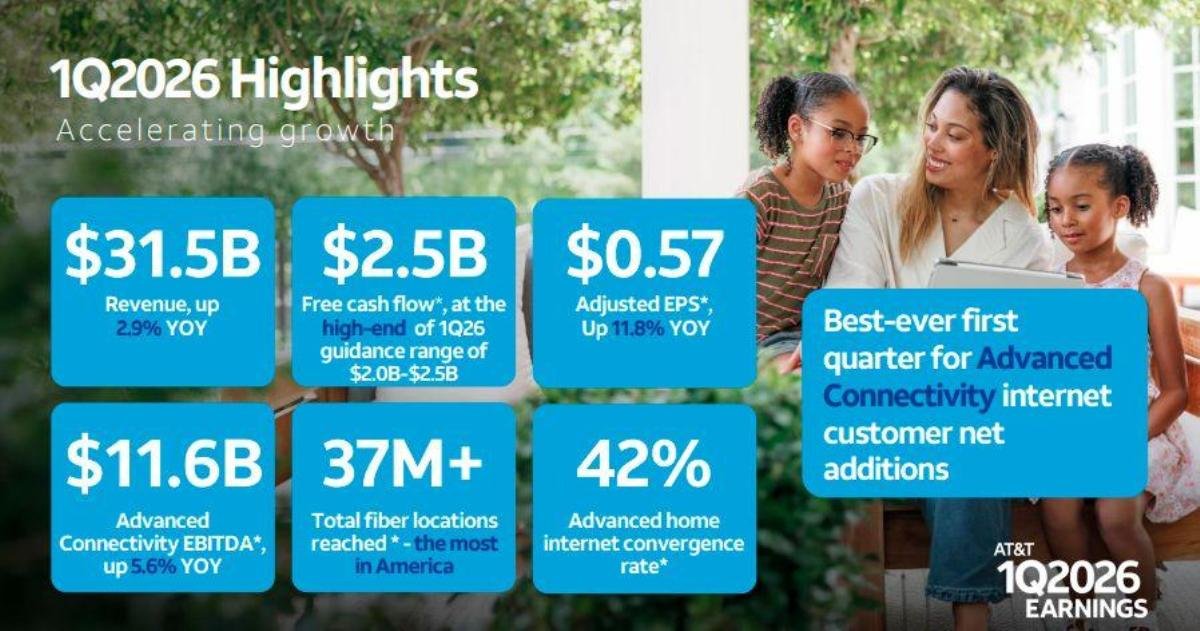
Revenue rose to $31.5 billion, increasing 2.9 percent year-on-year, driven primarily by wireless and fiber services. Advanced Connectivity service revenue reached $22.9 billion, up 3.6 percent, highlighting strong demand for bundled broadband and mobility offerings.
Subscriber growth remained robust, with 584,000 internet net additions, including 292,000 fiber and 292,000 fixed wireless users. AT&T also added 294,000 postpaid phone subscribers, reflecting strong momentum in its 5G mobility business.
Broadband and fiber expansion continue to be key growth drivers. AT&T surpassed 37 million fiber locations and targets more than 40 million by end-2026 and over 60 million by 2030. Fiber net additions and increasing convergence, with nearly 45 percent of broadband users also subscribing to wireless, underline the strength of its integrated strategy.
5G growth is closely aligned with this convergence strategy, as customers increasingly bundle wireless and home internet services. Wireless service revenue growth and higher device sales contributed to overall business expansion.
AT&T reported growth across key business segments, with Advanced Connectivity revenues rising 4.7 percent and operating income increasing 14.8 percent. Latin America also saw strong revenue growth of 20.8 percent, supported by subscriber gains and equipment sales.
Capital expenditure remains elevated to support long-term growth. AT&T invested $4.9 billion in capex during the quarter and expects full-year capital investment of $23 billion to $24 billion, primarily focused on fiber deployment and 5G expansion.
Operating expenses were stable at $24.8 billion, slightly lower, supported by cost optimization initiatives, lower legacy network costs, and transformation programs, partially offset by higher network and customer-related costs.
For 2026, AT&T expects service revenue growth in the low-single-digit range, including Advanced Connectivity service revenue growth of 5%+ and a decline in Legacy service revenue of 20%. AT&T is aiming for capital investment of $23-$24 billion in 2026.
AT&T’s strategy centers on converged connectivity, combining fiber broadband and 5G mobility to drive customer growth, improve retention, and increase revenue per user. The company continues to scale fiber infrastructure, expand 5G coverage, and transition away from legacy copper networks, positioning itself for sustained growth through 2028 and beyond.
BABURAJAN KIZHAKEDATH