
Artificial intelligence is transforming the way mobile networks are designed and evaluated, with traditional download speed benchmarks no longer sufficient to measure 5G performance. In its latest report, Ookla analyzed 22 markets and 86 mobile operators, identifying critical performance gaps that telecom operators must address to support emerging AI applications.
10 Key Takeaways from Ookla’s AI and 5G Report
AI is changing 5G performance benchmarks
Traditional metrics such as peak download speed no longer reflect AI readiness. Ookla says operators must prioritize upload capacity, multi-server latency, loaded latency, cloud infrastructure latency, and jitter to support AI workloads. The study covered 22 markets and 86 operators across North America, Europe, Asia Pacific, the Middle East, and Latin America.
Current 5G networks support text AI but struggle with advanced AI
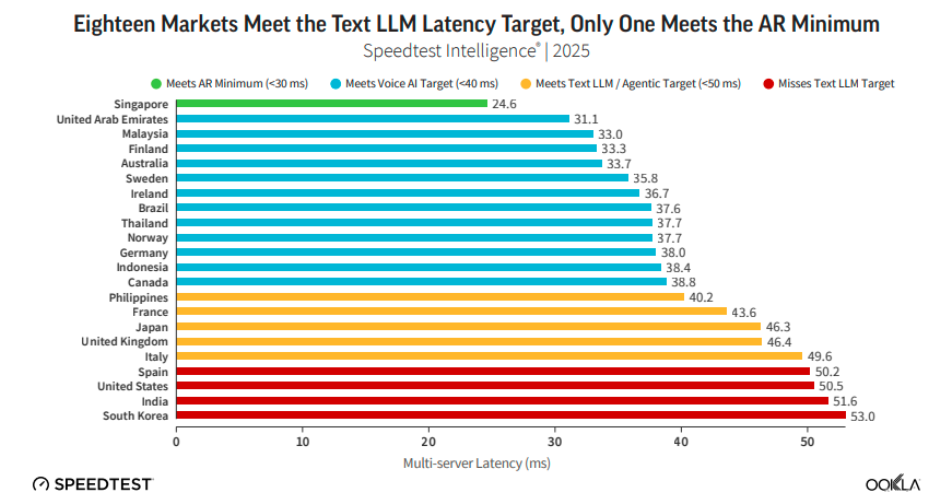
AI-ready performance varies by application. 18 of 22 markets achieve latency below 50 ms for text-based large language models (LLMs), while only 13 markets meet the 40 ms target required for conversational voice AI. No market currently achieves the sub-10 ms latency needed for augmented reality (AR) AI experiences.
Upload capacity is the biggest weakness
Most mobile operators dedicate only around 10 percent of total throughput to uplink traffic. Fewer than half of operators meet the 20 Mbps upload target required for AR and multimodal AI, while upload capacity has remained flat or declined in 12 of 22 markets since 2023.
Network latency worsens significantly under heavy traffic
Ookla found that latency degradation under network load ranges from 3.7x to 11.4x across markets, with large differences even among operators in the same country, highlighting the importance of consistent performance rather than peak speeds.
Cloud connectivity has become a competitive differentiator
AI performance increasingly depends on connections to cloud platforms such as Amazon Web Services (AWS), Microsoft Azure, Google Cloud, and Oracle Cloud Infrastructure (OCI). Within a single market, cloud provider selection can change latency by nearly 100 milliseconds, affecting real-time AI applications.
AI traffic is growing at an unprecedented pace
According to data referenced from Omdia, global AI-driven network traffic is expected to grow at a 73 percent compound annual growth rate (CAGR) between 2025 and 2033. AI traffic is projected to exceed conventional network traffic by 2031, fundamentally changing mobile traffic patterns.
ChatGPT dominates mobile AI usage
ChatGPT reached 800 million weekly active users by October 2025, processes over 2.5 billion messages every day, surpassed 1 billion global downloads in July 2025, and recorded 546 million monthly mobile users by April 2025. According to Ericsson, ChatGPT generated 60 percent of measured AI application traffic on analyzed mobile networks.
Google and Microsoft are processing hundreds of trillions of AI tokens
Google reported processing 480 trillion AI tokens per month as of April 2025, while Microsoft Foundry APIs processed more than 500 trillion tokens during fiscal 2025, representing growth of more than 7x year over year. Average AI prompts have expanded from around 1,500 tokens to over 6,000 tokens, increasing network demand.
AI-capable devices and smart glasses are accelerating network demand
Counterpoint Research expects generative AI smartphones to account for more than one-third of global smartphone shipments in 2025, with the mid-range segment representing 38 percent of AI-capable devices, up threefold from 2024. Omdia forecasts AI smart glasses shipments to reach 5.1 million units in 2025, increase 158 percent year over year, exceed 10 million units in 2026, and climb to 35 million units by 2030, growing at a 47 percent CAGR.
Enterprise AI will dramatically increase network traffic
Cisco projects agentic AI could increase enterprise network traffic to approximately 9 times current levels by 2035, compared with about 2.5 times without AI agents. Meanwhile, Berg Insight estimates there were 6,500 private 5G deployments worldwide at the end of 2025, particularly across manufacturing, logistics, and media sectors that require high uplink capacity and ultra-low latency.
BABURAJAN KIZHAKEDATH

