
Africa’s 5G market is entering a growth phase, with commercial deployments expanding, subscriber adoption accelerating, and governments increasing spectrum allocations to support next-generation mobile services.

Africa is expected to surpass 380 million 5G connections by 2030, while operators continue investing in network expansion, fixed wireless access (FWA), and spectrum to improve broadband connectivity across the continent, according to the latest GSMA Intelligence report prepared by Kenechi Okeleke, Senior Director and Shroug Ganawa, Senior Analyst.
Globally, 5G has become a mainstream technology with more than 390 commercial networks deployed across nearly 160 countries as of May 2026. Global 5G connections are forecast to reach 3.4 billion by the end of 2026, representing 37 percent of all mobile connections worldwide, with 5G expected to overtake 4G as the dominant mobile technology by 2028.
Africa’s rollout has accelerated significantly over the past year. By May 2026, 61 operators across 37 African markets had launched commercial 5G services, while 40 operators had also introduced 5G Fixed Wireless Access (FWA) offerings.
GSMA Intelligence projects Africa will end 2026 with just under 100 million 5G connections, equivalent to 6.2 percent of total mobile connections, before expanding to more than 380 million connections by 2030, accounting for over 20 percent of the region’s mobile subscriber base.
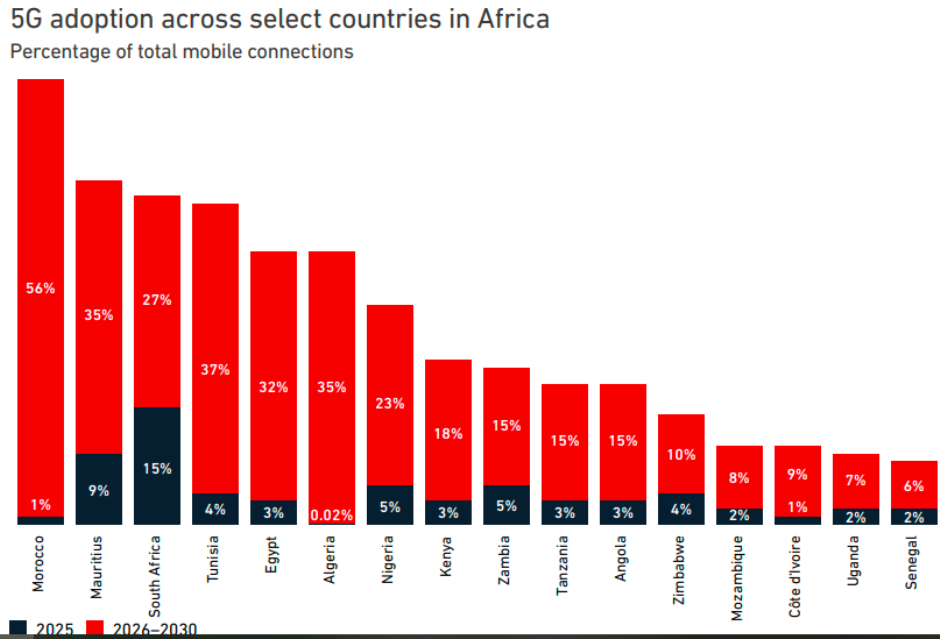
5G still represents only around 5 percent of Africa’s 1.5 billion mobile connections, compared with a global average of 33 percent, highlighting substantial room for subscriber growth. However, affordability remains a major challenge, with entry-level 5G smartphones still priced above US$100, limiting mass-market adoption in many countries.
5G coverage varies across Africa. Among the 16 focus countries, only Mauritius and South Africa had 5G population coverage of more than 50 percent as of May 2026. In most countries, 5G coverage remains concentrated within major urban economic hubs and targeted industrial sectors, GSMA said.
Most of the phone buyers are unable to spend above $100, which is the minimum price of entry-level 5G smartphones in Africa. Consumers are not upgrading to 5G because monthly minimum wage in many African markets is around $100.
Governments and regulators are accelerating spectrum assignments to support network expansion. As of December 2025, nearly 360 operators in more than 110 countries had received 5G spectrum globally, with mid-band frequencies, particularly 3.5 GHz, becoming the primary capacity layer for 5G deployments. More than 90 percent of European countries had completed 5G spectrum assignments by mid-2025, compared with less than 30 percent of African countries, although additional African markets are expected to complete allocations by the end of 2026.
Recent spectrum investments across Africa include Egypt’s allocation of 410 MHz across the 1.8 GHz, 2.6 GHz and 3.5 GHz bands, while Morocco awarded 120 MHz to Maroc Telecom and 70 MHz each to Inwi and Orange Morocco, requiring operators to achieve 45 percent population coverage by the end of 2026 and 85 percent by 2030. Kenya granted Safaricom a 25-year operating licence, while Tanzania assigned four 50 MHz blocks in the 3600-3800 MHz band under 15-year licences. Tunisia allocated 5 MHz in the 700 MHz band and 100 MHz in the 3.5 GHz band to each operator to support nationwide 5G rollout.
Infrastructure investment is also expanding through network-sharing partnerships. In Morocco, Maroc Telecom and Inwi established joint ventures to deploy 3,000 new telecom towers by 2028 and 6,000 towers by 2033, helping extend 5G coverage while reducing deployment costs.
5G Fixed Wireless Access is emerging as one of Africa’s strongest monetisation opportunities. Around 40 of Africa’s 61 commercial 5G networks already offer FWA services, with regional FWA connections expected to grow from just under one million in mid-2026 to more than 3.5 million by 2030. Globally, 5G FWA connections are forecast to increase from 42 million in 2025 to 101 million by 2030, supported by declining customer-premises equipment prices, which have fallen from more than US$200 to below US$80 for entry-level devices.
BABURAJAN KIZHAKEDATH

