

Telecom operators are building networks that adjust computing resources, radio settings and energy consumption as demand changes throughout the day. The aim is to accommodate traffic peaks while reducing the cost of running underused infrastructure during quieter periods.

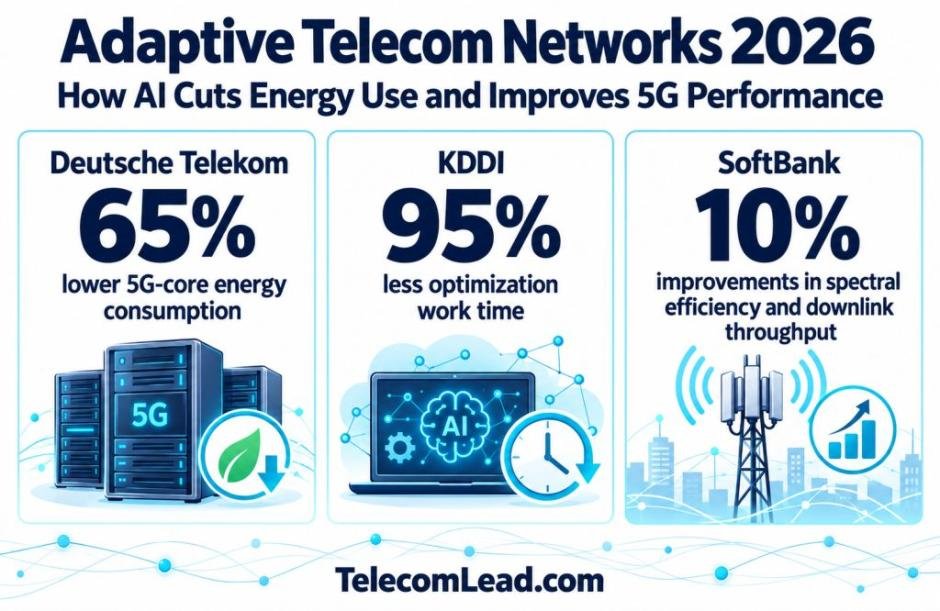
Results reported in 2026 illustrate the opportunity. Deutsche Telekom achieved up to 65 percent lower 5G-core energy consumption in initial live tests. KDDI reported more than 95 percent less optimization work time, while SoftBank’s commercial-network trial delivered approximately 10 percent average improvements in spectral efficiency and downlink throughput.
These initiatives operate at different speeds. Some radio decisions happen in real time, while capacity scaling and energy management respond to broader traffic patterns. Together, they support networks that adapt continuously rather than relying predominantly on fixed settings and manual intervention.
Deutsche Telekom Tests Up to 65% Energy Savings
Deutsche Telekom’s demand-driven 5G core energy management combines software controls with hardware optimization.
The operator reported up to 65 percent energy savings in initial live-network tests in February 2026. It continuously monitors utilization and allocates computing and network resources according to demand. Components can reduce activity when their capacity is unnecessary.
The distinction between testing and deployment matters: Deutsche Telekom said rollout would follow the initial tests. Predictive AI algorithms that anticipate traffic and reactivate components were identified as a planned enhancement, rather than an already completed capability.
Its shared Horizontal Telco Cloud provides the underlying architecture. Network functions can be introduced, scaled and updated independently, helping coordinate energy management across software and hardware.
For operators, the practical opportunity is to reduce idle consumption while preserving sufficient capacity and service reliability.
AT&T Builds a More Programmable Radio Network
AT&T is modernizing the infrastructure and software needed to change radio-network behavior more quickly.
In March 2026, the operator said more than 50 percent of network traffic was carried on open-capable hardware and more than 50 percent of its radio replacement program had been completed.
Its Open RAN and Cloud RAN modernization also included a third-party rApp deployed to optimize the live production network. Cloud RAN was operational in two cities at the time of the announcement.
Open-capable hardware does not mean every site is already operating as a fully open, multivendor network. AT&T describes it as infrastructure designed to support open architectures over time.
The business objective is greater programmability: operators can introduce optimization software and policy changes alongside physical upgrades. AT&T also reported testing Ericsson’s AI-native Link Adaptation, extending this approach into radio performance.
KDDI Reduces Optimization Work Time by More Than 95%
KDDI introduced technology in February 2026 that uses cooperating AI systems to optimize base-station parameters.
The settings influence radio direction, signal strength and traffic processing. In early deployment areas, KDDI reported a 25 percent improvement in its measure of locations prone to communications slowdowns compared with conditions before deployment.
Its AI-based base-station optimization also reduced optimization work time by more than 95 percent compared with manual operations. The company planned incremental expansion across Japan during FY2026.
This is a more specific result than a nationwide 25 percent speed increase. It demonstrates improvement in the evaluated congestion-related measure and a substantial reduction in configuration effort.
Distributed AI allows individual base stations to apply settings while sharing learning across the system. That approach addresses the difficulty of optimizing large networks through a single centralized model.
SoftBank Improves Performance Within Existing Spectrum
SoftBank and Ericsson validated AI-native radio software on SoftBank’s commercial 5G network in August 2026.
SoftBank’s trial of AI-native radio software recorded gains of up to approximately 25 percent in spectral efficiency and up to approximately 50 percent in downlink user throughput compared with conventional technology.
Across all evaluated locations, both measures improved by approximately 10 percent on average. The average results provide a more representative view than the maximum gains alone.
The AI-native scheduler makes link-adaptation decisions using changing radio conditions. It targets challenges such as interference, congestion and users near cell edges.
Improved spectral efficiency can help accommodate more traffic within existing frequency bands. However, this trial does not establish that physical network expansion is unnecessary; coverage gaps and sustained demand growth still require investment.
Cloud-Based 5G Cores Add Capacity Flexibility
Adaptive networks also require flexibility beyond the radio layer.
NTT DOCOMO Business’s March 2026 announcement described commercial deployment of a 5G core built on AWS, alongside NEC. Cloud infrastructure enables computing capacity to expand when traffic rises and contract when additional resources are no longer required.
The companies also reported using AI and GitOps to automate core-network design and construction, reducing construction time by approximately 80 percent. That figure concerns the build process, rather than an 80 percent reduction in operating costs.
Combining elastic computing with network automation can reduce the effort needed to deploy and manage capacity. Operators must still account for scaling speed, cloud expenditure, resilience and integration with existing infrastructure.
Enterprise Slicing Supports Reserved Capacity
NTT DOCOMO Business launched an enterprise 5G slicing service in March 2026, supporting communication capacity tailored to business requirements.
The service includes continuous and reserved usage, addressing locations such as stadiums, exhibitions and large events where demand rises during defined periods.
This connects network adaptation with enterprise purchasing. Customers can seek capacity aligned with a particular location, time window and service requirement.
The commercial value depends on measurable service commitments. Enterprises need clarity on availability, congestion performance and the capacity covered by their agreement.
Adaptive Networks Need Measurable Business Results
The operator examples show four distinct benefits: lower idle energy consumption, faster configuration, better use of spectrum and more flexible computing capacity.
They also demonstrate why results should be assessed within their stated scope. Live tests, commercial trials, early deployments and nationwide operations provide different levels of evidence.
Operators should track energy consumption alongside traffic, user experience during congestion, automation success rates and total operating expenditure. Resource reductions must preserve coverage, emergency communications and service commitments.
AI and cloud infrastructure give telecom operators more options for matching resources to demand. The competitive advantage will come from applying those controls reliably at scale — turning technical improvements into better customer experience and lower network costs.
FASNA SHABEER