

Reliance Jio delivered the fastest mobile download speeds in Karnataka’s Vijayanagara district, reaching 151.30 Mbps, followed by Bharti Airtel at 87.50 Mbps, Vodafone Idea (Vi) at 22.09 Mbps and BSNL at 10.47 Mbps, according to drive test conducted by the Telecom Regulatory Authority of India (TRAI) in August 2026.

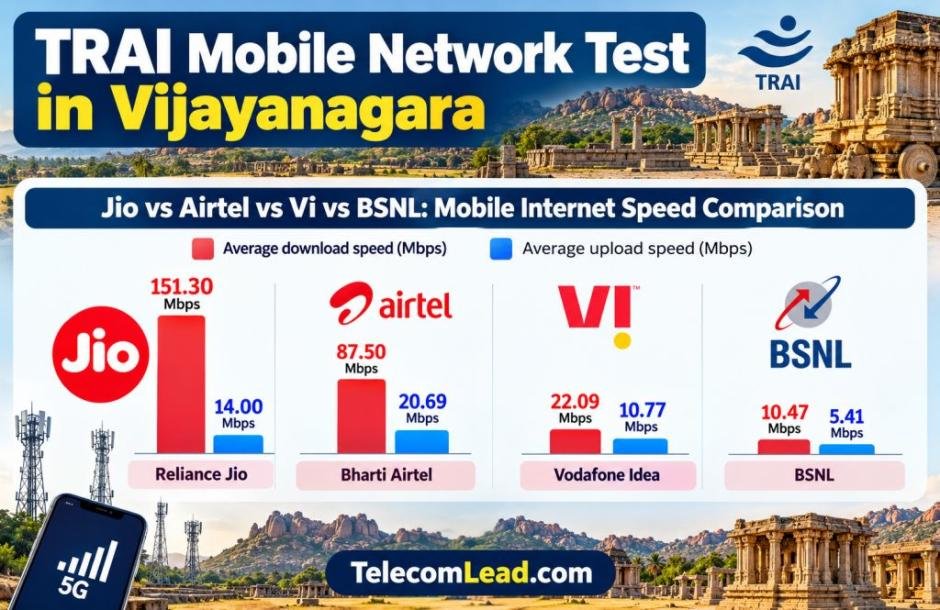
The findings highlight significant differences in mobile network performance across download speeds, upload speeds, voice coverage, call drops and service reliability. While Jio dominated download performance and recorded the lowest proportion of poor-signal samples, Airtel delivered the fastest upload speeds and the lowest call drop rate.
BSNL recorded the weakest overall performance, particularly in network coverage and call reliability.
TRAI conducted the tests between August 11 and August 14, 2026, covering 439.8 km of city routes, 74 km of highways, 13 hotspots and 7.6 km of walking routes.
| Jio vs Airtel vs Vi vs BSNL: Mobile Internet Speed Comparison | ||
Jio’s download speed was 73% faster than Airtel, 6.8 times Vi’s speed and 14.5 times BSNL’s speed.
Airtel, however, achieved an upload speed of 20.69 Mbps, outperforming Jio by 47.8%, Vi by 92.1% and BSNL by 282.4%.
The results indicate that Jio offered the strongest download performance for activities such as video streaming, large file downloads and cloud-based applications.
Airtel’s higher upload speeds could benefit users conducting video meetings, uploading multimedia content and transferring files to cloud platforms.
The comparisons reflect the network technologies available during testing. Jio, Airtel and Vi were measured on networks supporting up to 5G, while BSNL was measured on 4G.
Mobile Network Coverage: Jio Leads, BSNL Records Highest Coverage Gaps
TRAI measured poor signal strength across more than 48,000 samples for each telecom operator.
| Operator | Poor-signal samples | Poor-signal rate | No-coverage samples |
| Jio | 2,750 | 5.23% | 0 |
| Airtel | 3,067 | 5.86% | 148 |
| Vi | 8,930 | 17.40% | 194 |
| BSNL | 18,387 | 37.94% | 1,938 |
Jio recorded the lowest proportion of poor-signal samples at 5.23%, followed closely by Airtel at 5.86%.
Vi recorded weak signal strength in 17.40% of its samples, while BSNL experienced poor signal strength in approximately 37.94%.
The differences were particularly significant for network availability.
Jio recorded zero no-coverage samples, compared with 148 for Airtel, 194 for Vi and 1,938 for BSNL.
BSNL’s no-coverage rate reached approximately 4%, compared with 0.38% for Vi and 0.28% for Airtel.
These findings suggest that Jio and Airtel provided more consistent mobile coverage along the tested routes, while BSNL faced substantial network availability challenges.
Call Drop Rate: Airtel Performs Best, BSNL Records 8.71%
TRAI also evaluated voice call reliability by measuring dropped calls against successfully established calls.
| Operator | Successful calls | Dropped calls | Call drop rate |
| Airtel | 471 | 1 | 0.21% |
| Jio | 478 | 2 | 0.42% |
| Vi | 467 | 8 | 1.71% |
| BSNL | 425 | 37 | 8.71% |
Airtel recorded the lowest call drop rate at 0.21%, followed by Jio at 0.42%.
Vi’s call drop rate was 1.71%, while BSNL recorded a substantially higher rate of 8.71%.
BSNL experienced 37 dropped calls from 425 successfully established calls, indicating significantly weaker voice service reliability along the tested routes.
Voice Quality: Vi Records Highest Call Silence Incidents
TRAI also measured calls affected by silence lasting more than three seconds.
| Operator | Calls established | Calls affected by silence | Affected-call rate |
| Jio | 459 | 10 | 2.18% |
| Airtel | 533 | 13 | 2.44% |
| BSNL | 367 | 33 | 8.99% |
| Vi | 453 | 59 | 13.02% |
Jio recorded the lowest proportion of calls affected by prolonged silence, followed by Airtel.
Vi recorded the highest affected-call rate at 13.02%, with 59 calls experiencing silence exceeding three seconds.
BSNL followed at 8.99%.
These results indicate that voice quality issues were not limited to dropped calls. Users could also experience interruptions during calls that remained connected.
NH-50 Highway Network Test: Jio Download Speed Reaches 269 Mbps
TRAI separately evaluated mobile network performance along the 74 km Hosapete–Banavikallu highway route via NH-50.
The highway results revealed even larger differences in download speeds.
| Operator | Highway download speed | Highway upload speed |
| Jio | 269.09 Mbps | 19.29 Mbps |
| Airtel | 109.91 Mbps | 21.98 Mbps |
| Vi | 31.44 Mbps | 15.20 Mbps |
| BSNL | 6.12 Mbps | 2.73 Mbps |
Jio’s highway download speed of 269.09 Mbps was 2.45 times Airtel’s speed, 8.6 times Vi’s speed and nearly 44 times BSNL’s speed.
Airtel retained its leadership in upload performance, recording 21.98 Mbps against Jio’s 19.29 Mbps.
BSNL’s highway download speed declined to 6.12 Mbps, while its upload speed was just 2.73 Mbps.
Compared with district-wide results, Jio’s average download speed increased by approximately 78% on the highway route.
Airtel’s download speed increased by 26%, while Vi recorded an improvement of 42%.
BSNL’s download speed was approximately 42% lower than its district-wide average.
Highway Coverage and Call Drops: BSNL Faces Significant Challenges
| Operator | Poor-signal rate | No-coverage samples | Dropped calls |
| Jio | 2.81% | 0 | 0 |
| Airtel | 3.83% | 0 | 0 |
| Vi | 20.05% | 8 | 3 |
| BSNL | 31.77% | 481 | 3 |
Jio and Airtel recorded no dropped calls during the highway test, with 27 successfully established calls each.
Vi recorded three dropped calls from 28 successful calls, representing a call drop rate of 10.71%.
BSNL recorded three dropped calls from 23 successful calls, equivalent to 13.04%.
BSNL also recorded 481 no-coverage samples from 4,759 measurements, representing approximately 10.11% of highway samples.
In comparison, Jio and Airtel recorded zero no-coverage samples.
The results highlight the importance of network investment in highway corridors, where reliable connectivity supports navigation, emergency communications and mobile internet access.
TRAI Drive Test Covers Hampi, Hosapete and Tourist Destinations
The drive test included urban locations such as Hosapete, Hampi, Kamalapura, Hagaribommanahalli, Kotturu and Harapanahalli.
TRAI also examined mobile connectivity at 13 public hotspots, including the Hampi Utsav Grounds, Tungabhadra Dam, Hosapete APMC Yard, Kotturu Bus Stand and government offices.
Walking tests covered Hosapete Junction Railway Station, Lotus Mahal, Vijay Vittala Temple and Virupaksha Temple Complex.
The inclusion of tourist destinations, transportation facilities and public offices provides insight into mobile connectivity across different usage environments.
However, the published summary does not provide separate operator-wise speed measurements for every hotspot.
Key Findings From TRAI’s Vijayanagara Mobile Network Test
The August 2026 drive test identified four distinct performance trends.
Reliance Jio led in download speed and coverage consistency, recording 151.30 Mbps district-wide and 269.09 Mbps on NH-50. It also registered zero no-coverage samples across both test summaries.
Bharti Airtel led in upload speeds and call reliability, achieving 20.69 Mbps district-wide and the lowest call drop rate of 0.21%.
Vodafone Idea delivered intermediate data performance, but its 17.40% poor-signal rate and 13.02% affected-call rate highlighted coverage and voice quality challenges.
BSNL lagged in data speeds, coverage and dropped-call performance, with district-wide download speeds of 10.47 Mbps and an 8.71% call drop rate.
For telecom operators, the findings identify areas requiring improvements in radio coverage, network capacity, voice quality and service continuity.
The results represent network performance on the specific routes and at the times tested, rather than a comprehensive ranking of mobile networks throughout Karnataka.
BABURAJAN KIZHAKEDATH