


The Philippines is accelerating its transition to modern mobile voice infrastructure as telecom operators prepare for the nationwide shutdown of 3G networks by December 31, 2026. However, the country continues to lag regional markets in Voice over LTE (VoLTE) adoption, according to a new network performance study from Ookla.


The study, conducted across Metro Manila between February 17 and 22, 2026, covered more than 1,200 kilometers of drive testing across 14 cities and municipalities. Researchers collected over 23,000 voice and data test samples using Samsung flagship smartphones to evaluate real-world network performance.
Philippines Trails Regional VoLTE Adoption
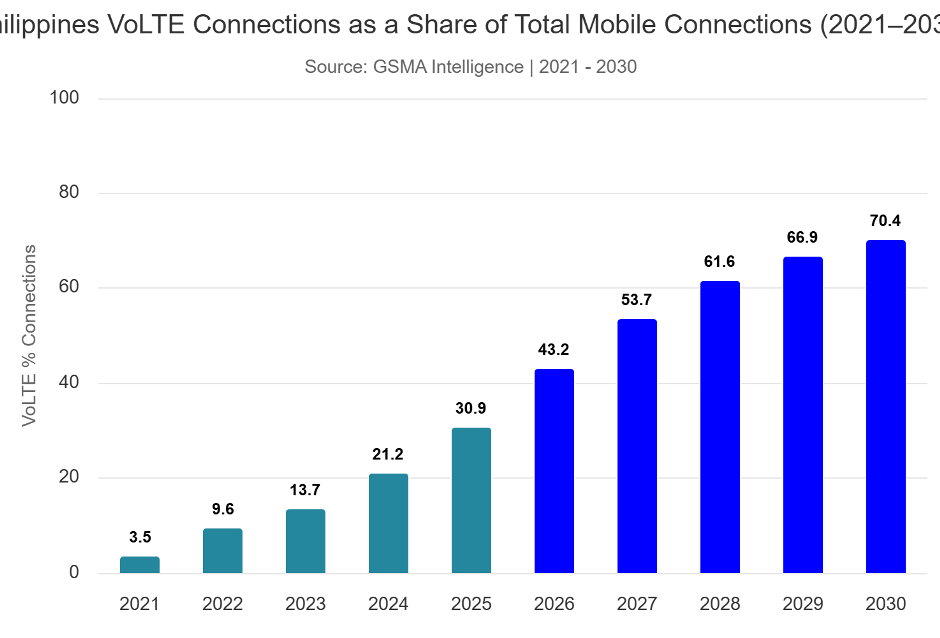
VoLTE accounted for only 30.9 percent of total mobile connections in the Philippines in 2025, significantly below the global average of 57.7 percent.
Ookla report said regional competitors have moved much further ahead, with Thailand reaching 65.2 percent VoLTE penetration, while Malaysia and Singapore have achieved 96.1 percent and 94.9 percent respectively.
GSMA Intelligence forecasts Philippine VoLTE adoption will exceed 50 percent in 2027 and rise to 70.4 percent by 2030 as operators migrate customers away from legacy networks.
Among operators, DITO Telecommunity recorded the highest VoLTE penetration at 41.9 percent of total connections in 2025, followed by Smart Communications at 31.7 percent and Globe Telecom at 27.4 percent.
Globe Leads Voice Call Setup Speed
Voice architecture continues to create significant differences in customer experience.
Globe delivered the fastest median VoLTE call setup time at 1.65 seconds, followed by Smart at 2.30 seconds. DITO recorded a median setup time of 4.59 seconds due to its reliance on Evolved Packet System Fallback (EPS-FB) within its 5G Standalone network architecture.
Voice traffic routing data revealed that Globe and Smart have almost fully migrated voice services to VoLTE, with 99.85 percent and 99.94 percent of voice calls respectively carried over VoLTE networks.
DITO, meanwhile, routed 88.89 percent of mobile-to-mobile voice calls through EPS-FB and only 11.11 percent directly through VoLTE.
HD Voice Quality Across All Operators
Despite differences in call setup performance, all three operators achieved HD-grade voice quality.
Using Mean Opinion Score (MOS) testing on a scale of 1 to 5, mobile-to-mobile calls consistently delivered Good to Excellent ratings above 4.0 across Globe, Smart, and DITO.
OTT voice applications such as WhatsApp produced lower Fair-quality ratings, with MOS scores ranging from approximately 3.89 to below 4.0.
DITO and Smart achieved Excellent mobile voice ratings, while Globe recorded Good-quality scores.
VoLTE Maintains Quality in Weak Coverage Areas
The study found that operator-managed VoLTE services maintained strong voice performance even under difficult radio conditions.
Approximately 9 percent of VoLTE samples and 10 percent of OTT samples were collected in weak coverage environments characterized by RSRP levels below -100 dBm and SINR values below 5 dB.
Under these conditions, VoLTE calls maintained MOS scores between 4.0 and 4.5, remaining within HD-grade quality levels.
OTT voice quality declined significantly as coverage weakened, with MOS scores dropping from approximately 3.7 to as low as 2.9, moving from Fair into Poor and Bad quality categories.
Globe recorded the lowest percentage of cell-edge samples, with only 5.8 percent of VoLTE tests and 7.3 percent of OTT tests occurring in weak coverage areas. Smart recorded around 10 percent of VoLTE samples and 12 percent of OTT samples in low-coverage conditions, while DITO recorded roughly 11 percent for both categories.
OTT Calls Connect Faster but Face Higher Failure Rates
OTT voice services showed slightly faster call setup times than VoLTE.
Globe recorded an OTT setup time of 1.62 seconds versus 1.65 seconds on VoLTE. Smart achieved 1.91 seconds compared with 2.30 seconds on VoLTE. DITO posted 1.72 seconds for OTT calls compared with 4.59 seconds for VoLTE.
However, OTT services experienced significantly higher call block rates.
VoLTE block rates were 0.47 percent for Globe, 0.59 percent for Smart, and 0.73 percent for DITO.
OTT block rates increased to 1.64 percent on Globe, 2.33 percent on DITO, and 2.76 percent on Smart.
Call drop rates remained low across all operators. VoLTE drop rates ranged from 0.04 percent to 0.20 percent, while OTT drop rates ranged between 0.12 percent and 0.19 percent.
3G Shutdown Drives VoLTE Migration
With the National Telecommunications Commission mandating the complete shutdown of 3G networks by the end of 2026, operators must accelerate migration efforts for millions of subscribers still using legacy voice technologies.
The transition is expected to improve network efficiency, increase spectrum utilization, support wider 5G deployments, and provide the foundation for emerging AI-powered communication services, including real-time language translation, conversational AI, digital assistants, and AI calling platforms.
As the Philippines moves toward a VoLTE-first environment, voice quality, call setup speed, and service reliability are becoming critical performance indicators alongside traditional mobile broadband speed measurements.
FASNA SHABEER