


Morocco’s mobile network infrastructure handled the surge of football fans during the 2025 Africa Cup of Nations, reflecting years of strategic investment and planning.

Backed by a $16.6 billion infrastructure program aligned with preparations for the 2030 FIFA World Cup, the country upgraded transport and digital networks, with telecom operators accelerating 4G expansion, fiber backhaul, and infrastructure sharing. This collaboration supported the launch of 5G in November 2025 under the Digital Morocco 2030 strategy, targeting 25 percent population coverage by 2026 and 70 percent by 2030.
Host cities such as Rabat and Casablanca led in broadband performance, while premium hotels in Agadir and Marrakesh delivered high-quality Wi-Fi for visitors. With over one million spectators and record-breaking match statistics, AFCON 2025 served as a large-scale test of network performance. Analysis of key stadiums using Speedtest Intelligence and Consumer QoE data showed that operators maintained strong connectivity, enabling smooth browsing, social media use, and video streaming for fans throughout the tournament.
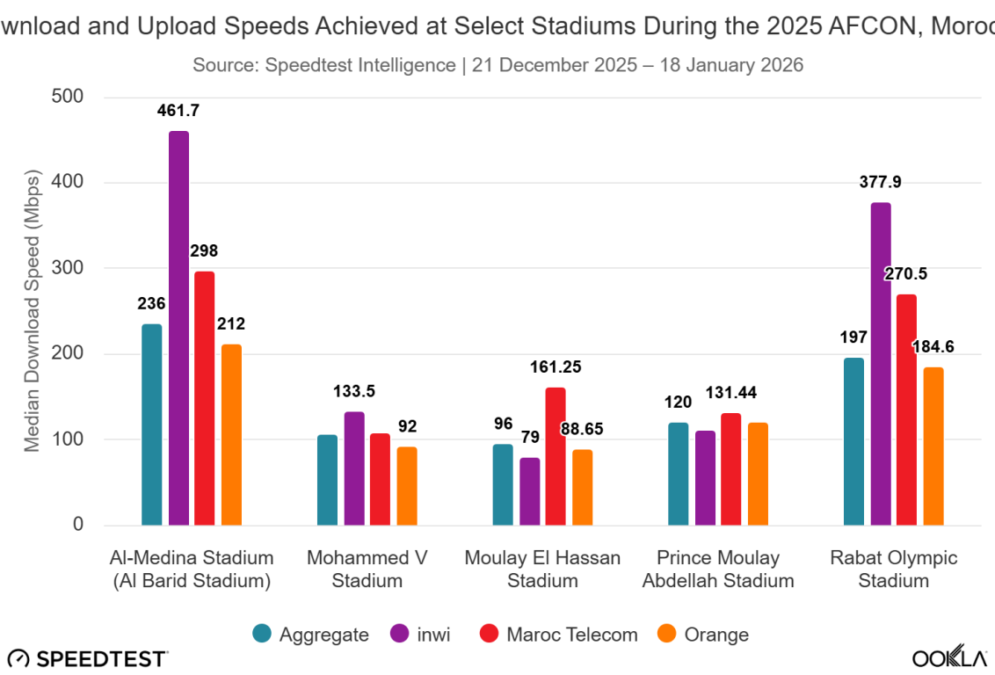
Speedtest Intelligence data highlights significant variation in network performance across stadiums and operators during AFCON 2025. Al-Medina (Al Barid) Stadium delivered the strongest results, with median download speeds of 236 Mbps, followed by Rabat Olympic Stadium at 197 Mbps, while Mohammed V, Prince Moulay Abdellah, and Moulay El Hassan stadiums recorded comparatively lower speeds.
Among operators, inwi consistently led in download performance, reaching peak median speeds of 461.7 Mbps at Al-Medina Stadium and 377.9 Mbps at Rabat Olympic Stadium. Maroc Telecom only topped performance at Moulay El Hassan Stadium with 161.25 Mbps, Karim Yaici said in a blog post.
Upload speeds showed a similar trend but with smaller gaps. Al-Medina and Rabat Olympic stadiums again led, both exceeding 50 Mbps, driven by strong inwi performance. In contrast, Prince Moulay Abdellah Stadium recorded the lowest upload speeds at 20 Mbps, while Moulay El Hassan and Mohammed V stadiums showed moderate performance, with varying leadership among Maroc Telecom, inwi, and Orange.
Network coverage analysis based on Reference Signal Received Power (RSRP) shows that Mohammed V Stadium and Prince Moulay Abdellah Stadium delivered the strongest 4G signals, indicating good overall availability, particularly within stadium premises. However, 5G coverage remained more limited in surrounding areas.
Mohammed V Stadium also led in 5G signal strength, with inwi providing a notably stronger signal than competitors, while Orange stood out at Al-Medina Stadium with superior 5G performance. Despite strong signal levels at Mohammed V, lower signal quality (RSRQ below -11 dB) points to interference-related issues, likely due to high user density.
In contrast, Rabat Olympic Stadium recorded the weakest 4G and 5G signal strength overall, although inwi’s lower 4G signal there may indicate more efficient spectrum usage and reduced interference.
Consumer QoE data indicates that web browsing performance across AFCON 2025 stadiums was generally strong, with fast and consistent page load times enhancing user experience. Median load times ranged from 1374 ms to 1477 ms, with Al-Medina and Rabat Olympic Stadiums delivering the quickest performance. Moulay Abdellah Stadium recorded the धीest load times, though differences between venues remained marginal.
More noticeable variation emerged between operators. Inwi led in four out of five stadiums, achieving the fastest load times, particularly at Mohammed V and Al-Medina. Maroc Telecom topped performance at Moulay El Hassan Stadium. In contrast, Orange consistently lagged behind, recording the slowest page load times across all venues, including the highest delay at Al-Medina.
Latency analysis shows varied performance across stadiums for messaging and video services during AFCON 2025. Al-Medina Stadium delivered the fastest messaging experience with the lowest latency, while Mohammed V Stadium recorded the highest messaging latency but excelled in video calling with the lowest delay.
Across venues, messaging latency remained relatively consistent, though operator performance differed significantly. Inwi led in most stadiums, offering the lowest latency for both messaging and video conferencing, while Orange performed strongly in select venues but showed occasional spikes. Maroc Telecom generally lagged in messaging latency, recording the highest delays in several stadiums.
For video calls, Mohammed V Stadium provided the best overall experience, whereas Moulay El Hassan and Al-Medina stadiums showed higher latency levels that could impact call smoothness. Overall, the results highlight strong but uneven performance, with inwi emerging as the most consistent operator across real-time communication services.
Video streaming performance during AFCON 2025 remained strong overall, with YouTube start times averaging around 1,400–1,500 ms, ensuring smooth playback with minimal delay. Al-Medina Stadium delivered the fastest start times, followed closely by Mohammed V Stadium.
However, operator performance showed clear differences. Inwi consistently led across all stadiums, achieving the quickest video start times, particularly at Moulay El Hassan and Al-Medina. In contrast, Maroc Telecom and Orange lagged behind, with start times typically 200 ms to 400 ms slower than inwi.
These results highlight that while overall streaming quality was robust, inwi provided a noticeably faster and more responsive video experience compared to its competitors across all venues.
BABURAJAN KIZHAKEDATH