

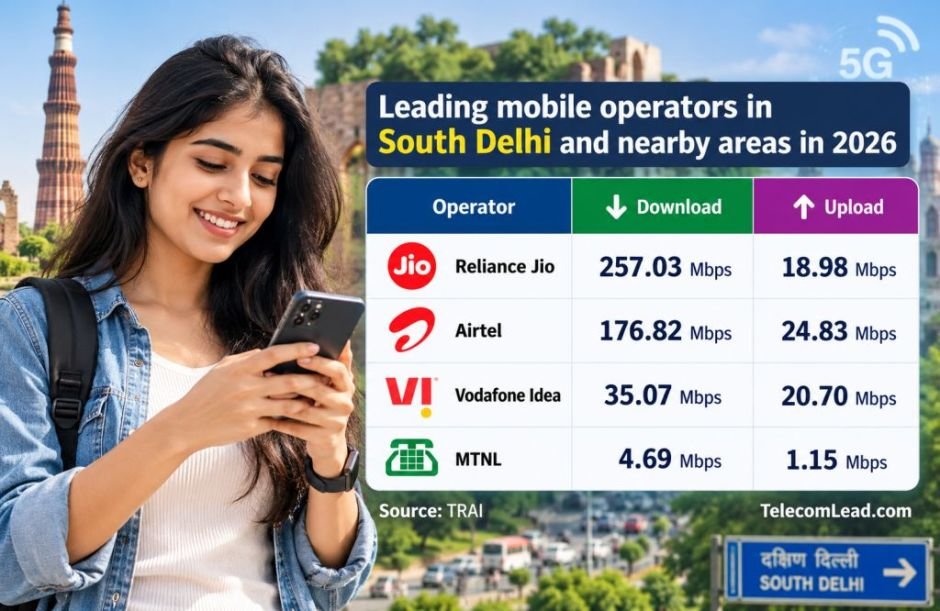
Reliance Jio delivered the fastest mobile download speed at 257.03 Mbps in TRAI’s July 2026 drive test across South Delhi and nearby areas, while Airtel recorded the highest upload speed at 24.83 Mbps. Vodafone Idea posted 35.07 Mbps download speed, while MTNL lagged significantly at 4.69 Mbps.

The Telecom Regulatory Authority of India (TRAI) tested mobile network performance across more than 310 km of city routes, along with hotspots and crowded pedestrian locations, providing an on-ground comparison of Airtel, Reliance Jio, Vodafone Idea and MTNL.
The drive test, conducted during July 6-10, 2026, covered Dwarka, Uttam Nagar, Janakpuri, Mahipalpur, Malviya Nagar, Saket, Lajpat Nagar, Naraina, Patel Nagar, Karol Bagh, Vande Mataram Marg, Mayur Vihar and Noida Sector 62, among other locations.
TRAI evaluated operators on download and upload speeds, network coverage, dropped calls and voice-call performance across available 2G, 3G, 4G and 5G networks.
Jio Records 257 Mbps Download Speed
Reliance Jio emerged as the clear leader in mobile download performance, recording 257.03 Mbps during the TRAI test.
Airtel ranked second with download throughput of 176.82 Mbps, while Vodafone Idea recorded 35.07 Mbps.
MTNL, whose network in the test supported up to 3G compared with up to 5G for the three private operators, achieved download speed of only 4.69 Mbps.
Jio’s download speed was about 45 percent faster than Airtel’s and more than seven times Vi’s measured speed on the routes tested.
The results highlight the performance gap between India’s major mobile operators in real-world network conditions, although TRAI notes that drive-test results represent network conditions at the locations, dates and times tested rather than overall performance across the entire Delhi telecom circle.
Airtel Leads Mobile Upload Speed at 24.83 Mbps
The ranking changed for upload performance.
Airtel delivered the fastest upload speed at 24.83 Mbps, ahead of Vodafone Idea at 20.70 Mbps and Reliance Jio at 18.98 Mbps.
MTNL recorded 1.15 Mbps.
Upload performance has become increasingly important as mobile users generate more traffic through video calls, social-media uploads, cloud applications and other interactive services.
Vi’s download performance remained substantially behind Jio and Airtel, but its 20.70 Mbps upload speed exceeded Jio’s 18.98 Mbps during the test.
Jio Records Lowest Call Drop Rate
Jio also delivered the strongest result for dropped calls.
TRAI recorded only one dropped call from 684 successfully established calls on Jio’s network, equivalent to a drop rate of about 0.15 percent.
Airtel had three dropped calls from 684 established calls, or approximately 0.44 percent, while Vodafone Idea recorded three drops from 689 calls, about 0.44 percent.
MTNL performed significantly worse, with 99 dropped calls among 661 successfully established calls, translating into a drop rate of nearly 15 percent.
| Operator | Successful Calls | Dropped Calls | Approx. Drop Rate |
| Jio | 684 | 1 | 0.15% |
| Airtel | 684 | 3 | 0.44% |
| Vodafone Idea | 689 | 3 | 0.44% |
| MTNL | 661 | 99 | 15.0% |
The results show relatively similar call reliability among the three private operators, with Jio recording the lowest number of drops during the drive.
Airtel and Vi Lead Jio on Signal Coverage
The coverage results present a somewhat different picture from the speed ranking.
Vodafone Idea recorded 527 poor-signal samples from 76,883 samples, equivalent to approximately 0.69 percent.
Airtel recorded 610 poor-signal samples from 76,581, or about 0.80 percent.
Jio had 1,050 poor-signal samples from 75,172, equivalent to roughly 1.40 percent.
This means that while Jio produced the highest download speeds, Airtel and Vi recorded a lower proportion of poor-signal samples on the tested route.
MTNL’s result was considerably weaker. TRAI identified 50,483 poor-signal samples from 72,804 samples, or roughly 69 percent of samples. MTNL also recorded 1,042 samples with limited service or no coverage.
By comparison, Airtel, Jio and Vi recorded zero limited-service/no-coverage samples in this measurement.
Jio Speed Exceeds Its Declared Typical Throughput by 17 Times
TRAI also compared measured performance with the typical download and upload speeds declared by the operators.
Jio had declared typical download throughput of 15 Mbps, compared with the 257.03 Mbps measured during the drive test. Its measured result was therefore more than 17 times the declared typical speed.
Airtel’s measured 176.82 Mbps was nearly 10 times its declared typical download throughput of 18 Mbps.
Vi recorded 35.07 Mbps, more than double its declared typical download speed of 15 Mbps.
MTNL was the exception. Its 4.69 Mbps measured was below its declared typical download throughput of 8 Mbps.
Upload results exceeded declared typical levels for all four operators. Airtel achieved 24.83 Mbps against a declared 8 Mbps, Jio delivered 18.98 Mbps against 7 Mbps, and Vi recorded 20.70 Mbps against 8 Mbps. MTNL’s 1.15 Mbps narrowly exceeded its declared 1 Mbps.
Voice Silence Remains an Issue Across 5G and 4G Networks
TRAI also measured instances where users experienced silence for more than three seconds during calls.
Airtel recorded 11 silence instances across 657 established on-network calls. Jio had 14 instances across 651 calls, while Vodafone Idea recorded 12 instances across 661 calls.
MTNL was not included in this 5G/4G call-silence comparison.
Although the absolute number of incidents was relatively small for the private operators, the metric is important because high download speed alone does not guarantee consistently strong voice experience.
TRAI Tests Networks at Delhi Hotspots and Crowded Markets
The scope of the test went beyond normal road-based measurements.
TRAI’s city drive covered 310.4 km, while another 5.5 km was covered through walk tests. Six stationary hotspot locations were also assessed.
The hotspots included IIT Delhi’s Administrative Building, AIIMS OPD Area, Bhikaji Cama Place Metro Station, Delhi Public School R.K. Puram, Hauz Khas Metro Station and ISBT Sarai Kale Khan.
TRAI also conducted walk tests at Dilli Haat INA, Sarojini Nagar Market and WTC Nauroji Nagar on July 10.
These locations are particularly relevant to mobile network assessment because dense crowds, indoor-outdoor transitions and concentrated data demand can put additional pressure on radio networks.
Jio Leads Speed, but No Operator Wins Every Metric
TRAI’s South Delhi drive test shows there is no single winner across every mobile network performance indicator.
Jio was the strongest performer for download speed, reaching 257.03 Mbps, and recorded the lowest call-drop rate at approximately 0.15 percent.
Airtel led upload performance with 24.83 Mbps while maintaining strong download performance at 176.82 Mbps.
Vodafone Idea performed well on coverage and upload speed, recording the lowest proportion of poor-signal samples among the four operators and a 20.70 Mbps upload speed, although its 35.07 Mbps download result remained substantially behind Jio and Airtel.
MTNL trailed the private operators across most major performance indicators, particularly coverage, call drops and data speeds.
The findings also underline why mobile network quality cannot be judged by download speed alone. Coverage consistency, upload throughput, dropped calls and voice quality remain critical components of the user experience as India’s operators expand and optimise their 5G networks.
For consumers in the tested areas of Delhi and Noida, TRAI’s July 2026 results indicate that Jio offers the strongest raw download performance, Airtel provides the fastest uploads, while Airtel and Vi delivered better measured signal consistency than Jio on the specific drive-test route.
BABURAJAN KIZHAKEDATH