

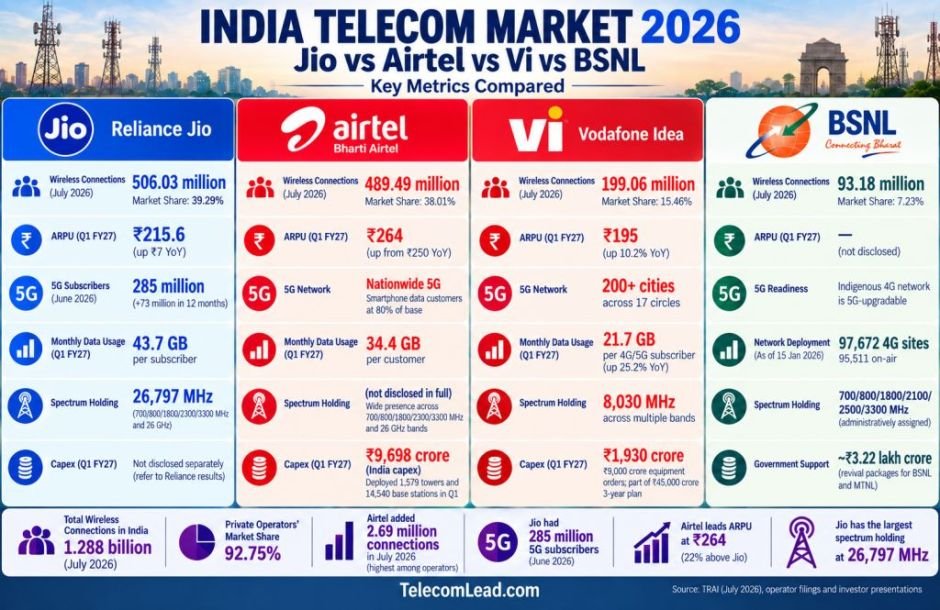
India’s telecom market is becoming a two-leader contest between Reliance Jio and Bharti Airtel, but the operators are winning on different metrics. Jio leads in total wireless connections, 5G subscribers and data consumption, while Airtel commands the industry’s highest average revenue per user (ARPU) and has recently been adding wireless connections faster than Jio.

Vodafone Idea (Vi), meanwhile, is attempting to convert capex and expanding 4G and 5G coverage into subscriber stability. State-owned BSNL is betting on its indigenous 4G rollout and eventual transition to 5G.
India had 1.288 billion wireless mobile connections in July 2026, according to TRAI’s July 2026 telecom subscription data.
The numbers reveal a market in which subscriber scale alone no longer determines competitive strength. Monetisation, 5G adoption, network investment, spectrum holdings and network quality are becoming equally important.
Jio Leads with 506 Million Connections, but Airtel Is Closing the Gap
Reliance Jio remained India’s largest wireless operator in July 2026 with 506.03 million connections and 39.29 percent market share. Airtel followed closely with 489.49 million and 38.01 percent.
That leaves only about 16.5 million connections between the two operators.
Airtel led monthly additions in July, gaining 2.69 million wireless connections, compared with 2.45 million for Jio. Airtel has been outpacing Jio in monthly additions in recent months, increasing competitive pressure at the top of the market.
However, Airtel’s expansion needs an important qualification. TRAI’s wireless figures include machine-to-machine (M2M) connections, and Airtel has built a particularly large M2M base. By July 2026, Airtel had about 84.45 million M2M connections, compared with approximately 26.56 million for Jio.
This means headline wireless subscriber growth should not automatically be interpreted as equivalent growth in individual mobile-phone customers.
The distinction also explains differences between TRAI numbers and customer figures disclosed by operators themselves. Jio, for example, reported 533.3 million connectivity subscribers for Q1 FY27, a different measurement from TRAI’s wireless subscriber series.
The more important competitive development is therefore the narrowing gap between Jio and Airtel rather than simply comparing headline annual connection additions.
Airtel Leads ARPU at ₹264, 22% Above Jio
Where Airtel has a clear advantage is monetisation.
Airtel’s mobile ARPU increased to ₹264 in Q1 FY27, compared with ₹250 a year earlier. Jio reported ARPU of ₹215.6, while Vi reached ₹195.
Airtel’s ARPU is therefore approximately 22 percent higher than Jio’s and 35 percent above Vi’s.
Airtel also reported average mobile data consumption of 34.4 GB per customer per month, while its smartphone data customer base increased by 21.1 million year on year, according to Bharti Airtel’s Q1 FY27 results.
The ARPU gap is important because India’s mobile operators are shifting their focus from simply acquiring subscribers toward improving revenue from existing customers through tariff changes, premium plans, postpaid, 5G and higher data consumption.
Jio’s ARPU increased by ₹7 year on year to ₹215.6 despite the company reporting no tariff action during the recent months.
Vi recorded the fastest percentage ARPU improvement among the three private operators. Its ARPU rose 10.2 percent year on year from ₹177 to ₹195, supported by premiumisation and a higher proportion of 4G and 5G users.
Jio Reaches 285 Million 5G Users
Jio has established the clearest lead in 5G subscriber scale.
The operator had 285 million 5G users at the end of June 2026, an increase of 73 million in 12 months, according to Reliance Industries’ Q1 FY27 results.
Jio’s total quarterly network data traffic reached 69.4 billion GB, up 27 percent year on year, while average monthly data consumption climbed to 43.7 GB per subscriber.
The scale of 5G traffic is particularly significant: Jio has said its 5G traffic is around 1.5 times its 4G traffic.
Airtel also operates a nationwide 5G network, although it does not disclose a directly comparable 5G subscriber figure. Its smartphone data customers represented around 80 percent of its mobile customer base.
Vi is moving rapidly from its delayed 5G start. Its 5G network is now available in more than 200 cities across all 17 circles where it owns 5G spectrum.
Vi ended Q1 FY27 with 130.1 million 4G/5G subscribers, up from 127.4 million a year earlier. Average data usage by a Vi 4G/5G subscriber increased 25.2 percent to 21.7 GB per month.
BSNL remains primarily a 4G story. Its indigenous network has been designed to be 5G-upgradable, giving the state-owned operator a migration route once commercial 5G deployment accelerates.
Airtel and Jio Have the Strongest Investment Capacity
Network investment remains one of the biggest differences between India’s leading operators and their smaller rivals.
Airtel’s India capex reached ₹9,698 crore in Q1 FY27, while consolidated capex was ₹13,386 crore.
Airtel deployed 1,579 towers and 14,540 mobile broadband base stations during the quarter. Over the previous year, it added 7,631 towers and 45,171 km of fibre.
Vi’s quarterly capex was significantly lower at ₹1,930 crore, although the operator is executing a network expansion programme. Vi has placed around ₹9,000 crore of equipment orders as part of its three-year ₹45,000 crore capex programme.
Vi added nearly 3,000 unique broadband towers during Q1 FY27 and more than 15,600 sites over the previous 12 months, taking its pan-India 4G population coverage to around 87 percent.
Jio’s Spectrum Portfolio Supports Its 5G Strategy
Spectrum is another area where Jio has built a substantial network asset base.
Jio has access to approximately 26,797 MHz of spectrum across bands including 700 MHz, 800 MHz, 1800 MHz, 2300 MHz, 3300 MHz and 26 GHz.
Jio’s 700 MHz spectrum provides low-band coverage with stronger propagation characteristics, particularly valuable for wider-area 5G coverage and indoor connectivity. Its 3.3 GHz spectrum provides mid-band 5G capacity, while 26 GHz offers very high capacity for selected dense locations and enterprise applications.
Vi holds around 8,030 MHz of spectrum, while BSNL has received administrative spectrum assignments across several bands, including 700 MHz, 800 MHz, 1800 MHz, 2100 MHz, 2500 MHz and 3300 MHz.
Spectrum depth will become important as Indian mobile data consumption rises and operators shift more traffic from 4G to 5G.
TRAI Network Tests Show Jio and Airtel Performance Advantage
Subscriber and investment figures tell only part of the story. Network performance is ultimately one of the most important competitive measures.
Recent TRAI independent drive tests across India provide snapshots of operator performance across different cities and highways.
On the Gandhidham-Santhalpur section of NH-27 in Gujarat, for example, TRAI measured average download speeds of:
Jio — 223.70 Mbps
Airtel — 146.35 Mbps
Vi — 23.76 Mbps
BSNL — 20.23 Mbps
Average upload speeds were 22.18 Mbps for Jio, 21.00 Mbps for Airtel, 13.00 Mbps for Vi and 6.35 Mbps for BSNL.
A single drive test should not be interpreted as a nationwide operator ranking, but the results illustrate the performance gap that network investment and 5G deployment can create.
Vi’s Challenge Is Turning Network Investment into Subscriber Growth
Vi’s operational indicators are beginning to improve after years of subscriber losses.
The operator reported 193.1 million company-reported customers in Q1 FY27, slightly above the previous quarter. Its ARPU reached ₹195, 4G/5G customers increased to 130.1 million, and 5G reached more than 200 cities.
Its network footprint includes 209,000-plus unique sites, more than 351,000 km of optical fibre and coverage across more than 487,000 towns and villages.
Vi’s challenge is financial as much as technological. Its ₹1,930 crore quarterly capex remains substantially below Airtel’s India investment, making disciplined deployment particularly important.
If improved 4G coverage and expanding 5G availability reduce customer churn, Vi could stabilise its position as India’s third-largest mobile operator.
BSNL’s Next Challenge Is Converting 4G Investment into Customers
BSNL represents a different competitive model.
By January 15, 2026, the company had installed 97,672 indigenous 4G sites, of which 95,511 were on-air. The deployment represents one of India’s most important domestically developed telecom-network projects.
BSNL also retains a significant presence in rural India, where commercial economics can make network expansion more difficult for private operators.
The critical test now is whether the 4G rollout can improve network experience, increase active mobile users and generate higher data consumption.
Its longer-term opportunity lies in upgrading the indigenous 4G architecture toward 5G without requiring an entirely new network.
Who Is Winning India’s Telecom Market in 2026?
There is no single winner across every metric.
Jio remains the scale leader, with 506.03 million TRAI wireless connections, 39.29 percent market share and 285 million company-reported 5G users. Its combination of spectrum, 5G adoption and 43.7 GB monthly data consumption per user gives it a formidable network position.
Airtel is the monetisation leader. Its ₹264 ARPU is around 22 percent above Jio and 35 percent above Vi. Airtel is also closing the headline wireless connection gap with Jio, although its large M2M base needs to be considered when interpreting TRAI subscriber figures.
Vi is showing signs of operational recovery. ARPU has reached ₹195, 4G/5G subscribers have risen to 130.1 million and 5G now covers more than 200 cities. Its biggest constraint remains the scale of investment required to compete with Jio and Airtel.
BSNL has substantially expanded its network infrastructure, but the next phase is more difficult: converting government-backed 4G investment into active subscribers, stronger data usage and eventually competitive 5G services.
India’s telecom battle in 2026 is therefore no longer simply about who has the most SIM connections. Jio leads on scale and 5G adoption, Airtel leads on customer monetisation, Vi is fighting for a network-led turnaround, and BSNL is rebuilding its technology platform. The next competitive phase will be determined by 5G traffic, network quality, ARPU and returns on billions of dollars of infrastructure investment.
FASNA SHABEER