

The global retirement of legacy mobile networks is gathering momentum as telecom operators seek to refarm spectrum, reduce energy consumption and move customers to more efficient 4G and 5G technologies.

The Global mobile Suppliers Association (GSA) identified 313 completed, planned or ongoing 2G and 3G network switch-offs across 89 countries and territories by June 30, 2026. This compares with 303 switch-offs in December 2025 and 254 in December 2024.
The latest figures demonstrate that operators and governments are increasingly treating legacy network shutdowns as an important component of mobile network modernisation.
158 network switch-offs completed
GSA report counted 158 completed 2G or 3G network closures, while operators had planned another 119 switch-offs. A further 36 operator switch-offs were in progress.
The report separately states that 37 networks were currently undergoing the shutdown process. This network-level total differs slightly from the operator classification of 36 switch-offs.
Although the pace of completed shutdowns dipped slightly during the first half of 2026, GSA expects activity to accelerate as operators implement previously announced retirement schedules.
Legacy network closures allow operators to reuse 2G and 3G spectrum for LTE and 5G. They can also lower energy consumption by removing infrastructure that carries relatively little traffic. Modern mobile technologies provide better security and stronger protection against cyberattacks.
139 operators target 2G network shutdowns
A total of 139 operators across 70 countries and territories had completed or announced plans for 2G switch-offs. This increased from 136 operators in 68 countries in December 2025.
Among them, 56 operators across 29 countries and territories had completed their 2G shutdowns. Another 68 operators in 44 markets had announced plans to close their 2G networks, while 14 operators in eight countries were progressing with switch-offs.
Iceland provided a recent example, with three operators shutting down their 2G networks in June 2026.
Completed 2G switch-offs have increased substantially during the past decade. GSA recorded seven closures in 2015 and earlier years, none in 2016, nine in 2017, three in 2018, one in 2019 and one in 2020.
Annual completed 2G shutdowns subsequently reached 10 in 2021, five in 2022, four in 2023, five in 2024 and six in 2025. Another five 2G networks were switched off during the first six months of 2026.
174 operators move to retire 3G networks
The transition away from 3G is progressing faster than the 2G shutdown programme. GSA identified 174 operators in 67 countries and territories that had completed, planned or started 3G closures.
Of these, 102 operators in 48 markets had completed their 3G switch-offs. Another 50 operators across 28 countries had announced closure plans, while 22 operators in 17 countries and territories had shutdowns in progress.
Five operators in two countries completed 3G switch-offs during the first half of 2026. These included three operators in Iceland and New Zealand operators 2degrees and One NZ.
Completed 3G shutdowns reached four in 2020 before rising sharply to 13 in 2021 and another 13 in 2022. The annual total increased to 16 in 2023, 22 in 2024 and 29 in 2025. Five additional 3G shutdowns were completed by the end of June 2026.
The figures show that 3G accounted for the majority of completed legacy network closures from 2020 onwards.
25 network shutdowns scheduled for second half of 2026
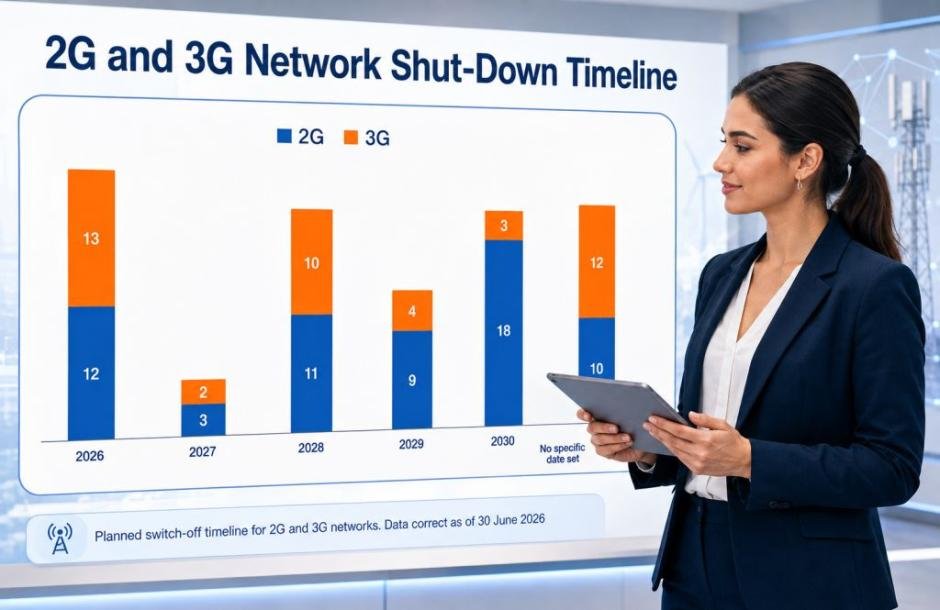
Operators planned to retire 25 networks during the second half of 2026, comprising 12 2G networks and 13 3G networks. This figure does not include the 37 networks already undergoing the switch-off process, some of which could be completed during 2026 or 2027.
The shutdown schedule includes five networks in 2027, split between three 2G and two 3G networks. Another 21 closures are scheduled for 2028, including 11 2G and 10 3G networks.
Operators plan to close 13 networks in 2029, comprising nine 2G and four 3G networks. The figure rises to 21 planned closures in 2030, including 18 2G and three 3G networks.
A further 22 planned switch-offs — 10 involving 2G and 12 involving 3G — did not have a specific closure date.
The report also refers to 82 networks remaining to be switched off after the 25 scheduled for the second half of 2026. Its chart distributes these planned closures across 2027, 2028, 2029, 2030 and the category without a confirmed date.
Governments and telecom groups set shutdown deadlines
Government mandates are helping establish clearer timelines for the retirement of legacy mobile technologies.
Eswatini has mandated the closure of 2G services by December 2026, followed by the shutdown of 3G services by December 2028.
Telecom groups are also setting multi-country targets. Orange Group aims to retire both 2G and 3G across Europe by 2030, although implementation schedules are expected to differ between individual countries. Orange Belgium, for example, completed its 3G shutdown in 2025.
IoT migration remains a major challenge
The transition presents risks for devices that do not support LTE or 5G. Unupgraded connections could stop functioning when operators deactivate their legacy networks.
The problem is particularly significant for machine-to-machine and Internet of Things deployments because industrial equipment, utility systems, security devices and connected machines can have lengthy replacement cycles.
Telecom operators must therefore balance the benefits of spectrum refarming and energy efficiency with the need to migrate customers and connected devices without disrupting essential services.
As the availability of 4G and 5G devices increases, traffic on 2G and 3G networks will continue to decline. This will strengthen the business case for operators to retire ageing infrastructure and reuse valuable spectrum for faster, more secure and energy-efficient mobile networks.
BABURAJAN KIZHAKEDATH